1/9
Research on architectural space design based on an empirical investigation of the communication life of older adults: taking unit-type nursing home as examples
The increasing severity of China's aging population, with a significant number of older adults experiencing disabilities, highlights the critical need for effective nursing home design to support social interaction and well-being. This study investigated two types of unit-type nursing homes (clustered and non-clustered architectural spatial layouts) to understand how their design influences the communication behavior of older adults. The research employed a mixed-methods approach, combining on-site surveying and mapping of building plans, real-time photography, interviews, questionnaire surveys focusing on social needs, and environmental behavior observation to systematically record and analyze the social dynamics among residents.
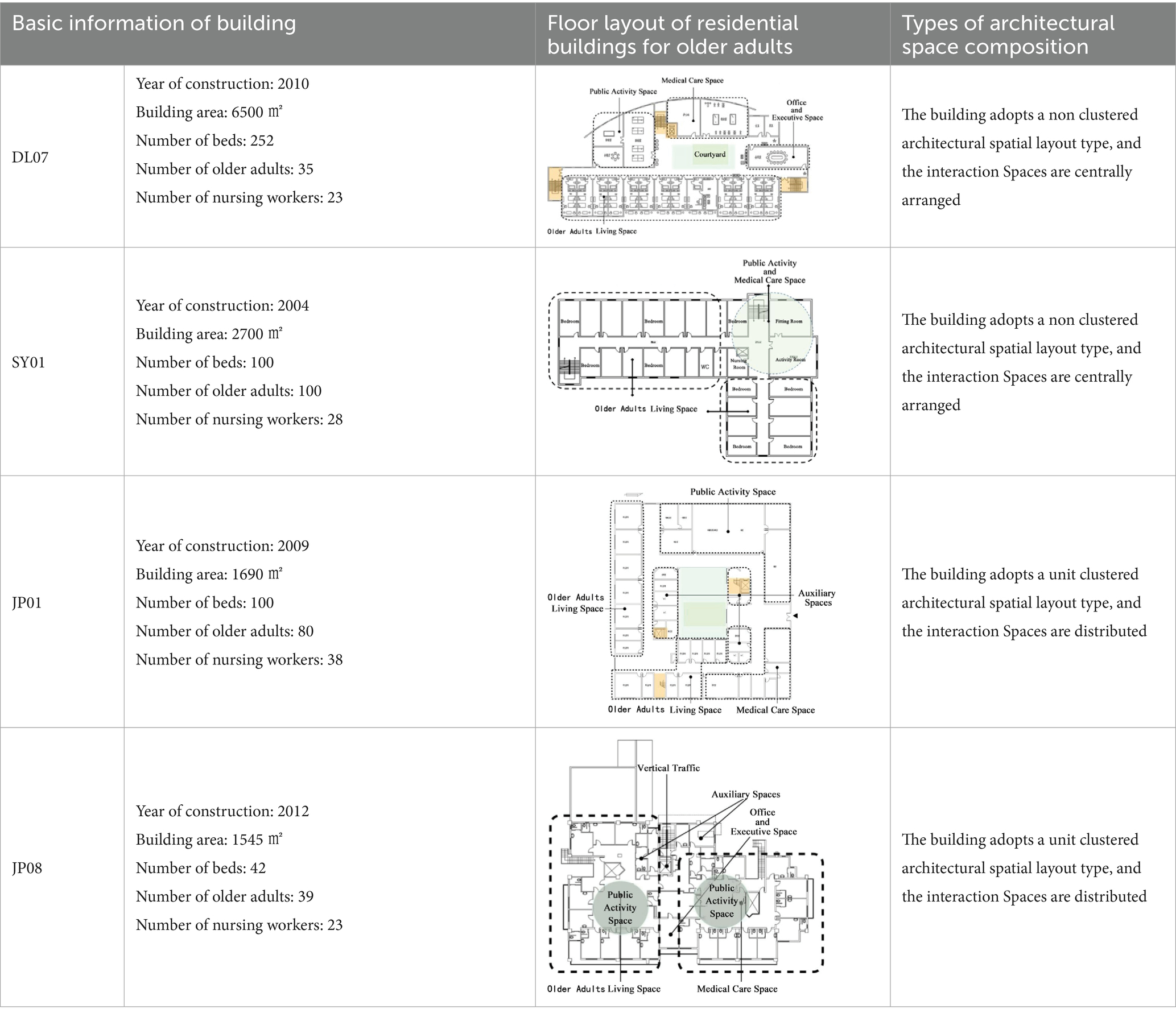
The methodology involved a three-day observational study of older adults' interaction behaviors in four nursing homes, with observations recorded every 10 minutes on architectural floor plans. These observations were then superimposed onto the plans, with pink areas representing designated interaction spaces and gray circular regions indicating observed interaction behaviors. Quantitative analyses were performed to determine the overlap between intended interaction spaces and actual usage, guided by the theory of mutual infiltration between environment and behavior. This theoretical framework suggests that a higher overlap indicates a more effective design in meeting the communication needs of older adults, while a lower overlap points to underutilized spaces and inadequate design for social engagement. The study specifically focused on older adults aged 65 and above who required wheelchairs for mobility, ensuring a consistent demographic for comparison.
Findings revealed significant differences between clustered and non-clustered nursing home designs. In non-clustered units (e.g., DL07 and SY01), communication spaces were often centralized and enclosed, leading to low utilization rates and scattered interaction behaviors, primarily in corridors and bedrooms. This design resulted in a low overlap between designated communication spaces and actual interaction fields, indicating that these spaces did not adequately meet residents' psychological communication needs. In contrast, clustered nursing units (e.g., JP01 and JP08) featured decentralized, open, and multi-functional communication spaces within living units, fostering a home-like atmosphere. These designs demonstrated a high overlap between communication behavior fields and designated spaces, suggesting that they effectively met the communication and psychological needs of older adults, leading to more frequent and continuous interactions within their living units.
Based on these findings, the study proposed several optimization design strategies. Firstly, adopting a small-scale cluster design for living units with clear spatial boundaries and independent common living spaces is recommended to accommodate the physical conditions of older adults and facilitate daily communication. Secondly, designing open communication spaces within living units that embody a family-like atmosphere, equipped with composite functions (cooking, dining, entertainment), is crucial. This approach encourages diverse interactions by weakening architectural barriers and using flexible, movable elements like furniture and plants. Thirdly, integrating urban life functions, such as small supermarkets, cafes, and bookstores, between living units can create a street-like atmosphere in corridor spaces, promoting social interaction among residents from different units and preventing social isolation. The inclusion of children's daycare facilities to foster intergenerational activities is also suggested to enhance residents' mental and physical health.
The research contributes theoretically by enriching the understanding of environmental influence on older adults' interaction behavior, integrating architectural, psychological, and behavioral science theories, and innovating research methodologies through quantitative analysis of space-behavior overlap. Practically, the proposed design strategies aim to enhance social interaction and quality of life for older adults, optimize nursing home operational efficiency and service quality, and promote innovation in care service models. The study emphasizes the feasibility of these strategies through modular design, resource integration for cost control, the use of durable materials and intelligent management for maintenance cost reduction, and adaptability to low budgets through policy support and community collaboration. Ultimately, the goal is to create adaptable, supportive environments that foster communication and improve the overall well-being of older adults in nursing homes, while also informing policy and industry standards for elder care infrastructure.
#OlderAdults #NursingHomeDesign #ArchitecturalSpace #SocialInteraction #EnvironmentalPsychology #AgingPopulation #ElderCare #CommunicationBehavior #SpatialLayout #OlderAdults #NursingHomeDesign #ArchitecturalSpace #SocialInteraction #EnvironmentalPsychology #AgingPopulation #ElderCare #CommunicationBehavior #SpatialLayout
0 comment in total
 No comments yet
You may also like

Flexible space: Design for aged care
Residential design through a lens of care
How is an aging baby boomer generation changing the design of homes?

Elzenhof Veenoord Courtyard for Elderly / Specht architects & planners

Case Studies in Community-Centered Living: Innovative Residential Design
This Assisted Living Facility Is Designed to Look Like a Small Town From the 1940s
Courtyards, Gardens, and Terraces for Seniors: Residences that Integrate Community Life into the Natural Environment
One man turned nursing home design on its head when he created this stunning facility

20 Examples of Floor Plans for Social Housing
Aging In Place Remodeling: A Checklist For Senior Homes

An Apartment in Brazil That Honors Nostalgia and Aging Gracefully
Home Sweet Home for Life
Better with age: Flooring trends in senior living
Is open-plan living dead? Here's what the design experts say