1/4
SC Johnson HQ: Exterior and Interior | Frank Lloyd Wright | Ken Burns
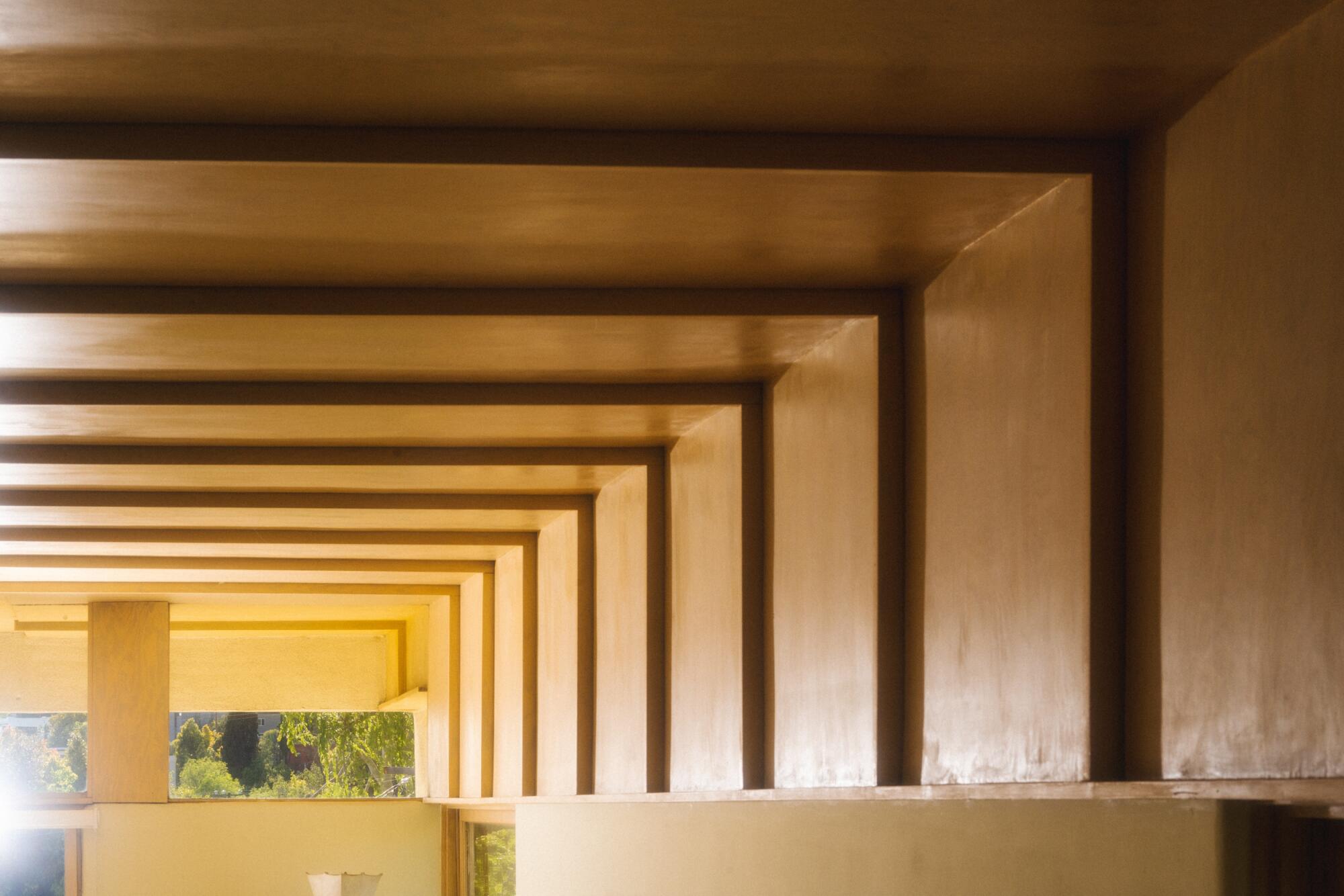
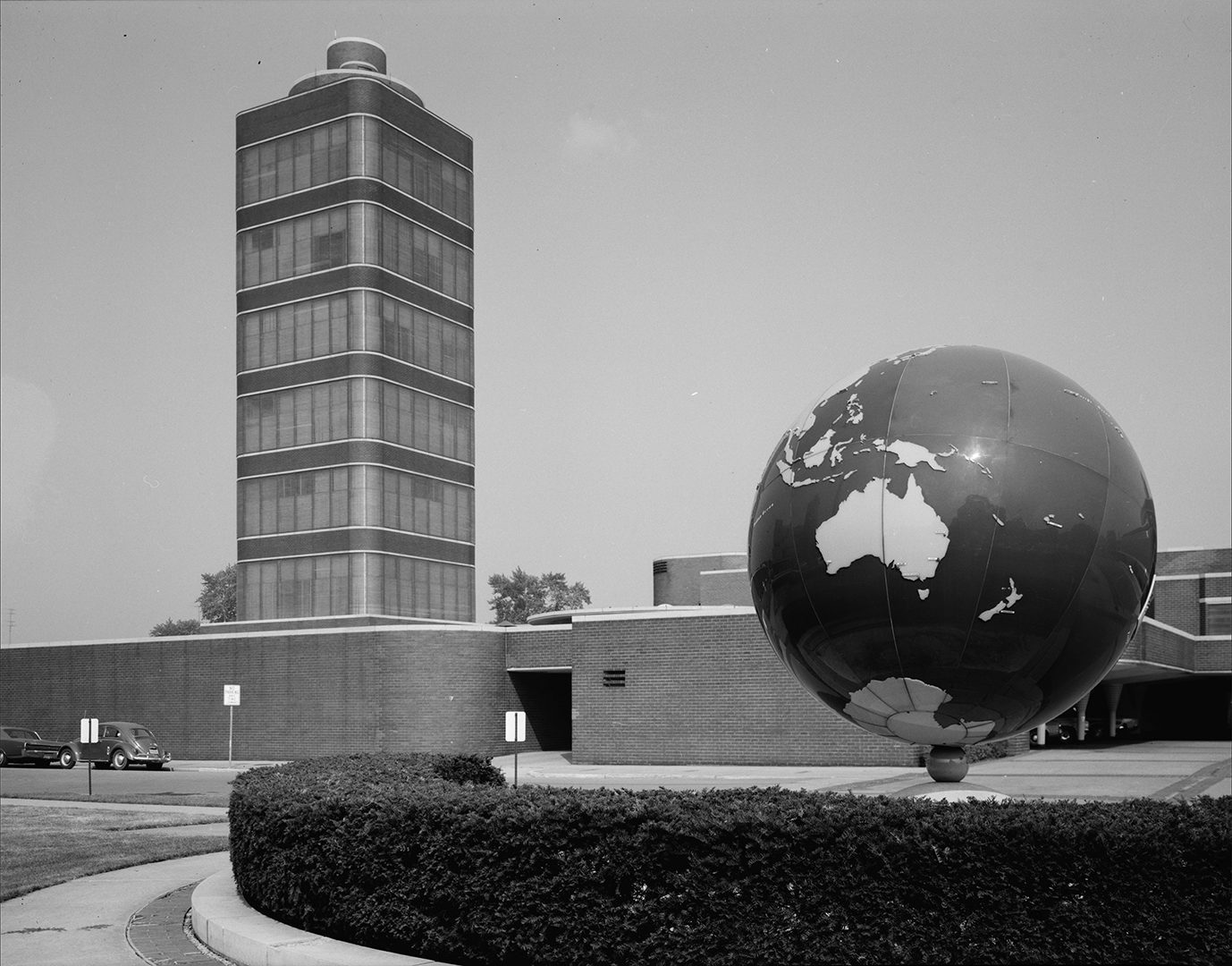
The SC Johnson Headquarters, designed by Frank Lloyd Wright, showcases an innovative architectural approach, particularly evident in its Administration Building and Research Laboratory Tower. The Administration Building features a lustrous ceiling supported by concrete columns designed to resemble lily pads, a natural metaphor that extends to the Research Laboratory Tower where concrete floors, mimicking tree branches, cantilever from a central shaft. This design choice, according to architectural historian Vincent Scully, creates a sense of being pulled into a 'pool,' with the lily pad columns making one feel as if floating underwater, evoking a womb-like experience. This contrasts with Wright's earlier Larkin Building, which, despite sharing a similar entrance and ascent to a grand space, was characterized by hard, blocky edges reflecting paternalistic capitalism, while the Johnson Wax Building embraces rounded, fluid surfaces.
A legendary episode surrounding the building's construction involved a structural integrity test of Wright's unique columns. Skeptical structural engineers questioned the design, prompting Wright to publicly demonstrate its strength. On June 4, 1937, Wright successfully loaded a test column with 24 tons of sand without it cracking, a significant event that garnered public attention and challenged conventional building theories. The Milwaukee Journal reported on this 'upside-down column' and its ability to hold heavy loads, highlighting the industrial commission's initial doubts and the festive atmosphere surrounding the test. Representatives from various companies and camera enthusiasts gathered, anticipating a potential collapse, but Wright, alongside his students and the company president, oversaw the successful demonstration.
The columns, described as 'flower' or 'ice cream cone' shaped, are nine inches in diameter at the base and gradually spread upwards, culminating in a 'calyx' and an 8 1/2-foot concrete 'petal' at the top. These 'petals,' spaced 20 feet apart, support the roof, with glass skylights filling the diamond-shaped spaces between them, allowing natural light into the building. This design defied established architectural rules, which dictated a maximum column height of 6 feet 9 inches for a nine-inch diameter base, whereas Wright's columns extended to 21 feet 7 1/2 inches. The secret to their strength lies in Wright's use of a steel mesh core instead of traditional steel rods. Wright explained this as a 'marriage' of materials, comparing the steel mesh to muscles and sinews, which are stronger than bones, and calling his approach 'organic' architecture.
Architecture critic Paul Goldberger highlighted the building's 'Marxist' quality, providing a beautiful, naturally lit space for workers, a monumental space for clerical staff, despite it being a corporate building. Frank Lloyd Wright himself articulated his vision in 'An Autobiography,' stating that the Administration Building was designed to be as inspiring a workplace as any cathedral, serving as a socio-architectural interpretation of modern business. The building employed a horizontal unit system of twenty feet and a vertical unit system of three and a half inches. Glass tubing was integral to the design, allowing light to permeate, and the exterior enclosing wall material seamlessly extended indoors. The structure's main feature was the repetition of slender, hollow, monolithic dendriform shafts, or 'stems,' standing on small brass shoes. Wright described the entire steel-reinforced structure as light, plastic, earthquake-proof, fireproof, soundproof, and vermin-proof, emphasizing that simplicity, while not fool-proof, is never for fools.
#FrankLloydWright #SCJohnsonHeadquarters #OrganicArchitecture #ArchitecturalInnovation #BuildingDesign #StructuralEngineering #MidCenturyModern #ArchitecturalHistory #InteriorDesign #FrankLloydWright #SCJohnsonHeadquarters #OrganicArchitecture #ArchitecturalInnovation #BuildingDesign #StructuralEngineering #MidCenturyModern #ArchitecturalHistory #InteriorDesign
0 comment in total
 No comments yet
You may also like
An Architect’s Life in a Diehard Profession

Dan Brunn Renovates Frank Gehry’s Very First House


Carrie and Boris Johnson's son Wilfred, 3, has the most unique bedroom decor


I was looking for a unique way to exhibit my favorite photographs – Don Johnson's unorthodox gallery wall is the solution
Contemporary Ranch Interior Design by Johnson & Associates

A Brooklyn Brownstone Brimming With Dramatic, Moody Interiors
This Dreamy, Green Jenkintown Mudroom Blends Form and Function

'Step through the front door and your expectations evaporate in amazement and delight': The humble end-of-terrace house that's a wonder of neo-Classical grandeur

‘Every day is like a changing picture’ at Johns Creek home with wall of windows

Meet Robert Jones | accent wall artist
Inside Ryan Murphy’s Halston-inspired Hollywood HQ


Step Inside a Historic Manhattan Apartment Transformed by Design Star Ryan Lawson

Exhibit of Kennedy's Hyannisport interior design

Design Brooklyn: Talking Interior Design With Jessica Warren of JP Warren Interiors
How Frank Lloyd Wright’s early furniture designs reinforced his vision
'Yellowstone' Has Impacted the Design World in the Most Dramatic Way

Consider the ceiling! On the possibilities to be found on the flip side


Home Design: Hyde Park Heirloom

A contemporary renovation has brought this Federation home closer to nature

This Popular Home Style Features Wide Porches, Low-Pitched Roofs, and Lots of Charm