New Zero-Energy Homes Almost to Cost Parity, While Codes & Incentives Help Cross the Finish Line
The concept of building zero-energy (ZE) or zero-energy ready (ZER) homes, which are comfortable, healthy, and dramatically cut energy bills, is becoming increasingly viable, with the potential for cost parity with standard homes. A recent report by the Rocky Mountain Institute, titled “The Economics of Zero-Energy Homes: Single-Family Insights,” explores the economic feasibility of these homes in various US locations. The study analyzed four cities—Houston, Atlanta, Baltimore, and Chicago—representing climate zones 2 through 5, where 90 percent of new construction homes are built, to identify the most cost-optimal energy upgrade packages. ZE homes are defined as those that produce or procure as much renewable energy as they consume annually, while ZER homes are designed to achieve ZE efficiency levels but do not yet include solar photovoltaics.
The findings indicate that the incremental cost to construct a ZE or ZER home is modest across all four zones. ZE homes saw an average incremental cost of 7.3 percent, and ZER homes averaged 1.8 percent. These figures are significantly lower than commonly perceived by consumers, builders, and policymakers. To expand the analysis nationally, the study utilized various tools and databases, including RSMeans for labor and material cost adjustments, PVWatts for solar resource adjustments, EnergySage for solar cost adjustments, and the Pacific Northwest National Laboratory’s analysis of the International Energy Conservation Code (IECC) for incremental cost adjustments relative to local energy codes. Local incentives were not factored into this scaled approximation.
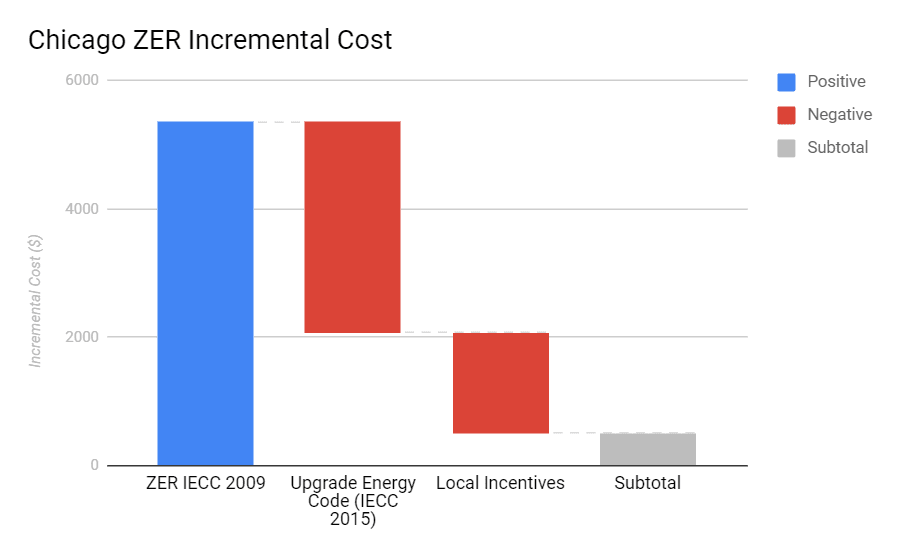
The scaled results for the 47 most populous US cities revealed that many cities could achieve cost parity for ZER homes with existing incentives, given an average incremental cost of 1.1 percent. This is particularly significant for ZER homes due to their scalability, as they are not restricted by solar resource availability or roof design. The research highlighted that local building energy codes, solar resources, labor and material costs, and comprehensive incentives play a crucial role in achieving cost parity. Stronger local building energy codes, such as IECC 2015, elevate the baseline for new construction, thereby reducing the incremental cost of ZER homes. Furthermore, robust local incentives, like those offered by ComEd in Chicago, can significantly lower the incremental cost, bringing a ZER home in Chicago from $5,368 to $495, resulting in payback through utility bill savings in under a year.
Boston serves as a prime example where cost parity for ZER homes has been achieved through a forward-thinking program from Mass Save. This program, a collaborative effort of Massachusetts’ natural gas and electric utilities and energy efficiency service providers, offers performance-based incentives that fully offset the estimated incremental cost of $1,837, effectively eliminating the cost barrier for ZER homes in the region. While ZER homes are approaching cost parity, ZE homes still appear to face higher upfront costs. However, third-party-owned solar financing, such as solar leases or power purchase agreements (PPAs), offers a solution. These financing models, which accounted for 41 percent of residential solar in 2017, allow builders to construct ZER homes and effectively convert them into ZE homes without additional upfront costs. Some providers even offer cheaper electricity rates than utilities, as demonstrated by Lennar's PPA that sets solar prices 20 percent below utility rates for 20 years.
To further facilitate the widespread adoption of ZE and ZER homes, policymakers can implement stronger energy codes, collaborate with local utilities to offer comprehensive incentives for homes exceeding code standards, and encourage businesses to provide PPAs and solar loans. This includes ensuring favorable interconnection and net-metering policies and clarifying legal and regulatory requirements for third-party solar ownership models. The report suggests that continued efforts in these areas will help push more cities across the finish line towards widespread adoption of energy-efficient and zero-energy housing. Future updates to the report will include climate zones 6 and 7, and a similar report for multifamily buildings is anticipated in early 2019.
#ZeroEnergyHomes #ZeroEnergyReadyHomes #CostParity #EnergyEfficiency #BuildingCodes #SolarEnergy #Incentives #SustainableBuilding #RenewableEnergy #ZeroEnergyHomes #ZeroEnergyReadyHomes #CostParity #EnergyEfficiency #BuildingCodes #SolarEnergy #Incentives #SustainableBuilding #RenewableEnergy
0 comment in total
 No comments yet
You may also like
A floor-to-ceiling tour of America’s most energy-efficient home


Deep Retrofit 2023: Show me the money, how to pay for it all

This Nearly Net-Zero Prefab Home Is an Environmentalist’s Dream Come True

How This Hunterdon County Couple Created a Super-Sustainable Home
The electric potential of the Inflation Reduction Act

Induction 411
Insulation Projects Increase as Property Owners Seek Lower Bills
Efficiency is at the Crux of this Nearly Net Zero Home Just Outside Golden

Deep Energy Retrofit for Affordable Housing

Zero-Interest Home Renovation Loans: What to Know


Insulation grants UK: do you qualify for free insulation?
18 energy saving ideas

Home Improvement Tax Credits and Rebates for Energy Efficiency in 2025
Cost-effectiveness and affordability evaluation of a residential prototype built with compressed earth bricks, hybrid roofs and palm midribs
Inside an Eco-Friendly Edina Haven by City Homes

A Retrofit for the Future


Meet a real estate agent showing clients how electrification can save them money
Peek Inside This Carbon Neutral Eco Home For Sale in Norfolk

The Future of Sustainability in Japan: Paving the Way to Net Zero Energy Housing


Let's Go! An Electric Explainer, and where we go from here!