Lighting application efficacy: A framework for holistically measuring lighting use in buildings
Lighting in buildings accounts for approximately 18% of electricity consumption, and while advancements like LEDs have improved the energy efficiency of hardware, the traditional metric of luminous efficacy (lm/W) fails to capture the true effectiveness of lighting in architectural spaces. Luminous efficacy quantifies light generated per watt, but it does not consider how much of that light actually contributes to human visual perception. In reality, a substantial amount of generated light is wasted because it doesn't reach an occupant's eye or contribute to their visual task.
Existing lighting design practices often exacerbate this issue. For instance, recommendations for uniform lighting to accommodate visual tasks across an entire space frequently lead to unnecessary illumination. More innovative approaches, such as smart dimming systems, absorption-minimizing lighting, and gaze-dependent lighting, could significantly reduce energy consumption by focusing light only where and when it's needed. However, lighting practitioners currently lack a comprehensive method to quantify the energy impact of various design decisions, including luminaire selection, surface reflectances, occupancy, and task requirements. Building standards and incentive programs, while promoting efficiency, also do not provide adequate quantification methods for different design approaches.
To address this gap, the concept of Lighting Application Efficacy (LAE) is proposed. LAE is defined as the relationship between the electrical power consumed by lighting hardware and the amount of light that genuinely contributes to building occupants' visual perception. This framework aims to provide a holistic measure of lighting efficiency, fostering more energy-efficient design practices, stimulating product innovation, and ultimately reducing energy waste. Previous attempts to quantify application efficacy, such as those by Rea and Bullough, and the U.S. Department of Energy, have merits but are limited in their ability to accommodate the full range of variables in the 'illumination lifecycle' or model changes in lighting conditions over time.
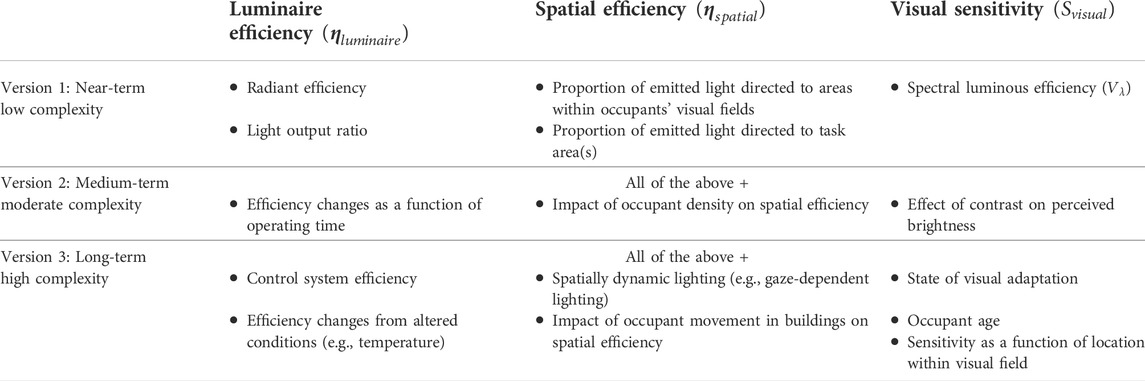
The proposed LAE framework is structured around the primary pathway of light in architectural settings: light generation and emission from a luminaire, its travel through space and into occupants' eyes, and the subsequent visual perception. Mathematically, LAE is expressed as the product of luminaire efficiency (ηluminaire), spatial efficiency (ηspatial), and visual system sensitivity (Svisual). A temporal dimension can be added to account for variations in occupancy and adaptive lighting controls. The framework envisions a three-stage development process. Version 1 will focus on computationally estimating the proportion of light directed to task areas and occupants' visual fields, leveraging existing luminous efficacy data. Version 2 will refine these inputs through human observer experiments to characterize perceptual effects of lighting contrast and validate spatial efficiency calculations. It will also incorporate light source degradation over time and the impact of occupant density. Version 3 is designed to be extensible, inviting contributions from the broader lighting community to continuously improve the model.
LAE calculations will be performed using Radiance, a free and open-source lighting rendering engine, ensuring accessibility and encouraging widespread adoption by other lighting software developers. The calculation process will guide designers through defining task areas, specifying occupancy conditions, and determining relevant irradiance values. This iterative process will allow designers to assess the impact of various design choices on LAE. The ability to measure LAE can transform how lighting design recommendations and building energy standards are established, enabling more specific and accurate guidelines linked to visual perception and space occupancy. This framework is not intended to solely optimize for application efficacy, as other factors like color quality, glare control, and aesthetics remain crucial. Instead, LAE serves as a vital consideration among many, encouraging the development of strategies to balance conflicting lighting goals and driving the commercialization of innovative, application efficacy-focused lighting systems.
#LightingApplicationEfficacy #BuildingEnergyEfficiency #ArchitecturalLighting #VisualPerception #SustainableDesign #SmartLightingSystems #EnergyModeling #BuiltEnvironment #LightingApplicationEfficacy #BuildingEnergyEfficiency #ArchitecturalLighting #VisualPerception #SustainableDesign #SmartLightingSystems #EnergyModeling #BuiltEnvironment
0 comment in total
 No comments yet
You may also like
5 tactics for sustainable architectural lighting
5 ways you didn't know smart lighting can improve your living space and wellbeing

These Task, Accent, And Ambient Lighting Tips Can Transform Your Home

Light Bulb Moment: 5 Things to Consider When Switching to LED Bulbs

Human-Centric Lighting: Foundational Considerations and a Five-Step Design Process
The Magic of ADAPTIVE’s 8 Layers of Lighting Design

Lighting Beyond Function: How The Licht Project Transforms Modern Spaces
iguzzini pioneers nearly invisible smart lighting infrastructure with filorail track & newfo spot
15 Interiors that Illustrate the Effectiveness of Indirect Lighting

Comparing Energy-Efficient Light Bulbs: LED, CFL and Halogens

15 Lighting Products That Will Work in Any Home, From a Cramped Studio to a Windowless Basement

Passive Design Strategies for Energy Efficient Buildings in the Arabian Desert
How to Use Ambient Sensing in Smart Lighting for Energy Efficiency

The Best Light Bulbs for All Your Home’s Lighting Needs, Tested

What is lampscaping? Interior designers share their tips for creating a cohesive lighting scheme across the whole home
An interior designer’s guide to lighting your home

Effects of indoor lighting environments on paper reading efficiency and brain fatigue: an experimental study
Best Lighting Designs Spotted in 2023

Investigating lighting calibration opportunities in virtual reality for real-world illumination fidelity: an empirical study of variable lighting arrangements
Lumen on the Horizon