Discriminatory housing practices in the District: A brief history
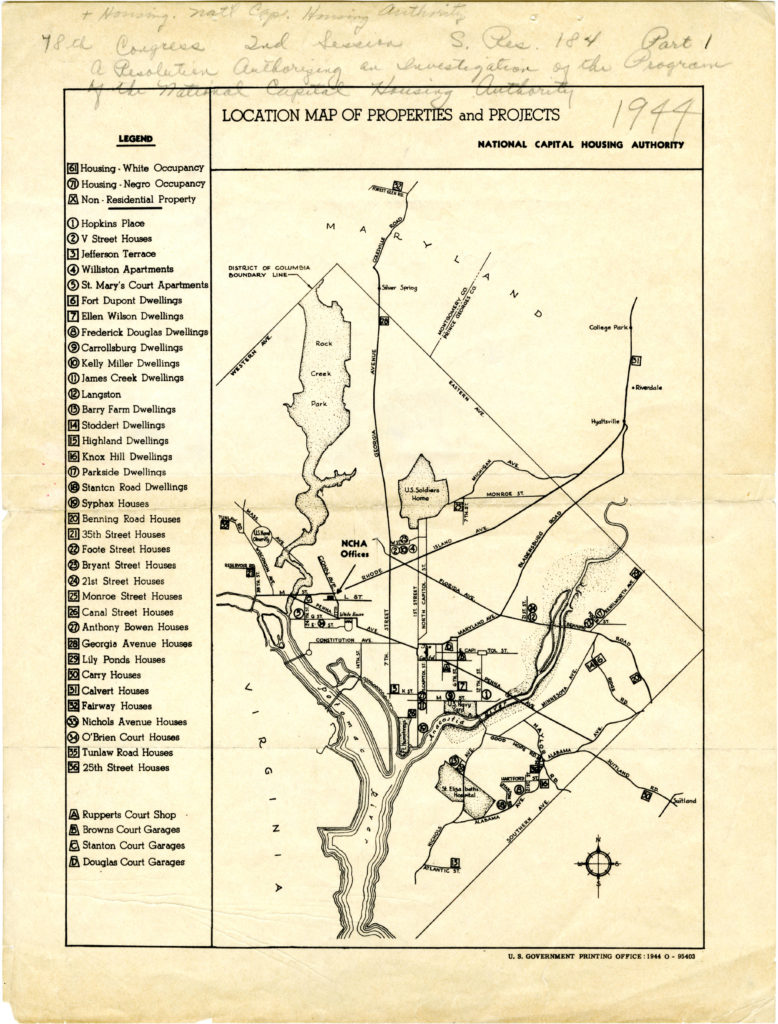
This article provides a concise overview of discriminatory housing practices in Washington, D.C., focusing on the 20th century to the present, to contextualize current racial disparities in wealth, income, and homeownership. It draws upon several authoritative resources, including "The Color of Wealth in the Nation’s Capital," which meticulously traces the systematic barriers that prevented D.C.'s Black residents from accumulating wealth and assets, ranging from the Black Codes of the 1840s to modern-day phenomena like white flight and urban renewal. The article emphasizes that racial inequalities are not merely residual effects of slavery but rather the direct result of explicit discouragement and exclusion from housing markets by federal and local governments, banks, realtors, and citizens' associations.
Historically, government regulations at all levels actively promoted racial segregation. Federal housing policies, as detailed in Richard Rothstein's "The Color of Law," subsidized housing and loans for white families, encouraging their migration from urban centers to segregated suburbs. This process simultaneously facilitated wealth accumulation for white populations and eroded the tax base of cities. In D.C., for instance, nearly 60 percent of the white population departed between 1950 and 1970, driven by new affordable housing opportunities and resistance to public school integration. Concurrently, Black residents were confined to overcrowded and deteriorating housing options due to widespread prohibitions on living in many neighborhoods. This intentional underinvestment led to severe living conditions, with a significant percentage of Black homes lacking basic amenities like running water and electricity by 1960.
Urban renewal initiatives, rather than alleviating these conditions, often exacerbated them. Projects in D.C., such as the demolition of homes in the southwest quadrant, displaced thousands of low-income Black residents without providing adequate replacement housing. Howard Gillette, Jr.'s "Between Justice & Beauty" highlights that of 5,900 new units constructed, only 310 were for moderate-income families. This displacement destabilized communities and disrupted families. Furthermore, zoning laws were employed to maintain low-density, single-family homes in predominantly white, affluent areas, while concentrating apartment buildings in lower-income, often Black, neighborhoods. For example, Ward 3 in D.C. is almost entirely zoned for single-family units, contrasting sharply with Ward 8, where multi-family units dominate residential land.
The long-term effects of these exclusionary practices are evident in subsequent generations, particularly through the intergenerational transfer of housing wealth. Home equity enabled white families to build economically stable lives and finance their children's education, creating a stark disparity compared to Black families. Even today, middle- and high-income Black families are disproportionately found in low-income neighborhoods, and Black Americans experience lower rates of upward economic mobility. The 2008 financial crisis further highlighted these disparities, as predatory lending practices targeted Black and Latinx applicants with subprime loans, leading to higher interest rates and severe financial losses when the housing market collapsed. Even those with good credit were often steered away from traditional loans. This resulted in Black households, which held a larger share of their wealth in homeownership than white households, being disproportionately affected. The homeownership gap between white and Black households widened significantly by 2016, exceeding levels from 1900. While credit scores play a role post-recession, ongoing research suggests that modern-day redlining persists, with people of color more likely to be denied conventional mortgage loans even after controlling for various financial factors, as demonstrated by investigations in numerous U.S. metropolitan areas, including D.C.
#HousingDiscrimination #RacialEquity #DCHistory #UrbanPlanning #Redlining #WealthInequality #HousingPolicy #FinancialCrisis #Segregation #HousingDiscrimination #RacialEquity #DCHistory #UrbanPlanning #Redlining #WealthInequality #HousingPolicy #FinancialCrisis #Segregation
 No comments yet
Housing and Residence Life


I Put Up a Fence in Maine. Why Did It Cause Such a Fuss? (Published 2024)

Disability-Forward Design Across Multiple Cities

The Dark Side of Historic Preservation


Why We Can’t Have Mid-Century Modern


Why Dining Rooms Are Disappearing From American Homes