1/11
Revisited: Carpenter Hall House
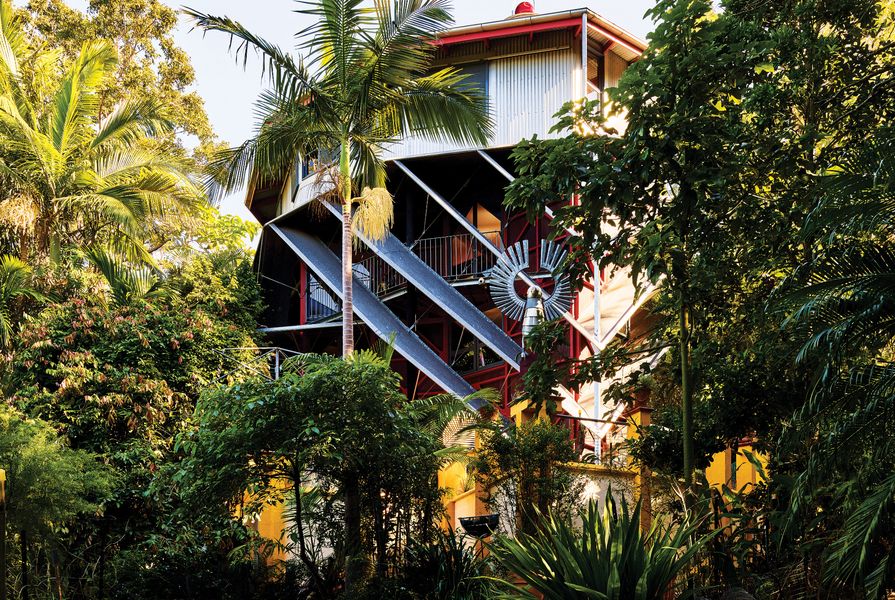
The Carpenter Hall House, a five-story timber-and-tin tower located on the slopes of Brisbane's Eildon Hill, has been a thirty-year labor of love for its architect Russell Hall and client Jennifer Hall. Commissioned in the mid-1980s by Jennifer Hall, who desired to live in a tower due to her "Rapunzel complex," the house was completed in 2018. It has been recognized as a nationally significant piece of architecture by the Australian Institute of Architects since the early 2000s, yet access to its interior has been limited.
The house employs a traditional nineteenth-century timber construction technique, featuring exposed stud bracing, single-skin walls, and tall timber stumps. These elements are enveloped by diagonal sunshades made of galvanized steel, which complement the timber structure's pattern. While its materiality aligns with Queensland's timber-and-tin building tradition, the Carpenter Hall House deviates significantly in its construction methods and design. Russell Hall eschewed the then-common skewnailed abutted timber construction, which he believed would compromise structural stability. Instead, he adopted a technique similar to roof truss construction, utilizing machine-pressed nailplates gang-nailed to studs to ensure robust timber-to-timber connections.
The dwelling's plan and form also depart from typical Queensland timber houses on stumps. Russell extruded the building vertically and introduced a unique geometric variation based on two dodecagons (twelve-sided polygons). The top-level studio occupies a smaller dodecagon with a 2.7-meter radius, circumscribed by a larger dodecagon with a seven-meter radius, whose fragments define the outlines of the four lower levels. The number twelve is a foundational element, with each side of the larger dodecagon measuring precisely twelve feet, a measurement Russell relates to the human body, being twice Le Corbusier's "modulor." The number twelve also appears in the exposed timber frame, which has twelve distinct segments, with each facet four bays wide and each level three bays high.
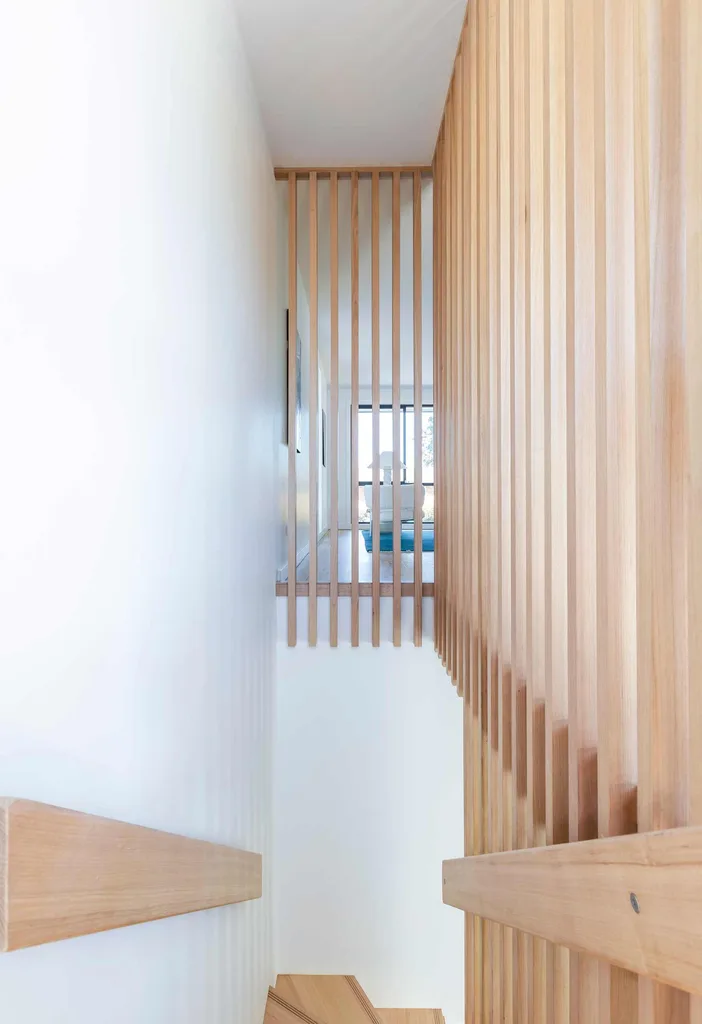
Russell Hall's design exhibits a fascination with mathematical forms and a penchant for the surreal, reminiscent of Antoni Gaudi's work. The house evokes legendary fables, particularly Rapunzel and Sleeping Beauty. A staircase with organically shaped railing panels ascends through the dark timber interior, featuring colorful stained-glass windows that offer glimpses of the distant city, emphasizing the abode's remoteness. The ascent past ornate furniture and an antique four-poster bed leads to a needlecraft studio at the top of the tower. This space is capped by a lantern containing fluid-filled prisms that project rainbow patterns both inside and out.
Despite its extraordinary design, the Carpenter Hall House did not receive the 2018 Robin Dods Award from the Queensland Chapter. However, its timeless quality suggests it transcends being merely a "2018 building" or even a "1980s building." It is envisioned as a timeless architectural piece that will be admired for centuries, akin to Gaudi's Casa Batlló.
#CarpenterHallHouse #RussellHallArchitects #BrisbaneArchitecture #ResidentialDesign #TimberAndTinConstruction #ArchitecturalInnovation #QueenslandArchitecture #BespokeDesign #CarpenterHallHouse #RussellHallArchitects #BrisbaneArchitecture #ResidentialDesign #TimberAndTinConstruction #ArchitecturalInnovation #QueenslandArchitecture #BespokeDesign
0 comment in total
 No comments yet
You may also like
Revisited: Fisher House
Mission reborn: Clayfield House
19th Century Montclair Home Undergoes Stunning Makeover

A Gut Renovation Turned This Capitol Hill Rowhouse Into a European-Inspired Escape

When restoring historic homes, what’s old is new again

Back to school: Paper House Project makes a Hackney schoolhouse a home
Charlestown home built on family foundation
Step inside this chalet-style family home in Hampshire
Melbourne’s Cornerstone House creates modern beauty out of rough materials

Arts & Architecture: Wheeler Kearns’ ‘Case Study’ House

Brooklyn Renovation: Blowing Out the Back Wall in Carroll Gardens
A brick veneer home’s contemporary renovation in Carlingford

Coming home to an 1880 English country manor in Montgomery County
Finding more room in a Charlestown row house by digging out the basement

Inside an Iconic Church-Turned-Family Home That First Ran in House Beautiful in 1989

Step Inside a Historic Wiltshire Estate Where Colorful, Easygoing Style Prevails

Darius Rucker’s Charleston Home: Before and After Photos of His Home Restoration

Hearth House by AOC
Courtyard House / cal30.arquitectos


Chardin Hall