1/16
Islamic Carpets in European Paintings
The popularity of pile-woven carpets from the Islamic world, often referred to as oriental carpets, in Europe from the fourteenth century onward is extensively documented through their frequent appearance in European paintings. These paintings serve as a crucial historical resource for scholars studying early carpets, so much so that many types of Islamic carpets from the Middle East are now identified by the names of European artists who depicted them, including Lotto, Holbein, Ghirlandaio, Crivelli, and Memling. The historical significance of expensive textiles underfoot, representing wealth, power, and sanctity, dates back to biblical times. This cultural concept is evident in various artworks, such as the Sienese painter Duccio's depiction of garments spread before Christ on Palm Sunday, and later, Sir Walter Raleigh's gesture of placing his cloak for Queen Elizabeth.
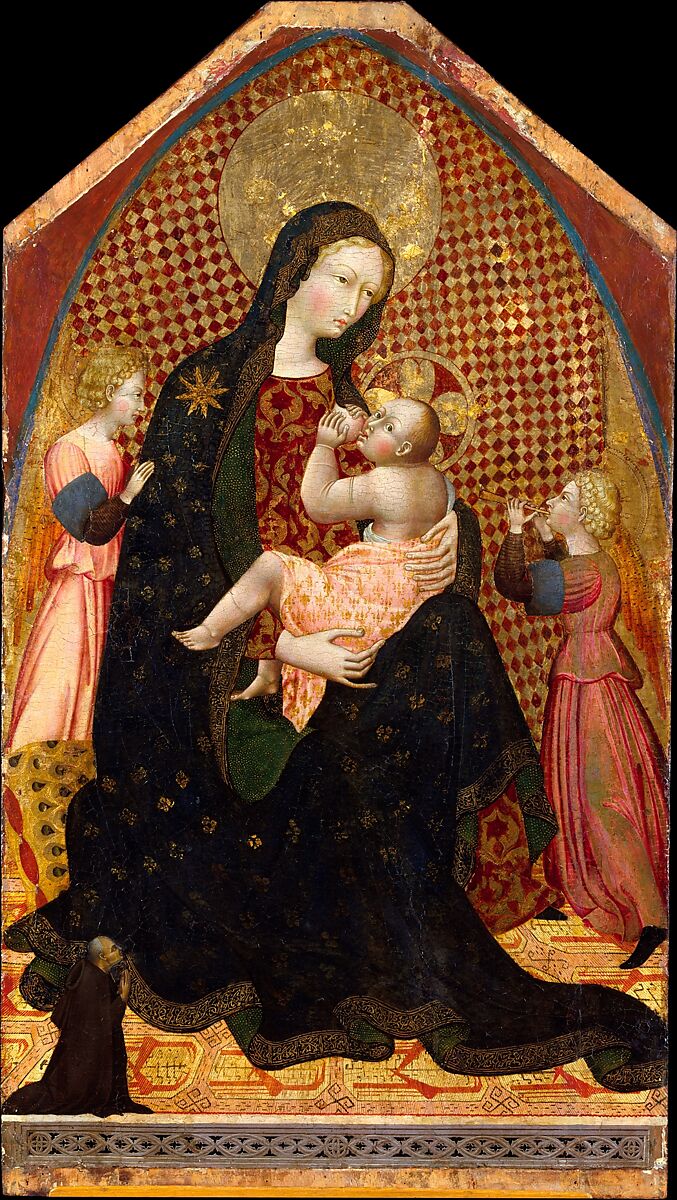
A fifteenth-century painting by Giovanni di Paolo, titled *Madonna and Child with Two Angels and a Donor*, features one of the earliest and rarest types of Turkish carpets exported to Italy, characterized by highly stylized animal motifs within octagons. By the sixteenth century, carpets became common motifs in portraits, symbolizing sophistication, education, and high social and economic standing. An anonymous portrait by Moretto da Brescia, for instance, includes a border of a contemporary Anatolian rug from Ottoman Turkey at its base. The seventeenth century saw an even broader integration of carpet depictions across Europe.
Lotto carpets, identifiable by their distinctive designs, are well-represented in this period. Earlier, larger examples exhibit borders with stylized strapwork reminiscent of Kufic Arabic script, while later versions feature small medallions. Jan Brueghel and Peter Paul Rubens' painting, *The Feast of Acheloüs*, illustrates a beautiful Lotto carpet with red and yellow arabesques from central Turkey draped over a table during a contemporary Flemish outdoor banquet. The pattern's popularity is further demonstrated by Nicolaes Maes' painting of a young girl peeling apples, seated beside a table adorned with a luxurious Lotto carpet.
Syrian carpets, particularly rare in Europe, also appear in paintings. Gabriël Metsu's *A Musical Party* showcases a "chessboard" carpet with geometric star designs from early seventeenth-century Syria on a table. Medallion carpets from Ushak in west-central Turkey were another frequently depicted type. Metsu's *The Visit to the Nursery*, a rich Dutch interior scene, prominently displays a large Ushak medallion carpet draped over a table. Gerard ter Borch the Younger's *A Woman Playing the Theorbo-Lute and a Cavalier* features a small west Anatolian medallion carpet with a unique design on the table in front of the musical pair.
Johannes Vermeer, despite his limited artistic output, frequently included oriental carpets in his paintings. *A Maid Asleep* shows two distinct seventeenth-century Anatolian carpets, while *Young Woman with a Water Pitcher* presents a soft, thickly textured Persian carpet with floral arabesques on a red ground, again placed on a table. The practice of displaying carpets on tables in upper-class interiors continued into the eighteenth century, as seen in Pietro Longhi's *The Visit*, where a West Anatolian prayer carpet from the Gördes district covers a table in an elegant Italian interior.
As carpets became more accessible in Europe, larger examples were imported for floor coverings. Francis Wheatley's *The Saithwaite Family* depicts an aristocratic British couple and their daughter on a vast eighteenth-century Ushak carpet. In early nineteenth-century France, Jean August Dominique Ingres' portrait of Jacques-Louis Leblanc reflects a deliberate nod to earlier portraits. The carpet-covered table, adorned with books, a handwritten letter, and an inkwell, symbolizes a long-standing tradition in European painting that links carpets not only with economic and social status but also with learning and literacy. The small Anatolian carpet on the table in Ingres' work closely resembles an actual eighteenth-century example from the Metropolitan Museum's McMullan collection. Depictions of carpets in European and American paintings persisted throughout the twentieth century, appearing in works by artists like Matisse and William Glackens, affirming the enduring fascination with their colors, textures, and patterns among both patrons and artists.
#IslamicCarpets #EuropeanPaintings #ArtHistory #TextileArt #CulturalSignificance #DecorativeArts #OttomanTurkey #Vermeer #InteriorDesign #IslamicCarpets #EuropeanPaintings #ArtHistory #TextileArt #CulturalSignificance #DecorativeArts #OttomanTurkey #Vermeer #InteriorDesign
0 تعليق إجمالاً
 لا توجد تعليقات بعد
قد تعجبك أيضًا
Textile as Portable Garden
Designers say we should all take these 7 lessons from European style for an eclectic take on luxury

Older’s Blade Runner-inspired furniture has an agenda


Great Collections

The ancient Islamic roots of modernity

Tented rooms are the whimsical trend making a comeback in 2024 – here's how to get the look
5 Stunning Wall Treatments That Will Make Your Home Feel Truly European

A LARGE PETAG TABRIZ CARPET, NORTH WEST PERSIA, CIRCA 1920
This classical, European-inspired wall decor is back in style for 2024 – designers love its elegant appeal
Tapestries Are No Longer Just for Gothic Castles (Published 2024)
The 10 Next Big Trends in Luxury Textiles
18 modern Mediterranean-style houses with a holiday vibe

5 Stunning Wall Treatment Ideas That Will Make Your Home Feel Truly European

Christian Fischbacher and Hadi Teherani create fabric designs informed by the Iranian landscape
Here Are the Biggest Trends We Spotted at the ‘Couture Week’ of Interiors
Notes: how to transform the paint industry with a brilliant idea

Live from HIX: Arte unveils L’Invite collection of wallcoverings
Study of materials and techniques in painted ceiling panels from a palace in Cremona (Italy, 15
What the Rooms from 6 Famous Paintings Would Look Like Today

Moroccan Tiles in Global Architecture: A Rising Trend in 2025