1/15
Framing Failures in Wood-Frame Hip Roofs under Extreme Wind Loads
Residential roof failures are a prevalent and costly issue during extreme wind events, with hip roofs generally considered more resilient than gable roofs. However, recent damage survey data from tornadoes reveal an understudied failure mode: partial framing failures in hip roofs. This study investigates these failures, reviews common roof design and construction practices, and utilizes two-dimensional finite element models to estimate element-level load effects on hip roof trusses and stick-frame components. The likelihood of failure for each member is assessed based on demand-to-capacity (D/C) ratios, comparing trussed and stick-frame structures to evaluate their relative performance.
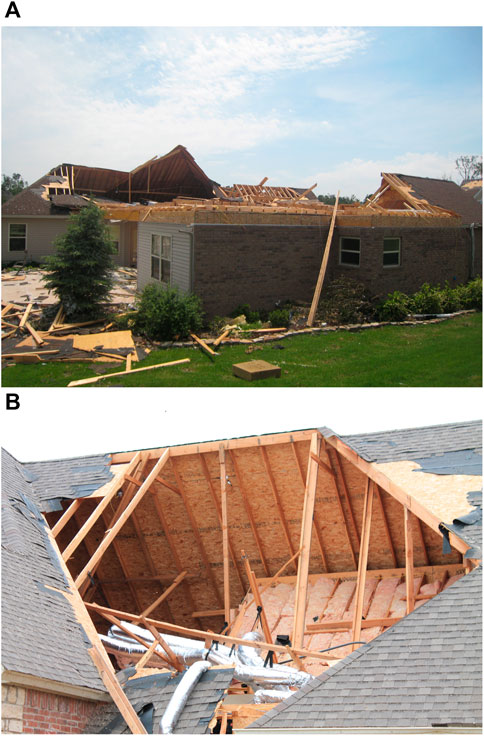
The research begins by reviewing existing literature on residential wind damage, noting that most previous work focuses on roof-to-wall connection (RTWC) failures and sheathing loss. While the Enhanced Fujita (EF) Scale for tornadoes categorizes damage (DOD-4 for sheathing loss, DOD-6 for major roof failures), the current understanding of DOD-6 is often limited to RTWC failures. Damage survey data from the 2013 Moore, Oklahoma (EF5) and 2011 Tuscaloosa, Alabama (EF4) and Joplin, Missouri (EF5) tornadoes were analyzed. This analysis revealed numerous instances of partial hip roof framing failures, where parts of the roof frame, in addition to sheathing, were removed while RTWCs appeared intact. In some areas, these framing failures constituted a significant portion of observed roof damage, particularly in newer, steep-sloping, stick-frame hip roofs.
Statistical analysis of damage in two neighborhoods in Joplin, Missouri, following the 2011 tornado showed that in Region 1, 56% of houses with relevant damage experienced partial framing failure, compared to 35% with RTWC failure. In Region 2, these numbers were 33% and 37%, respectively, indicating that framing failures are a common occurrence. The varying distribution of failure types between regions suggests that factors like construction age, roof slope, and potential debris impact may influence failure modes.
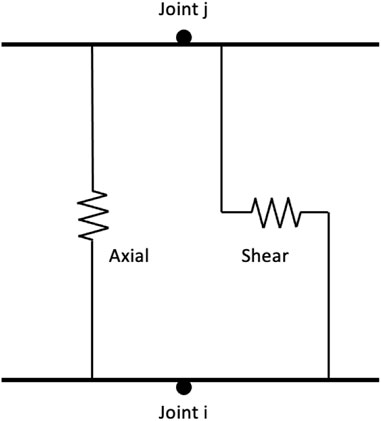
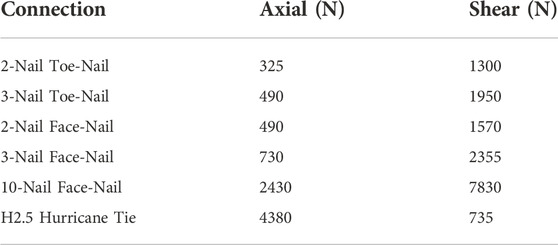
A numerical modeling method was developed using SAP2000 to analyze internal load effects and strength behavior of wood-frame roof components under wind uplift. The method identifies vulnerable elements by comparing maximum demand on framing members and connections to their minimum capacities. The analysis confirmed that toenailed RTWCs are highly vulnerable in both trussed and stick-frame hip roofs, often being the first element to fail. However, the study highlights that if hurricane straps are used to reinforce RTWCs, the point of failure can shift to other framing members and joints within the roof structure. For instance, in a truss with hurricane straps, the top chord members and joints show higher D/C ratios than the RTWC, indicating their increased vulnerability.
For stick-frame roofs, the analysis of a representative jack rafter also indicated the toenailed RTWC as the most vulnerable point, followed by the connection at the ridge. The D/C ratios suggest that stick-frame roofs, especially older ones potentially built to outdated standards or with construction errors, may contain more highly vulnerable elements. The study acknowledges limitations in its two-dimensional modeling, emphasizing the need for three-dimensional models to account for load sharing and sheathing effects. It concludes that framing failures are a possible and common mode of failure in hip roofs, potentially occurring at lower wind speeds than previously assumed for major roof damage, and suggests the need for further investigation to refine building codes and the EF-Scale for different residential design methods.
#WoodFrameStructures #TornadoDamage #EnhancedFujitaScale #HipRoofs #FiniteElementModeling #DegreesOfDamage #ResidentialStructures #WindLoad #StructuralEngineering #WoodFrameStructures #TornadoDamage #EnhancedFujitaScale #HipRoofs #FiniteElementModeling #DegreesOfDamage #ResidentialStructures #WindLoad #StructuralEngineering
0 comment in total
 No comments yet
You may also like
Design of stick-framed wood roofs under tornado wind loads
What to do When You Have Roof Damage From Hail

VIDEO SERIES: How To Build a Bay-Window Roof
Thermally Broken Roof Framing
Joints in a built-up beam
Framing a Dramatic Dormer
Development of a Full-Scale Structural Testing Program to Evaluate the Resistance of Australian Houses to Wind Loads
Examining some of the important factors when choosing products for ceilings and roofs

Framing a Roof With Larry Haun
Framing a Cold Roof
Folded Plate Roofs Are Back, and Now in Mass Timber
Ask the Builder: Joist hangers, beams and columns
Hurricane-Proof Construction with the Fortified Home Standard
How Strong Gable Ends and Wall Bracing Can Protect Your Home in Natural Disasters
Timber Frame Vs Post And Beam Construction