1/5
Choreographer William Forsythe on melding man, machine and dance
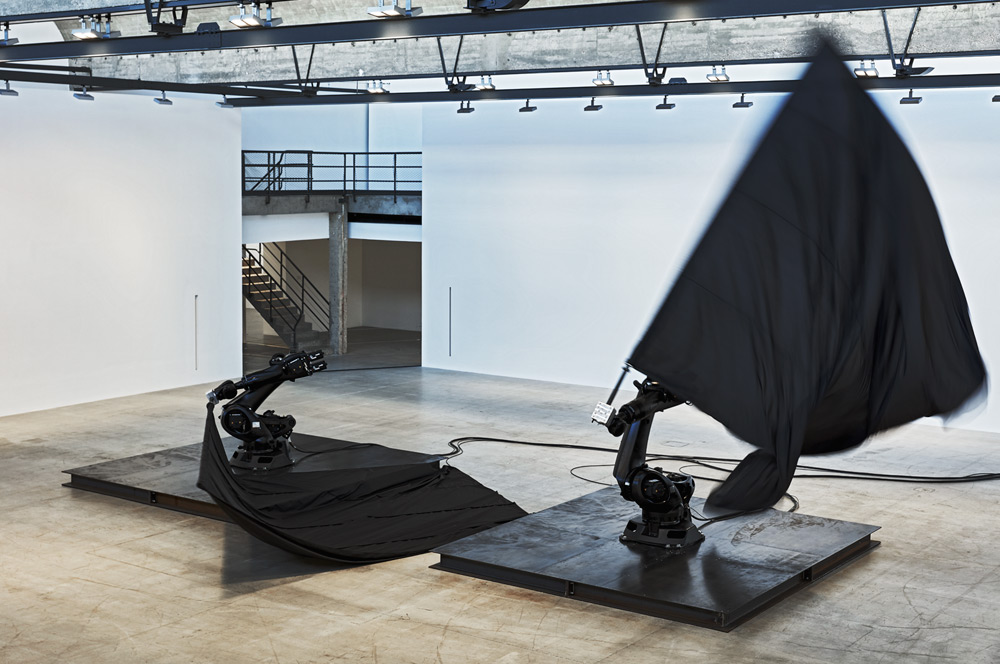
This article explores William Forsythe's 'Choreographic Objects' exhibition at Gagosian Le Bourget, where he investigates the intersection of human movement and machine capabilities. The centerpiece of the exhibition is a pair of robotic arms, supplied by the manufacturer Kuka, that manipulate large black flags through a 28-minute sequence. This work extends Forsythe's long-standing interest in alternative 'writing tools' for movement, moving beyond the traditional human dancer to incorporate mechanical forms.
The robotic installation, titled 'Black Flags', was first presented in 2014 and has been meticulously re-programmed for the Gagosian space. Forsythe's programmer, Sven Thöne, dedicated six months to redesigning each movement to accommodate the specific dimensions and airflow of the gallery, which was transformed by Jean Nouvel in 2012. This adaptation highlights the precise and technical nature of the work, emphasizing that the robots are not operating with artificial intelligence but rather executing pre-programmed choreographies. Forsythe differentiates this work from typical AI applications, noting that the robots are 'plucked from their industrial tasks' and given 'poetic tasks' before returning to their factory jobs.
Forsythe draws a parallel between his robotic choreography and historical figures like Loie Fuller, whose 'Serpentine Dance' utilized wooden poles to extend human movement. He notes the competitive edge that industrial robots possess over human joints and muscles, capable of executing 'absolutely platonic' geometries that are digitally or mechanically driven. This contrasts with the inherent complexity and deviation found in human movement. The exhibition challenges conventional notions of choreography by proposing that the audience is witnessing a 'digital entity's idea of horizontality or verticality or circularity or torque'.
The exhibition also includes a video featuring dancers Rauf Yasit (aka RubberLegz) and Riley Watts, further showcasing Forsythe's exploration of diverse forms of movement expression. The inclusion of human dancers alongside the robots emphasizes a broader dialogue about the nature of movement and its various forms of execution. The gallery setting for 'Black Flags' implies that the artwork could be acquired by institutions or collectors, a process Forsythe clarifies as the acquisition of the choreography itself, rather than a traditional sculpture. He emphasizes that his intention is to create 'choreographic work' and find new 'sites for choreographic writing'.
The visual and auditory elements of 'Black Flags' are significant. The movement of the black flags has elicited varied interpretations from viewers, ranging from 'otherworldly sea creatures' to a critique of nationalism and political forces. However, Forsythe largely sidesteps explicit political readings, stating that he chose black for its 'aesthetically, relatively neutral' qualities. The soundscape, created by the flapping of fabric and the whirring of machines, adds another layer to the experience. Forsythe describes this as an 'unintended music score', highlighting a snake-like hissing noise when a flag drags across the floor. He views the work as a 'piano duet' that aims to erase any associative narrative, leaving the interpretation open to individual viewers.
#WilliamForsythe #ChoreographicObjects #GagosianLeBourget #RoboticArt #ContemporaryDance #ArtExhibition #MachineInArt #MovementArt #DigitalChoreography #WilliamForsythe #ChoreographicObjects #GagosianLeBourget #RoboticArt #ContemporaryDance #ArtExhibition #MachineInArt #MovementArt #DigitalChoreography
0 comment in total
 No comments yet
You may also like
Ann's Performing Arts Centre is Designed for Dancing
mifune design studio conducts shower curtain dance in hotel t'point
A Work of Art

Trevor Yeung’s “Courtyard of Detachments”
Kinetic Art Table Creates and Erases Endless Zen Patterns

Every Wall is a Door
Setting the Scene

These hanging light sculptures bloom like flowers

Two designers turn a Webster dance studio into a shared workspace

The Artful Life Questionnaire: Sara Nash

I’m at the hot tub. I’m at the art installation. I’m at the combination hot tub-art installation

yoshimasa tsutsumi: anzas dance studio