1/10
Highlights from Creole Interiors in Andrew LaMar Hopkins’ Paintings
The article delves into the intricate world of Creole interiors as depicted in the paintings of Andrew LaMar Hopkins. Hopkins, who developed an early fascination with architecture, interiors, and fashion, began painting interiors at the age of ten. His exhibition, “Créolité,” at the Venus Over Manhattan gallery, showcases over 15 acrylic paintings that serve as odes to Creole interiors of the 18th and 19th centuries. Organized by Alison Gingeras, these vibrant and detailed artworks reflect Hopkins's deep knowledge of the era's design and art traditions, with each object and character revealing broader historical connections between Europe, the Gulf Coast, and the Caribbean. Hopkins, despite living in Savannah, continues to observe Creole architectural elements, such as French doors, balconies, and shutters, across the region.
Hopkins's personal life, including his experience performing in drag, is as colorful as his art. His alter ego, Désirée Joséphine Duplantier, is featured in a solo portrait within the exhibition, and each painting subtly incorporates his vast understanding of interior design history as it relates to Creole culture. The artworks are rich with stories of people and built environments influenced by class, intellect, and aesthetics. The article highlights ten specific paintings, with Hopkins providing insights into their architectural, design, and historical symbolism.
One featured painting, “Creole Jubilee,” illustrates the eclectic nature of early 19th-century Creole interiors in Louisiana. It depicts an arrangement of European and North American furniture, including French doors, a French porcelain vase, and a Philadelphian wooden chest, reflecting a period when furniture making was still nascent in the South. Another work, “Creole Tête-à-tête,” captures an 1830s New Orleans afternoon scene in the French Quarter, revealing construction traditions like the use of imported stone for cooling. “Alix de Morainville in the Louisiana Wilderness” tells the dramatic story of a French aristocrat who migrated to Louisiana, her European past symbolized by a harp in a typical Louisiana farmhouse, alongside local craft. The painting highlights design traditions like curved table legs, popular in France and later among Creoles, and a basket woven in local tradition, honoring the plantation workers who assisted de Morainville.
“The Tomb of America’s First Architect Benjamin Henry Latrobe in Creole New Orleans” pays homage to Benjamin Henry Latrobe, one of America's first formally trained architects. It depicts a shrine to Latrobe in a 19th-century cemetery, emphasizing the lack of formal architectural education in early America and the presence of gentleman architects. “Anglo Saxon Family Living in Creole New Orleans” illustrates the cultural melting pot of New Orleans after various shifts in colonial rule, showcasing a blend of French and American furniture and design elements, like Louis Philippe-era French seating and a New York marble and wooden table. This painting underscores the coexistence of diverse cultures and social observations from the era.
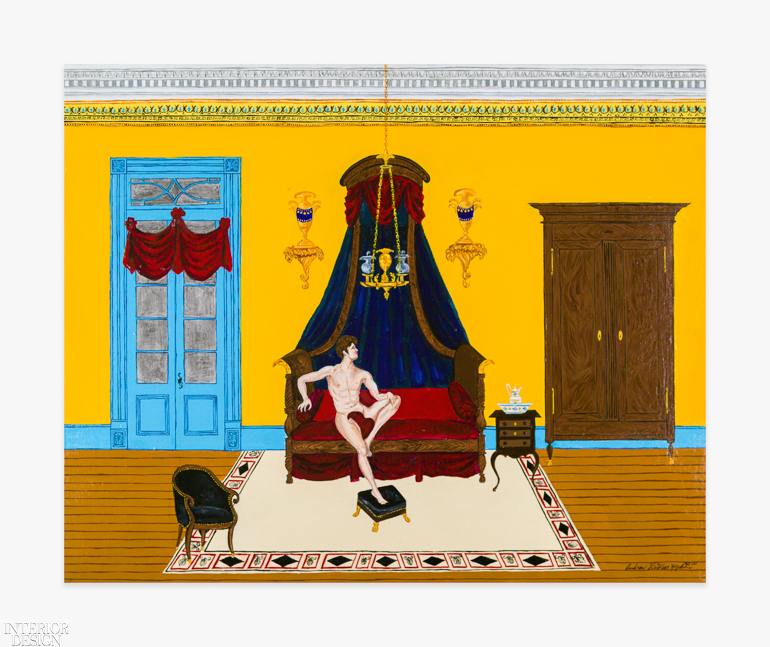
“Neptune’s Bathroom” is described as a “tasteful nude” painting, inspired by an Instagram image of Christian Dior’s bathroom and an antique shop find. It connects late 18th-century fashion rejuvenation with interior design. “The Baroness Micaela Almonester de Pontalba in the Hôtel de Pontalba” recounts the story of Micaela Almonester de Pontalba, one of Louisiana’s wealthiest women. The painting features a Japanese lacquered room in her Parisian mansion, reflecting the era's fascination with Chinoiserie style. “Tea Time in Creole New Orleans” portrays 1840s domestic architecture and racial dynamics, with a servant bringing tea to a white woman. This painting includes cherished heirlooms, a French clock, a painting by Jacques Aman, and a flamingo watercolor by John James Audubon, providing insights into social hierarchies and artistic practices of the time.
“Marie Laveau in her Saint Ann St Creole Cottage” contrasts with the opulent interiors by depicting a humble Creole cottage, emphasizing that Creole identity was often expressed through interiors rather than facades. It showcases the home of New Orleans’s Voodoo queen, Marie Laveau, highlighting the blend of Catholicism and Voodoo and social customs such as interracial cohabitation. Finally, “Gabriel Aime at Le Petit Versailles” illustrates the luxurious plantation life in Louisiana, featuring the owner's son with European art and decorative objects, including a porcelain bust and a replica of a Leonardo da Vinci painting, symbolizing the wealth and cultural exchange of the period. These paintings collectively offer a rich tapestry of Creole history, culture, and design, filtered through Hopkins’ unique artistic lens and meticulous research.
#CreoleInteriors #AndrewLaMarHopkins #ArtExhibition #NewOrleansHistory #19thCenturyDesign #LouisianaCulture #InteriorDesignHistory #VenusOverManhattan #ArchitecturalTraditions #CreoleInteriors #AndrewLaMarHopkins #ArtExhibition #NewOrleansHistory #19thCenturyDesign #LouisianaCulture #InteriorDesignHistory #VenusOverManhattan #ArchitecturalTraditions
0 comment in total
 No comments yet
You may also like
'You could go for it a little bit more in your home' – why this designer thinks we should all be more nervous about our interior design decisions
Grand libraries perfect for crime-solving duo Holmes and Watson


Out of the Ordinary

Design inspiration: Thumbed-through paperbacks make for a nice home library


Anthony Hopkins transforms his open living room with color

Color, art, and a handful of Mid-century icons gave this 1950s ranch a bright new identity
Sue Chan’s Minimalist L.A. Home Is the Antidote to Her Hectic Day Job


Design Guru Henry Holland Talks Style, Inspiration & More

I'm generally against open-concept living rooms, but Anthony Hopkins uses pops of color to elevate his into a cozy jewelbox I can get behind
A Painter’s Home That Celebrates Hawaii (Published 2022)

Step Inside a Glowing Charleston, South Carolina, Home That’s Filled With Stunning Furniture

What the Rooms from 6 Famous Paintings Would Look Like Today


Anthony Hopkins' perfect gallery wall has simultaneously bold and calming effects in his living room

Kohler Unveils New Pearlized Finish in Harry Nuriev Installation

Henry Holland is shaking up the world of fabrics - find out how…

What Houses Used to Look Like 100 Years Ago

How a Maximalist Lei Maker and Her Family Downsized to a 1,000 Square-Foot Honolulu Bungalow

Hot off the press – Harlequin x Henry Holland
The 'micro mosaic' at Holkham Hall that uses a fascinating, unusual technique pioneered by the Vatican
Talking with Jeanine Hayes and Bryan Mason about Crown Heights, Design Philosophy and Stoop Culture