This Tiny Solar House Made of Legos Is a Lesson in Sustainable Design
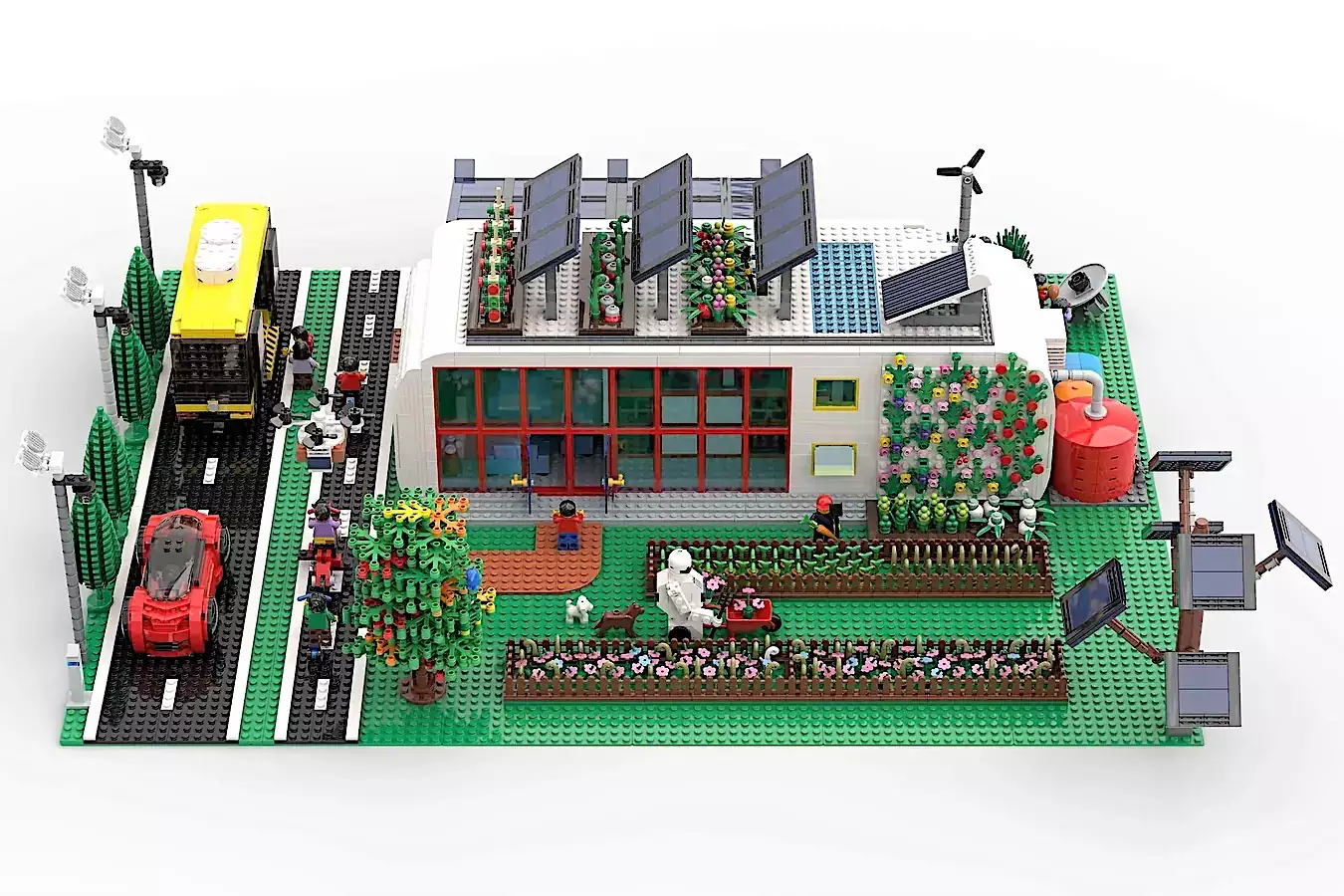
The article discusses a Lego project depicting a Sustainable Solar House, designed by Alexis Issaharoff, CEO of Antah Solar, over 11 months. Issaharoff's creation aims to educate children and adults about renewable energy and sustainability in an engaging manner. The house features numerous sustainable elements, including various solar panel technologies like tracking bifacial panels on the roof, building-integrated panels, and a solar tree. It is designed to be all-white for heat reflection and incorporates a heat pump powered by solar panels and battery storage, a rainwater collection system, and a biodigester for waste management. The design also adheres to Passive House principles, although the author raises concerns about the extensive use of glass and potential thermal bridging issues, as well as the efficiency of urban wind turbines.
A central theme of the article revolves around the perceived 'political' nature of sustainable design, especially when presented within the context of Lego. Marcel Steeman, a Dutch regional councilor, faced repeated rejections from Lego Group for his proposal to include bike lanes in Lego City, with the company stating it avoids 'political statements.' This stance is contrasted with Issaharoff's Sustainable Solar House, which is inherently 'ideological' due to its focus on independence from traditional utilities, self-sufficiency in food production, and sustainable waste management. The house’s design explicitly excludes private cars, instead featuring a properly separated bike lane and self-driving public transport, aligning with a vision of future urban mobility.
The article also touches upon the concept of 'gizmo green' or 'conspicuous conservation,' where advanced environmental technologies are prominently displayed, sometimes overshadowing fundamental design principles that reduce energy consumption. Issaharoff’s Lego house, with its array of visible sustainable features, exemplifies this. Despite its innovative and comprehensive approach to sustainability, the project faces a challenge similar to the bike lane proposal: gaining approval from Lego Group. Issaharoff needs 10,000 supporters on the Lego Ideas platform for the company to consider producing it as an official kit.
Further, the article highlights the material choice for the Lego model, acrylonitrile butadiene styrene (ABS) plastic, and the preference for natural materials in real-world sustainable building. It also notes the design's relatively low-density single-family housing model, albeit appreciating the zero setbacks to the bike lane, and raises privacy concerns regarding solar drones. The broader discussion questions whether the absence of sustainable infrastructure and practices in toy models, such as bike lanes or self-sufficient homes, is itself a political statement, implying that current conventional urban planning and consumption patterns are a default ideological stance. The article concludes by expressing support for the Lego Sustainable Solar House, acknowledging its potential to promote important environmental concepts, despite potential resistance from Lego Group due to its 'ideological' implications.
#SustainableDesign #Lego #SolarEnergy #RenewableEnergy #TinyHouse #EcoFriendly #UrbanPlanning #PassiveHouse #GreenBuilding #SustainableDesign #Lego #SolarEnergy #RenewableEnergy #TinyHouse #EcoFriendly #UrbanPlanning #PassiveHouse #GreenBuilding
0 comment in total
 No comments yet
You may also like
Solar-powered tiny home on wheels is made from reclaimed wood
6 beautiful homes that run on solar power

This Nearly Net-Zero Prefab Home Is an Environmentalist’s Dream Come True

This farmhouse style tiny home is outfitted with solar panels and rainwater collection for off-grid living
Solar-powered home embraces sustainable design in Chihuahua

The Solar-Powered Orchid Tiny House Has a Gorgeous, Light-Filled Interior
We Found a Villa-Inspired Tiny House for Under $12K at Amazon, and It's Drenched in Natural Light
An Entirely Self-Powered House (With a Secret Garden!) in Melbourne

How One Woman Pulled Anchor and Set Sail in a Solar-Powered Tiny Home
This tiny home features an open-plan layout and solar system for off-grid living!

Sustainable Homes
Ecocapsule, a Sustainable Solution for Outdoor Living


Lego-like product saving energy in construction

Ready to Set Sail? Konga’s Newest Prefab Will Float Your Boat
11 Eco-Friendly Houses That Will Inspire You to Live Greener

The Sand Castle -Bar Harbor, Maine

The Tiny Black House That Could Rewrite the Future of Construction
This Amazon Solar-Powered Tiny Home Has 2 Bedrooms, Modern Finishes, and Tons of Natural Light—Under $11K

10 Must-Watch Documentaries on Renewable Architecture: Innovations & Insights


7 Great Weekend Solar Power Projects