1/4
The First Passive, Phius-Certified Industrial Building in the U.S.
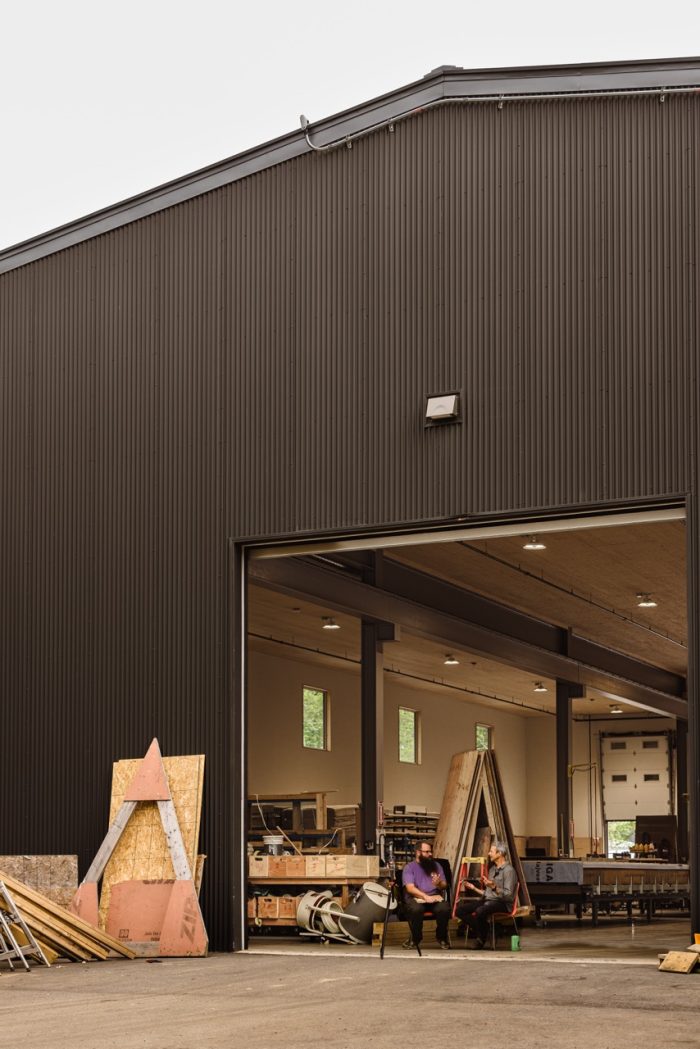
The article details how GO Logic's new panel shop, the first passive, Phius-certified industrial building in the United States, successfully passed a blower door test despite featuring four large overhead doors. Located in Belfast, Maine, the 16,000 sq. ft. facility with 23-ft walls and doors measuring 8x10, 16x14 (two), and 18x16, presented significant challenges for achieving airtightness. Large overhead doors are inherently prone to leakage due to long seams, moving joints, compromises in weatherstripping between durability and tightness, necessary clearances for movement, and susceptibility to pressure and deflection effects. To overcome these challenges, the design and construction prioritized extreme airtightness in all other building envelope components and careful selection and installation of the doors themselves.
The strategy involved several key elements. High-performance insulated doors were selected, specifically CHI commercial insulated sandwich doors, 3 inches thick with a claimed R-27 performance. While the actual R-value might be slightly lower in real-world conditions, these doors provided a strong foundation for minimizing thermal losses, complementing the R-value of the building's walls. Crucially, upgraded weatherstripping, meticulous adjustment, and precise sealing details were implemented. This included vinyl and thick brush weatherstrips, with careful alignment of tracks during installation to ensure the door panels compressed tightly against the seals when closed. This craftsmanship in field alignment was a significant factor in reducing leakage.
Furthermore, the rest of the building's envelope was made exceptionally tight. The walls, constructed with 2x8 engineered studs and standing 23 ft tall, were insulated with dense-pack cellulose to achieve an R-value comparable to or better than the doors. The ceiling featured a continuous Class II vapor barrier membrane that also functioned as the air barrier, with all seams meticulously taped. Continuity of the air barrier was rigorously maintained at all critical junctions, such as where walls meet the ceiling, at slab edges, and around door frames, to minimize leakage in these areas. This comprehensive approach ensured that any leakage through the doors did not disproportionately impact the overall airtightness.
During blower door testing, the building exhibited better performance under pressurization (positive pressure) than under depressurization. This phenomenon is attributed to the doors being pressed more tightly against their seals and stops under positive pressure, thereby reducing leakage. In contrast, negative pressure can exacerbate leakage by pulling on any existing gaps. The shop's operational behavior also contributed to its success; the doors are typically closed, leading to mostly 'standing leakage' rather than dynamic losses from frequent opening. Even when opened, the transient losses are manageable due to the building's thermal mass, internal heat, and radiant heating, coupled with infrequent and short opening durations.
The blower door results were well within acceptable limits for Phius certification, achieving 0.041 CFM/sq. ft. envelope area, significantly better than the 0.06 Phius Standard. While the doors were identified as the largest contributors to leakage, their impact was not enough to exceed the overall leakage requirements. The article concludes with key recommendations for achieving high-performance envelopes in buildings with large overhead doors, emphasizing the importance of treating these doors as serious envelope components, specifying high-quality insulated doors, upgrading weatherstripping with a focus on adjustability, ensuring extreme tightness in all other envelope assemblies, carefully detailing door-frame transitions, testing in both pressurization and depressurization modes, and accounting for real-use behavior mitigation.
#BlowerDoorTest #PassiveHouse #PhiusCertification #EnergyEfficiency #IndustrialBuilding #Airtightness #BuildingEnvelope #InsulatedDoors #Weatherstripping #BlowerDoorTest #PassiveHouse #PhiusCertification #EnergyEfficiency #IndustrialBuilding #Airtightness #BuildingEnvelope #InsulatedDoors #Weatherstripping
 No comments yet
MESH Architectures and The Brooklyn Home Company Complete New York City’s First Mass Timber Condominium

In conversation with Esther Van Eeden on Passive House design


Property of the week: a light-filled live/work loft in San Francisco
Built to Last: Michiana ICF Supply


How They Pulled It Off: A Record-Breaking Passive House Behind a Refreshed Bungalow


Prefabricated wall panel system facilitates Passive House certification

The world’s first sustainable fully-integrated, plug-and-play, wall-mounted workstation and folding desk!