1/14
A comparative life cycle assessment of fiber-reinforced polymers as a sustainable reinforcement option in concrete beams
The growing environmental awareness and the imperative for sustainable construction practices have led researchers and practitioners to seek innovative alternatives to reduce greenhouse gas emissions and energy consumption associated with traditional structural work. One promising alternative is the use of Fiber-Reinforced Polymer (FRP) bars as reinforcement in concrete members. FRP bars offer several advantages over steel, including high tensile strength, lightweight properties, and superior corrosion resistance. These characteristics also present a potential solution for using seawater instead of fresh water in concrete mixtures, which is particularly beneficial in regions facing harsh climates and water scarcity, such as the Arabian Peninsula.
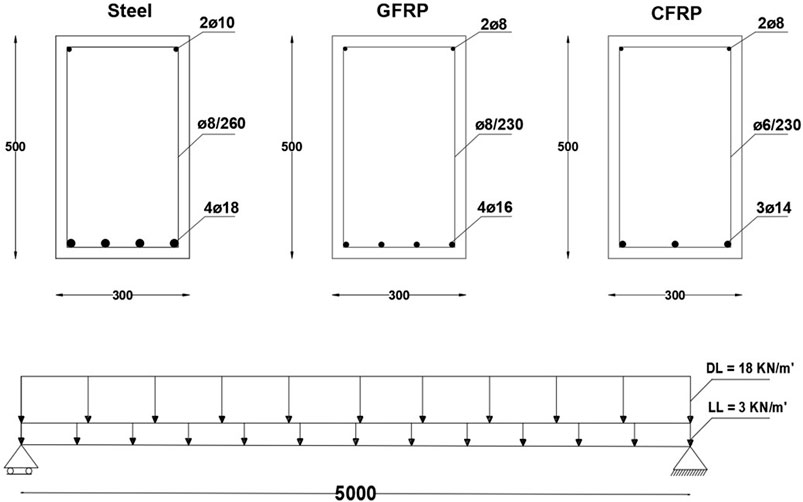
This study conducts a comparative life cycle assessment (LCA) to evaluate the environmental impacts of various FRP bar types—namely glass fiber-reinforced polymer (GFRP) bars, carbon fiber-reinforced polymer (CFRP) bars, and steel-glass fiber-reinforced polymer (SGFRP) bars—against traditional steel bars. The assessment also extends to compare steel-reinforced concrete beams made with desalinated fresh water against GFRP/CFRP reinforced beams constructed with seawater, aiming to reduce freshwater consumption and environmental impact. The methodology adheres to the ISO 14040 framework and utilizes Gabi LCA software for analysis, defining functional units as a 1-meter long bar with a 12 mm diameter for bar comparison and a 5x0.5x0.3-meter beam for beam comparison, each designed to carry the same load. The system boundaries encompass raw material extraction and manufacturing processes for all components, excluding transportation under the assumption of similar origin for comparative purposes. The ReCiPe methodology is employed for life cycle impact assessment across 14 environmental impact categories, including climate change, ozone depletion, human toxicity, water depletion, and fossil depletion.
Results from the cradle-to-gate LCA indicate that GFRP bars generally perform better environmentally than steel bars in 10 out of 14 categories, showing significant reductions in climate change, fossil depletion, human toxicity, and water depletion. In contrast, CFRP bars exhibit worse environmental performance than steel bars in 10 categories, largely due to the high energy demand for carbon fiber production. SGFRP bars demonstrate environmental impacts positioned between those of steel and GFRP, offering a balance of enhanced durability from FRP and ductility from steel. For reinforced concrete beams, the GFRP beam shows better environmental performance than the steel beam in 9 out of 14 categories, while the CFRP beam performs better in 8 categories. This improved performance is attributed to the reduced reinforcement ratio possible with the high tensile strength of GFRP and CFRP bars. The utilization of seawater in GFRP/CFRP beams significantly reduces the carbon footprint associated with water use, achieving a 99.7% reduction in CO2 emissions from desalinated water production.
Cement and steel are identified as the primary contributors to environmental impacts in steel-reinforced beams, with cement alone accounting for 68.5% of the climate change impact. Similarly, in FRP-reinforced beams, cement remains a dominant environmental factor in most categories, followed by the FRP bars themselves. While CFRP bars exhibit higher environmental impacts in certain categories, their application is justified in projects prioritizing weight reduction and durability, such as bridge decks and marine structures, where their lightweight nature and corrosion resistance can lead to longer service life and reduced maintenance costs. The study emphasizes that material selection should involve a comprehensive analysis considering cost, performance, durability, and environmental effects. Future advancements in manufacturing processes and mass production of FRP materials are expected to further reduce their environmental footprint, positioning them as environmentally friendly alternatives to traditional steel reinforcement bars in concrete construction.
#LifeCycleAssessment #FiberReinforcedPolymer #GFRP #CFRP #SustainableConstruction #ConcreteBeams #SeawaterConcrete #EnvironmentalImpacts #BuildingMaterials #LifeCycleAssessment #FiberReinforcedPolymer #GFRP #CFRP #SustainableConstruction #ConcreteBeams #SeawaterConcrete #EnvironmentalImpacts #BuildingMaterials
 No comments yet
10 Innovative Materials Poised to Make Home Building More Sustainable

Is There a Future for Fabric-Formed Concrete Structures?

7 Best Roofing Materials For Durability & Longevity (2025 Review)


Fiber-Cement Siding: An Attractive Alternative to Wood

7 Concrete Alternatives


Sustainable Construction in Concrete - A Greener Future

Sustainable Concrete Panel Construction | Spotlight on Nexii and Vero Building Systems