Durable Epoxy Coatings Provide Endless Design Possibilities
Fourteen years ago, Jesse Barber established his decorative concrete business, initially focusing on overlays, countertops, micro-toppings, and color staining. After four years, he started integrating epoxy floor systems into his services to provide more durable decorative finishes for both residential and commercial clients. Barber observed that traditional staining, coloring, and sealing applications were sufficient for low-traffic areas but quickly deteriorated in commercial settings, leading him to seek more robust solutions. His research led him to Arizona Polymer Flooring, a supplier of epoxy floor systems, prompting him to adopt their epoxy and polymer products. This transition allowed him to deliver higher-quality and more durable projects, contributing to his business growth over the past decade. Currently, 75 percent of his projects are residential, with the remaining 25 percent commercial. His operations are supported by one field employee and his wife, Debbie, who manages all administrative tasks.
A significant turning point for Barber was realizing the superior durability of clear polyurethane finishes when used with epoxy systems, compared to the sealers he previously applied to stained floors. He emphasizes that while creating visually appealing floors is important, their long-term appeal depends on their ability to withstand wear and tear. Polyurethane finishes are more scratch-resistant, with most superficial abrasions being easily repairable through light sanding before a new topcoat application. Barber highlights two recent commercial restaurant projects to illustrate the design versatility and quality achievable with epoxy systems.
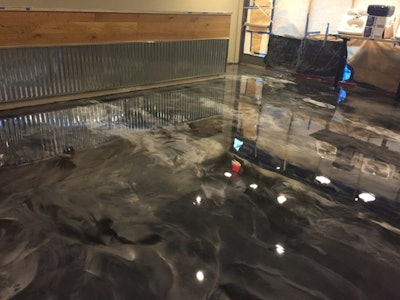
For the 2,400 sq.-ft. Zombie Dogs’ restaurant in Dayton, OH, Barber created a metallic industrial look by hand-troweling a blend of three colored epoxies (Epoxy 400): 50 percent mercury, 25 percent gunmetal, and 25 percent pearl. The project involved a floor with both new and old concrete sections, which Barber lightly ground to prepare for the base gunmetal epoxy coat, serving as a primer. The next day, he lightly sanded this base coat before hand-troweling the mercury and pearl epoxies to achieve a variegated appearance. He explains that pouring beads of different epoxies and troweling them together creates the desired color and pattern variations, with the thicker viscosity of the epoxies contributing to the design's depth. On the third day, a light sanding was followed by a clear polyurethane 325 topcoat. In the kitchen area, the same color scheme was used, but a more durable and sanitary topcoat, Epoxy 600 with 60-grit aluminum oxide, was applied for easier maintenance.
At the Mellow Mushroom restaurant in Louisville, Barber designed a multi-area abstract and blended layout using four Epoxy 400 colors: mercury, coffee, pearl and blue mixture, and gunmetal and blue mixture across a 3,000 sq.-ft. new concrete floor. He began by lightly grinding the surface for optimal adhesion. A Mongoose decorative concrete saw was used to score the pattern for the design. Barber then taped off sections and applied the outer colors first, followed by the pearl and blue middle section on the subsequent day. He notes that for patterned projects, logistical planning is crucial, particularly ensuring sections are completed before the epoxy sets. This often involves creating defined seams at room thresholds to manage large projects over several days. After all color applications, Barber grouted the score lines and applied a Poly 325 topcoat.
Barber’s growing epoxy flooring business mirrors a broader industry trend, particularly in the Louisville area. He attributes this to the superior maintenance and cleanability of epoxies with polyurethane topcoats, which are more durable and resistant to spills and stains. He observes that in food service environments, spills can be quickly addressed with a dry mop, and routine cleaning can be done with a wet mop, ensuring the surface remains presentable. While other concrete finishing options like polishing have their merits, Barber finds epoxies offer a more stain-resistant surface, especially in demanding settings like restaurants. He differentiates his services by offering artistic, custom looks, which, despite being slightly more expensive, effectively market his capabilities. He believes customers are increasingly seeking unique, modern floor designs. Daniel Owen, owner of Arizona Polymer Flooring, confirms the rising interest in metallic epoxies over the past five years, emphasizing the necessity of a clear polyurethane topcoat to preserve the high-end aesthetic and ensure longevity. Without it, the floor would quickly dull. Owen states that the aesthetics, ease of cleaning, and durability of an epoxy floor system with a clear urethane coat significantly enhance its appearance and lifespan, with metallic epoxy systems particularly helping contractors deliver unique, modern looks to their clients.
#EpoxyFlooring #DecorativeConcrete #FloorSystems #CommercialDesign #ResidentialDesign #PolyurethaneFinish #ConcreteDesigns #CustomFlooring #InteriorDesign #EpoxyFlooring #DecorativeConcrete #FloorSystems #CommercialDesign #ResidentialDesign #PolyurethaneFinish #ConcreteDesigns #CustomFlooring #InteriorDesign
0 comment in total
 No comments yet
You may also like
The Best Epoxy for Countertops in Kitchens and Bathrooms

6 inspiring sensory surface trends to expect in 2023
This injection molding technology creates super lightweight yet durable materials

Wood Coating Market Sees Strong Growth Driven by Demand for Sustainable and Durable Finishes
Beautiful Gaco Roof Coating
The 10 Best Concrete Paints That Seal the Deal

Anti-fingerprint surfaces — a trend that’s here to stay

Amorim Cork Composites spotlights the versatility of cork
2025’s Best Epoxy for Countertops in Kitchens and Bathrooms
10 reasons epoxy floors will rule 2016
Armourcoat creates durable clay wall covering as "ecological alternative to paint"
Can you paint a tile floor? Expert advice for a durable, long lasting finish

Transforming Ordinary to Art with Epoxy Flooring Systems
Ideal Work showcases innovative finishes, coatings and flooring on Dezeen Showroom
A new vision for cork, that is attractive and utilizes contemporary digital designs
More Practical Than Plaster and Cement: This Material Is on Our Reno Radar
A next-generation material for sustainable padding applications

Decorator’s Caulk

The Best Concrete Paints for Masonry Surfaces, Tested
Epoxy Flooring-Your Guide for 2020