1/7
From mix to fix: The benefits of single-component grout
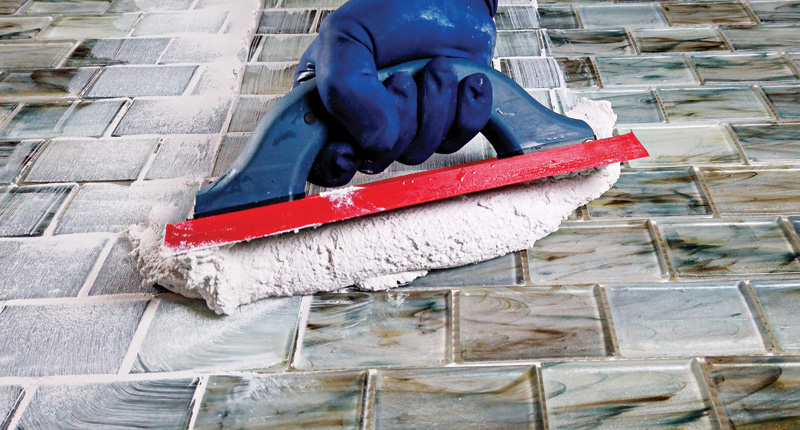
Single-component grouts have seen significant advancements, with dedicated ANSI standard designations like A118.19 for Organic Premixed Grouts and A108.22 for their installation. These standards, developed after extensive testing by the Materials & Methods Standards Association (MMSA) and accepted by the American National Standards Institute (ANSI), ensure the quality and reliability of these products. The standards are applicable for various tile types, including ceramic, glass, and gauged porcelain. Unlike traditional cement and epoxy grouts, the development of ANSI A118.19 required new test methods, focusing on indentation resistance rather than compressive strength, given the smaller grout joint sizes in modern applications.
Organic premixed grout, as defined by ANSI A118.19, is a factory-prepared, ready-to-use mixture of water, polymers, aggregates, pigments, and other materials, designed to be water-resistant, stain-resistant, and uniformly colored. A key advantage is its premixed nature, which eliminates the need for on-site additions of water or resins, ensuring consistent color and long-term durability. Polymers are crucial in these grouts, forming strong adhesive bonds that enhance crack and abrasion resistance, as well as water and stain resistance. The absence of portland cement in their formulation also prevents efflorescence. Single-component grouts are inherently water and stain-resistant, not requiring sealers due to an impenetrable film created by the adhesive polymer. This non-porous nature makes them easier to clean and resistant to mold and bacterial growth, often exceeding the stain resistance of epoxy grouts.
While single-component grouts offer numerous benefits, including improved indoor air quality due to lower VOCs and being a safer option for installers sensitive to epoxy, they are not a one-size-fits-all solution. Factors such as material costs, installation expenses, maintenance requirements, and resistance to heat and chemicals must be considered. The article emphasizes that the grout's price should not be the sole determinant, advocating for an informed decision based on a project's budget, performance needs, and owner's vision. Comprehensive resources like ANSI A108, A118, and A136 standards, and the TCNA Handbook for Ceramic, Glass, and Stone Tile Installation, are recommended for understanding tile setting methods and materials.
The article compares four main types of tile grouts: ANSI A118.6 Standard Cement Grouts, A118.7 High Performance Cement Grouts, A118.19 Organic Premixed Grouts, and A118.3 Chemical Resistant Epoxy Grouts. Standard cement grouts are the least expensive but are prone to efflorescence, have lower strength and stain resistance, and require sealers. High-performance cement grouts offer improved stain resistance and color uniformity, with rapid setting properties. Organic premixed grouts are ready-to-use, do not effloresce, are crack-resistant (but not for movement joints), and require no sealer. However, they are not suitable for continuously submerged installations or high-temperature environments. Epoxy grouts provide the highest heat, abrasion, and chemical resistance but come with higher material and installation costs, specific mixing requirements, and potential allergic reactions for installers.
Polymer technology has significantly advanced grout performance, providing stronger and more durable installations resilient to thermal cycling, moisture exposure, and various loads. Polymers create an improved microstructure, enhancing bond strength, adhesion, impact resistance, and moisture/chemical resistance. In cement grouts, polymers fill micropores and microcracks, strengthening the matrix. In organic premixed grouts, polymers act as the sole binder, eliminating the porosity and mixing inconsistencies associated with cement-based products. The use of a rounded organic filler instead of angular sand improves the grout’s rheologic properties, making installation easier and ensuring complete filling of narrow joints. The consistent factory-proportioned components of single-component grouts guarantee color uniformity, and their impervious nature after curing simplifies cleaning and eliminates the need for sealers. The evolution of grouting solutions, from simple sand and cement to advanced polymer-based formulas, reflects industry needs for better consistency, stain resistance, and ease of use, with single-component grouts representing a contemporary, efficient choice for diverse projects.
#SingleComponentGrout #PremixedGrout #ANSICertification #GroutTechnology #TileInstallation #ConstructionMaterials #PolymerTechnology #BuildingStandards #MaterialScience #SingleComponentGrout #PremixedGrout #ANSICertification #GroutTechnology #TileInstallation #ConstructionMaterials #PolymerTechnology #BuildingStandards #MaterialScience
0 comment in total
 No comments yet
You may also like

Getting the Grout Right
What Is Microcementing? A Complete Guide to Designers' Favorite Ultra-Durable Material

I Just Discovered This ‘Grout Effect’ Sealant, and It's Changing the Game |
The Statement Shower: A New Approach to Cement Tile

Tile Grout

How to change grout color - the easiest little touch to make your home feel fresh again
Transforming Ordinary to Art with Epoxy Flooring Systems

Why Joanna Gaines says grout color deserves more attention

Sanded vs. unsanded grout – the differences, pros, cons, and how to choose the best fit for your DIY project
I Tried “Chunky Grout” in My Bathroom Makeover — Here’s How It’s Holding Up One Year Later

Cement
5 Costly Mistakes People Always Make When Buying Tiles — And How to Avoid Them
How to repair chipped or broken tile and replace grout

Can I use mosaic tiles on the floor? Expert advice you need to know before making your decision
The best tile and grout color combinations – designer-approved pairings for more creative tiling
IN DEPTH: Caulking & Adhesives

More Practical Than Plaster and Cement: This Material Is on Our Reno Radar
This is how you can easily replicate the colourful grouting trend - and for less than £4!

Masonry reinvented: One brick at a time

How to Choose the Perfect Grout Color for Your Next Project, According to a Designer