1/5
Tomás Saraceno’s Cloud Cities Barcelona: utopian ecology, education, and epic city views
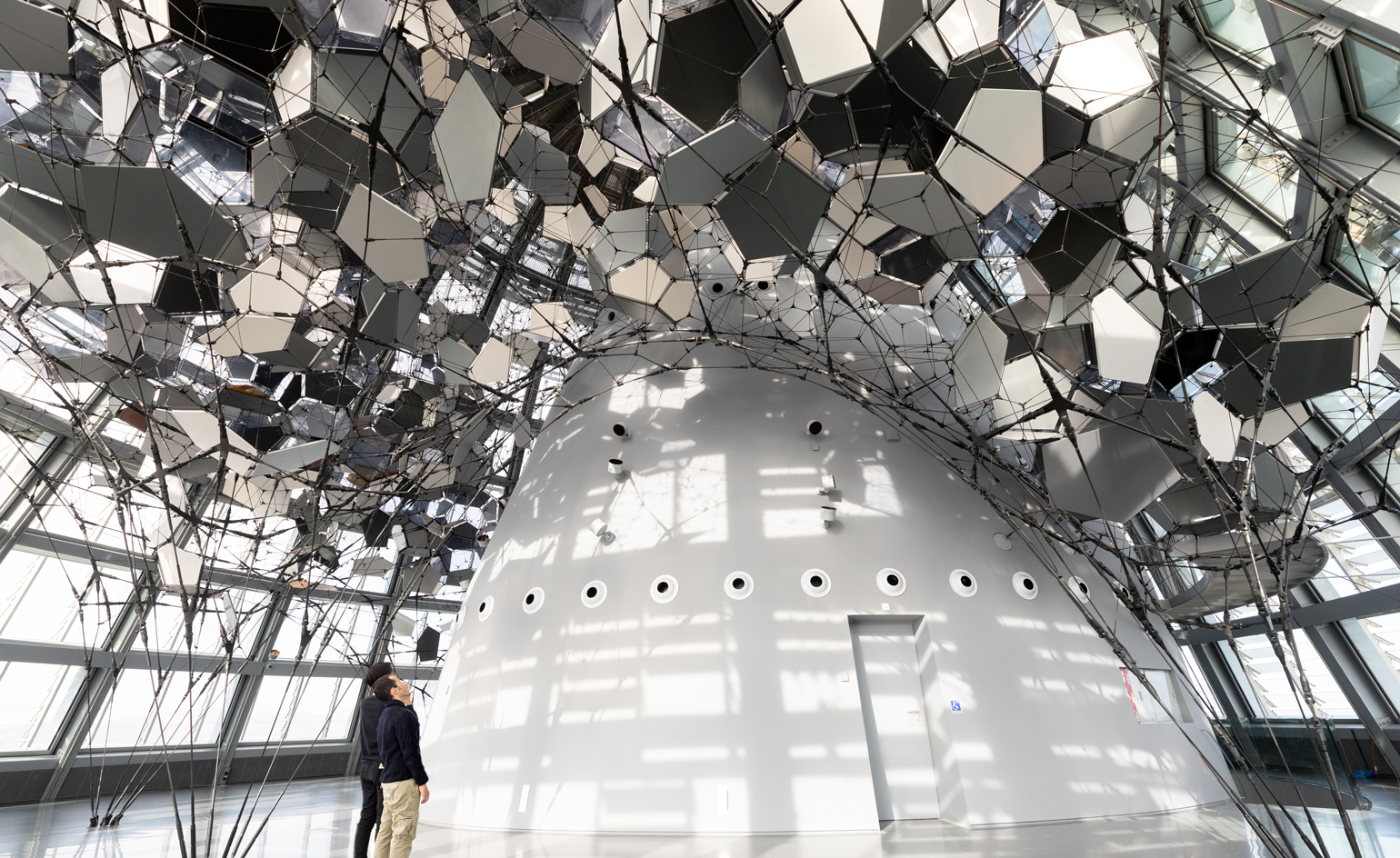
The article explores Tomás Saraceno's permanent installation, 'Cloud Cities Barcelona,' located within the Mirador Torre Glòries in Barcelona. This artwork transforms three office floors at the summit of the tower into an interactive civic space, blending elements of architecture, ecology, sculpture, and invention. Saraceno, an Argentine-born, Berlin-based artist, is known for his unconventional approach, as evidenced by his past collaborations with spiders for an installation at Palais de Tokyo and a weblike structure in Florence's Palazzo Strozzi. 'Cloud Cities Barcelona' is the latest and most complex iteration of his 'Cloud Cities' series, which began in 2002.
The installation is inspired by post-war radical thinkers such as Buckminster Fuller, Yona Friedman, and Archigram. Saraceno's work seeks to foster new relationships among people, nature, and architecture within these reflexive environments. The 'Cloud Cities Barcelona' structure is an intricate network of slender cables and geometric panels, forming a tunnel-like passage that visitors can navigate. This interactive experience is designed to be physically demanding and disorienting, challenging visitors to engage with the artwork in a unique way. The journey through the installation is described as sometimes claustrophobic, requiring visitors to clamber through tight spaces, evoking a sense of being enveloped within the structure.
Scattered throughout the installation are 113 pods, some containing cushions and books on various topics like form, politics, and nature. Saraceno envisions these pods as 'reading spaces,' drawing a parallel to the public libraries he frequented in Argentina during his university years. He sees the installation as more than just a tourist attraction; it is a provocation for a new type of space for contemplation and learning. Saraceno expresses a desire for the permanent installation to eventually serve as a public square, with potential future access mechanisms such as showing a book for free entry, emphasizing its role as a necessary urban space.
The environmental implications of Saraceno’s work are also highlighted. With natural clouds diminishing due to climate change, he proposes that similar networked webs could be constructed externally on existing glass buildings. These external structures could provide internal shade while simultaneously creating new explorable civic spaces. The engineering behind 'Cloud Cities Barcelona' is noteworthy, with each of the 256 cable-connecting joints being uniquely generated by a 3D design software. This meticulous design ensures the structure's robustness despite its seemingly ephemeral and light appearance. The article contrasts Saraceno's intention for a thoughtful, engaging experience with the common, superficial interaction of art for selfies, emphasizing that 'Cloud Cities Barcelona' demands physical engagement and encourages visitors to pause, reflect, and perhaps engage in unexpected conversations or simply observe the city from within this man-made cloud.
#TomásSaraceno #CloudCitiesBarcelona #InteractiveArt #PublicArtInstallation #BarcelonaArchitecture #UtopianEcology #CivicSpace #ArtAndArchitecture #TomásSaraceno #CloudCitiesBarcelona #InteractiveArt #PublicArtInstallation #BarcelonaArchitecture #UtopianEcology #CivicSpace #ArtAndArchitecture
0 opmerkingen in totaal
 Nog geen opmerkingen
Dit vindt u mogelijk ook leuk
Are fleeting architectural fads marring SLO?

The Legacy of Sea Ranch, a Utopian Community in Northern California

mome.estudio's zen housing units repurpose residential building on madrid's outskirts
Ten architecture projects by students at the City College of New York
LABAU (Bioclimatic Architecture and Urban Agriculture Laboratory)
He's an architect passionate about sailing, leadership and building communities

Masdar City’s Phase 2 Master Plan Moves Forward


Championing Chief Architects
The Next Frontier in Urban Design Will Send You Undeground
Round About Baths / Leopold Banchini Architects

Bayview Parks Open Space Plan
Tourism in Sitges – A walk through Vinyet and Terramar