1/3
Esther Mahlangu: how the famous South African artist keeps her Ndebele culture alive
Esther Mahlangu, an 89-year-old South African visual artist, is celebrated for her large-scale murals featuring the traditional patterns and colors of the Ndebele people. Her retrospective exhibition, initially shown in Cape Town, has now opened in Johannesburg, highlighting her significant contribution to contemporary African arts. Mahlangu, who did not receive formal schooling, learned the art of Ndebele ornamentation by observing elders, such as her grandmothers, practice wall paintings in the homestead. Through consistent practice, she mastered this intricate art form.
Mahlangu's work gained international attention in 1989 after being discovered at the Botshabelo open-air museum in Middelburg. French researchers invited her to participate in a project to paint the halls of the Centre Pompidou in Paris, marking her first trip abroad and the beginning of a global career that took her to Japan, Portugal, the US, New Zealand, Italy, and Spain. Today, she is recognized as the global ambassador for Southern Ndebele material culture, with her artworks serving as a vital expression of Ndebele identity, ensuring its preservation and continuity across various geographical and temporal contexts.
The Ndebele people have historically utilized architecture, mural painting, and beadwork as primary means to express and maintain their distinct identity. This material culture became especially crucial during periods of dispersion, such as the wars against colonial boers in the 1800s and the onset of apartheid in the 1940s. Despite losing land and facing displacement, Ndebeles continued to paint their homes and maintain architectural designs as a form of cultural resistance and a defense against the erosion of their identity. This practice ensured the evolution of their material culture, symbolizing continuity and resilience.
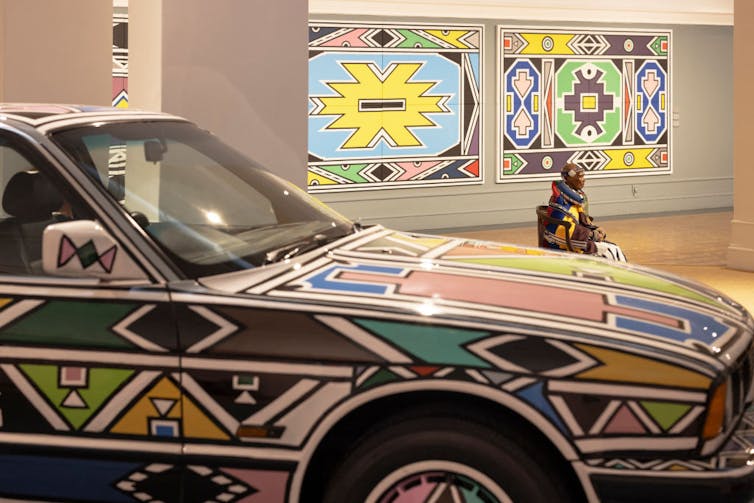
Wall paintings, predominantly created by women, expressed Ndebele values, marriage traditions, and the significant role of women in the domestic sphere. These paintings made women socially visible and positioned them as guardians of Ndebele identity for future generations, particularly in the absence of men who often left for migrant work. Initially, natural materials like clay, cow dung, and soil were used to create red, black, and white paints. Modern Ndebele artists, including Mahlangu, now use acrylic paints mixed with a small amount of clay, incorporating complex geometric patterns alongside contemporary objects like light bulbs and airplanes.
Beyond wall paintings, Mahlangu also uses traditional Ndebele dress to display her cultural identity. She consistently wears beaded blankets, a common attire for Ndebele women, with the beads reflecting her age and marital status. Her bracelets and hairstyles also convey similar cultural information. Certain beaded adornments are reserved for special occasions, such as welcoming initiates back from traditional schools. Different types and colors of beaded adornments signify age-sets and various stages of growth from childhood to adulthood. This tradition of beadwork and painting is passed down through generations, serving as a conduit for the preservation and transmission of Ndebele cultural identity, with figures like Mahlangu making this heritage more visible in the modern era.
Mahlangu exemplifies innovation within tradition by transitioning from natural pigments to brighter acrylic paints while remaining true to Ndebele aesthetics. Her willingness to experiment is evident in her use of colors from the democratic-era South African flag in her work, aligning with the country's nation-building project. Despite using modern materials, she retains the traditional practice of mixing paints with clay. Her engagement with modern technology and the commercial art world includes a notable commission from BMW in 1991, where she painted one of their art cars using chicken feathers. In addition to prestigious exhibitions and public art commissions, Mahlangu diversifies her work by selling cultural products like coffee cups, decor pots, and beaded blankets. She is also dedicated to educating the next generation, teaching young boys and girls wall painting, beadwork, and traditional Ndebele dances at her homestead in Mpumalanga, thereby ensuring the continuity of Ndebele culture.
#EstherMahlangu #NdebeleCulture #SouthAfricanArt #TraditionalArt #MuralPainting #Beadwork #CulturalPreservation #AfricanIdentity #ContemporaryArt #IndigenousArt #EstherMahlangu #NdebeleCulture #SouthAfricanArt #TraditionalArt #MuralPainting #Beadwork #CulturalPreservation #AfricanIdentity #ContemporaryArt #IndigenousArt
 No comments yet
Meet Linnea Pergola

Artist Spotlight: Miimi and Jiinda

Meet the rising stars of African design championing heritage and craft
Barbara Cook

The Beautiful Mind of Solange

Meet Nichole Blackburn Manthe: Fine Artist and Muralist
How South Africa inspired designer Suzanne Miller Farrell's living room and her new fabric collection