1/2
Coupling URM walls with RC walls ‒ EESD
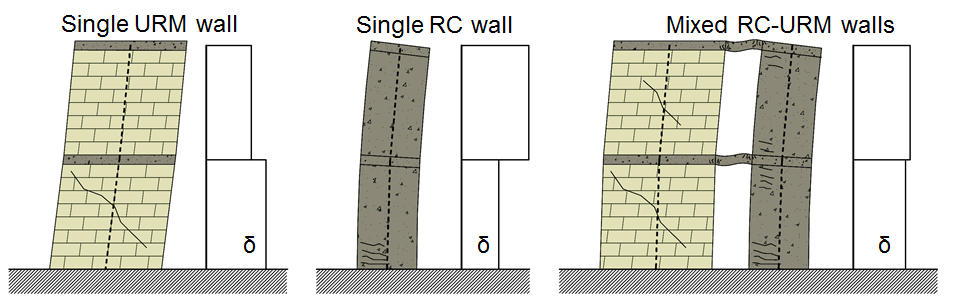
In regions characterized by low to moderate seismic activity, such as Switzerland, structures that combine reinforced concrete (RC) and unreinforced masonry (URM) walls are prevalent. Despite their commonality, a comprehensive understanding of their seismic performance remains elusive. The structural integrity of these mixed RC-URM buildings is significantly influenced by both types of walls, given that their stiffness and strength are often comparable.
This research project aims to deepen the understanding of the seismic behavior of buildings incorporating both RC and URM walls. A key objective is to formulate performance-based seismic design guidelines specifically tailored for these structures. This includes establishing clear definitions for various performance limit states that these buildings should meet under seismic loading. Additionally, the project focuses on the out-of-plane response of URM walls within these composite structures, investigating how boundary conditions provided by slabs and adjacent walls affect their behavior.
The research methodology involves two extensive large-scale testing programs. The first program entails quasi-static cyclic tests conducted on systems comprising one RC wall and one URM wall. These tests are designed to simulate the cyclic loading experienced during an earthquake and to observe the structural response. The second program, known as the CoMa-WallS Project, involves shake table tests on a four-story building constructed at half-scale, integrating both RC and URM walls. This larger-scale test allows for a more realistic assessment of the overall structural performance under dynamic seismic excitation.
The project has already yielded significant insights, including the publication of an article on quasi-static cyclic tests of two mixed reinforced concrete–unreinforced masonry wall structures. A dataset associated with this research is also publicly available. The project has received funding from several sources, including the Federal Office for the Environment, the FP7 program for access to the TREES laboratory of EUCENTRE under a specific grant agreement, and in-kind contributions from Morandi Frères SA.
Ultimately, the findings from this research are intended to improve the seismic resilience of mixed RC-URM structures. By providing a better understanding of their behavior and developing robust design guidelines, the project contributes to enhancing the safety and performance of these common building types in earthquake-prone areas, ensuring they can withstand seismic events effectively and minimize damage and risk to occupants.
#SeismicBehavior #ReinforcedConcrete #UnreinforcedMasonry #StructuralEngineering #EarthquakeResilience #PerformanceBasedDesign #ShakeTableTests #BuildingStructures #SeismicBehavior #ReinforcedConcrete #UnreinforcedMasonry #StructuralEngineering #EarthquakeResilience #PerformanceBasedDesign #ShakeTableTests #BuildingStructures
0 comment in total
 No comments yet
You may also like
Mechanically stabilized earth walls
Saint-Gobain Weber EWI Render Brick colour created to match aesthetics for Rotherham regeneration project
Build a "Perfect Wall" on a Budget for Affordable High-Performance
A Secure Solution For Framing Floating Walls In Shifting Soil

M|R Walls by Mario Romano for CDUK
A Quick-Drying, Mold-Resistant Wall Assembly
Designing brick veneer for loadbearing exterior walls
Insulate Your Basement, Part 3
The Versatility of Drywall in Architecture: Pros and Cons