1/8
Restored Roof Lanterns - Chambord Castle
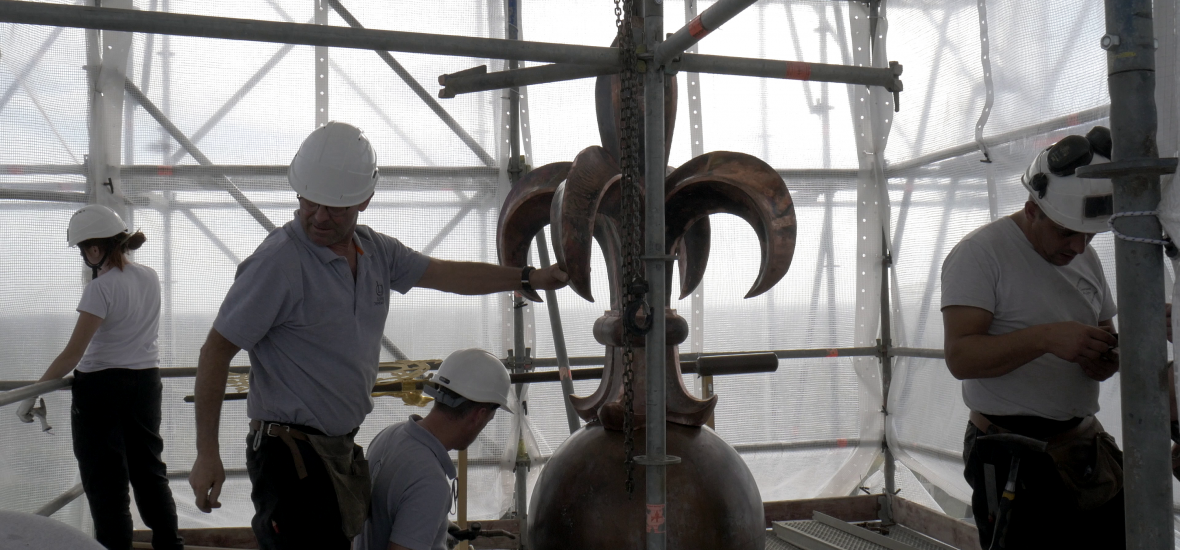
The Château de Chambord has completed a comprehensive restoration of its six roof lanterns, a project launched in 2021 and finalized in June 2023. Supervised by François Chatillon, Chief Architect of Historic Monuments, this was the first significant restoration work on the lanterns in over 50 years, beyond minor repairs. The project addressed critical structural and waterproofing issues, and simultaneously re-established the decorative unity of the château's roofing.
Upon initial assessment, three of the six roof lanterns exhibited structural support problems and numerous waterproofing defects. The restoration involved extensive repairs to the frameworks, including rectifying incorrectly assembled parts, straightening and reinforcing central components and braces essential for structural integrity. Damaged wooden elements were replaced, and the lead and slate roofing was re-waterproofed to prevent future damage. The urgent need for these repairs was underscored by the risk of framework undermining due to water seepage and stability concerns.
A significant aspect of the restoration was the re-establishment of the historical decorative unity of the roof lanterns. Previous analyses of Chambord's roofing had revealed various decorative styles over time, often featuring ornate finials and ornamentation at the base of each dome, designed to complement the intricate stone decorations of the Lantern Tower and corners. However, the existing aesthetic was relatively plain, particularly after the reconstruction of the Henri V corner's roofing in 1950, which adopted a minimalist style following a fire in 1945. Subsequent restorations of the François I and Caroline of Berry lanterns also removed earlier ornamentation, leading to a divergence from the château’s overall decorative scheme.
To correct this, the National Heritage and Architecture Commission, based on a Ministry of Culture report, approved the re-creation of historical lead decorations, including fleurs de lys, salamanders, and candlesticks. Additionally, the weathervanes were gilded to match their last known state from the second half of the 19th century, thereby harmonizing the roofline with the château’s profusely intricate stonework. This decision aimed to restore the visual richness and historical accuracy of the monument.
The project involved a collaboration of specialized craftspeople and companies from the Centre-Val de Loire region. Guèble, a member of the Villemain Group, was responsible for the scaffolding. Battais-Centre and Ateliers Perrault undertook the framework restoration. Loire Ornements, with assistance from Couvertures de Loire, executed the intricate lead ornamentation. Atelier Mariotti, a certified “Living Heritage Company,” performed the gilding of the weathervanes, while Atelier Tollis managed the coloration of the leaden domes. Groupe UTB was responsible for the roofing work, installing slate on the Chapel Tower and Robert of Parma Tower, and lead on the Dieudonné, François I, Henri V, and Caroline of Berry Towers.
The restoration was a substantial undertaking, with key figures indicating 6 lanterns restored, each standing 12 meters high with the weathervane (10.3 meters without), and weighing 15 tonnes. The project required 80 tonnes of scaffolding reaching 54 meters high and involved 30 people, with a total cost of nearly €4 million. Stephen A. Schwarzman, a major donor to Chambord, provided significant financial support, reaffirming his commitment to preserving the château’s cultural heritage, following his previous donation for the formal gardens.
As a concluding phase to the roof lantern restoration, Chambord's nine new bells were installed in Henri V Tower in September 2023, precisely where 17th-century bells once stood. These bells, crafted by independent bell-maker Alexandre Gougeon, replicate a historical system first commissioned by King Louis XIV in 1683 for a clock and three bells. This original system was partly destroyed or dismantled after a fire in 1945. The new bronze bells vary in note, weight, and diameter, ranging from C4 (250 kg) to A5 (16 kg).
The project was significantly aided by the France Relance recovery plan, which provided credits that allowed the restoration to be undertaken comprehensively rather than staggered over five years. This expedited timeline bolstered the heritage sector by providing extensive work for specialized firms and craftspeople, many of whom had faced financial challenges due to COVID-19 lockdowns. For ornamentalists and gilders, in particular, this represented a rare opportunity to engage in a large-scale project demanding their specific expertise.
#ChateauChambord #RoofRestoration #HistoricMonuments #ArchitecturalPreservation #FrenchHeritage #StephenSchwarzman #TraditionalCrafts #FranceRelance #BellsInstallation #ChateauChambord #RoofRestoration #HistoricMonuments #ArchitecturalPreservation #FrenchHeritage #StephenSchwarzman #TraditionalCrafts #FranceRelance #BellsInstallation
0 comment in total
 No comments yet
You may also like
Bringing Back the Bell Jar Lantern

Ceiling Lights

Best outdoor lanterns — 12 beautiful buys that will add a warm glow to your backyard

Antique Originals

Ballone Castle: How a roof-less shell inhabited by cows became medieval modernism at its finest
5 Hand-Crafted Lighting Fixtures by Sun Valley Bronze


Watts New
The new chandeliers which offer decorative flourishes and a breath of fresh air in a world of pendant lights
Where to Buy Vintage Lamps, Including Reissues and Rarities

Objects of desire: Turning old airplane parts into pendant lights
20 Iconic Lamps Every Design Lover Should Know by Heart

24 Times String Lighting Made Patios Prettier

Keeping the Light On

The Vatican Gets a New Lease on Life with LED Lighting
Want Effortless, Instant Ambience? Get One of These Candle Lanterns.
Browsing: Let there be light. And the quirkier the better

Our Editors Swear By These Shops for Buying Vintage Lamps Online


Charles Spencer reveals rarely-seen part of sprawling home brimming with chandeliers

12 Moody Candle Wall Sconces That Deliver More Romance Than a Lightbulb Ever Could| domino

Antique Beams & Boards Gives Old Barns New Life