1/18
Field-based thermal performance analysis of a cement-stabilized, core-insulated rammed earth house in a cold climate
This study conducts an exploratory, in-depth case study on the short-term thermal and hygrothermal performance of a cement-stabilized, core-insulated rammed earth house situated in a cold-climate region of eastern Canada. Rammed earth construction is increasingly advocated as an eco-efficient solution for winter-dominated climates, attributed to its inherent thermal and moisture-regulating properties. However, empirical validation of its performance under real-world conditions remains limited. The research involved a three-day monitoring campaign conducted under free-running winter conditions, utilizing three complementary methods: infrared thermography (IRT), surface heat flux sensing, and in-situ temperature and humidity measurements. The findings indicate measurable thermal lag, reduced diurnal temperature swings, and delayed heat dissipation during unheated periods, signifying high passive heat retention within the structure. IRT results illustrated dynamic surface temperature responses to solar exposure, particularly pronounced on the south-facing wall. Heat flux data further corroborated reduced transmittance through the composite earthen envelope, affirming its insulating capabilities. Indoor temperature and relative humidity levels maintained remarkable stability throughout the monitoring period, demonstrating effective hygrothermal buffering. This research provides a rare, high-resolution benchmark dataset that characterizes the short-term behavior of insulated rammed earth walls in cold climates. It supports future simulation-based and long-term field investigations, contributing to a more robust understanding of sustainable building practices in challenging environmental conditions.
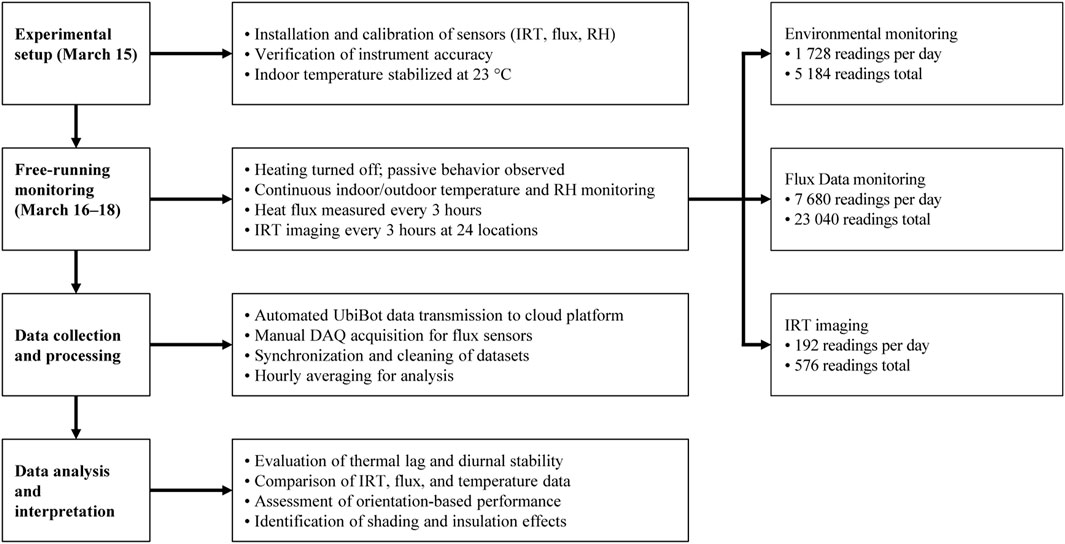
The methodological framework integrated experimental setup, controlled preconditioning, multi-sensor field monitoring, and data synthesis. The field campaign evaluated the short-term thermal and hygrothermal response of the full-scale cement-stabilized, core-insulated rammed earth residence. Following sensor calibration and thermal stabilization, the building transitioned to a free-running state to isolate envelope-driven dynamics. Infrared thermography, surface heat-flux sensing, and in-situ hygrothermal monitoring were deployed concurrently to capture thermal lag, diurnal stability, and hygrothermal buffering. Data acquisition combined automated and manual systems, followed by synchronization, averaging, and cross-validation of datasets. This integrative framework ensured a comprehensive and reproducible assessment of the envelope’s passive performance, linking in-situ evidence to material and environmental parameters. The case study building, a single-story guest house in southern Ontario, features load-bearing walls reinforced with steel rebar and a continuous core insulation layer of 152 mm thick foam board, resulting in a 508 mm thick wall assembly. The building’s compact and symmetrical layout facilitated orientation-based monitoring, with varying window-to-wall ratios maximizing passive solar gains on the south side while limiting winter heat losses on other orientations.
Key findings include the significant thermal lag observed on the south wall, with interior flux values rising 2–3 hours after exterior peaks and with substantially lower amplitude, demonstrating the envelope’s capacity for storing and gradually releasing solar energy. Despite exterior temperatures dropping below -3°C, interior surfaces and indoor air remained thermally stable (19.0°C–22.8°C) with minimal humidity fluctuations, confirming the suitability of core-insulated, cement-stabilized rammed earth for cold climates. Discrepancies between IRT and embedded sensor data highlighted the complementary nature of these methods in characterizing surface and sub-surface thermal dynamics. Orientation-dependent responses showed strong diurnal gains on south- and east-facing walls, emphasizing the importance of bioclimatic design. The stable indoor relative humidity (44%–52%) demonstrated effective moisture buffering, contributing to thermal comfort without active mechanical systems. The study concludes that insulated rammed earth wall systems act as effective thermal and hygrothermal buffers, providing a valuable dataset for future research and supporting the design of energy-efficient, climate-responsive earthen envelopes.
#RammedEarthConstruction #ColdClimatePerformance #ThermalMassEffect #HygrothermalBuffering #BuildingEnvelopeAnalysis #OnSiteMonitoring #InfraredThermography #SurfaceHeatFluxMeasurement #RammedEarthConstruction #ColdClimatePerformance #ThermalMassEffect #HygrothermalBuffering #BuildingEnvelopeAnalysis #OnSiteMonitoring #InfraredThermography #SurfaceHeatFluxMeasurement
 No comments yet
Investigating EIFS Performance Across Climates: Exterior insulation and finishing systems studied in long-term test
How to Insulate Concrete Foundation Walls From the Inside Out