1/17
The Best Tin Snips for Your Metalwork Projects, Tested
Tin snips are specialized tools essential for cutting thin gauge metals in various home renovation and artistic projects, such as repairing rain gutters, installing metal roofs, or replacing wood stove pipes. These tools resemble heavy-duty scissors, featuring thick, durable handles and short, strong blades designed to cut through materials like stainless steel, tin, and copper. This guide, based on extensive testing, identifies the best tin snips available, categorized by their suitability for different applications.
The testing process involved evaluating 16 different tin snips and aviation snips over 7 hours, cutting more than 60 linear feet of various metals including 20-gauge cold-rolled steel, 28-gauge rectangular duct, and 26-gauge standing seam metal roofing and aluminum gutter. Each tool's dimensions, weight, operational smoothness, comfort in hand (including with gloves), clean-cutting ability for straight lines and curves, and durability (through drop tests) were assessed. The results were compiled using a scoring rubric to determine top performers.
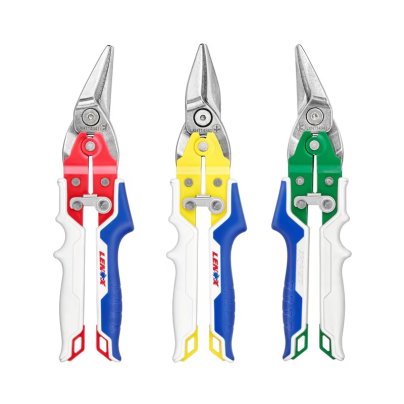
The Lenox 3-Pack Forged Steel Aviation Snips were recognized as the best overall choice. This moderately priced set includes snips for straight, left-curved, and right-curved cuts, featuring forged steel blades capable of cutting up to 18-gauge sheet metal. Their ergonomic, slip-resistant overmold handles and offset design, which keeps hands above the metal during long cuts, contributed to their high rating. The set outperformed other options in smoothness and ergonomics, demonstrating excellent performance across various cut types and proving durable in drop tests.
For budget-conscious users, the Craftsman Aviation Snips Set offers a good value. This three-piece set, designed for occasional use, includes offset clockwise-cut, counterclockwise-cut, and straight-cut pairs. Its induction-hardened steel blades cut through 18-gauge cold-rolled steel and 22-gauge stainless steel. While slightly less smooth in operation than the Lenox set, its comfortable grips and one-handed latch system make it a practical choice for less frequent tasks.
Specialized applications also have their top picks. The Midwest Power Cutter Offset Long Cut Aviation Snip is ideal for metal roofing due to its 2¾-inch blades that facilitate faster, easier long cuts in roofing panels, steel siding, and sheet materials. These snips feature heat-treated forged molybdenum alloy steel blades with serrations for precise grip and compound leverage handles for increased cutting force. For tight spaces, the Midwest Upright Right Aviation Snip, with its blades extending at a right angle, allows access to narrow areas, cutting vinyl siding, aluminum, and up to 24-gauge sheet metal effectively. Malco Max2000 Double Cut Aviation Snips are recommended for ductwork, utilizing a triple-blade design to create clean, distortion-free cuts in round air ducts and stovepipes.
Other notable recommendations include Irwin Utility Snips for straight cuts in lightweight materials like wire mesh and corrugated roofing, and Stanley Fatmax Straight Cut Aviation Snips for their versatility across various materials due to their ability to cut straight, clockwise, or counterclockwise. The Crescent Wiss Compound Action Aviation Snip Set stands out among aviation snips for its comfortable grips and smooth action, despite having cast steel blades rather than forged. The Craftsman All-Purpose 10″ Tin Snips are a strong general-purpose option for lighter metals, offering simplicity and broad functionality. Lastly, the Malco 12″ Andy Aluminum Handled Snips are praised for their lightweight design and replaceable blades, making them ideal for aluminum and copper.
When selecting tin snips, key considerations include the type of snip (traditional, aviation, offset, vertical), the material and its gauge, the specific application, and comfort features like grip and handedness. Handle color-coding (yellow for straight, red for counterclockwise, green for clockwise) provides guidance. Proper usage involves nesting metal deep into the jaws and, for circular cuts, creating a starter hole. Sharpening non-serrated blades involves cleaning, disassembling, smoothing the cutting edge with a diamond sharpening stone, and reassembling with lubrication. The primary distinction between tin snips and aviation snips lies in their pivot mechanisms and leverage, with aviation snips offering increased force for thicker metals.
#TinSnips #MetalworkTools #HomeRenovation #DIYProjects #ToolReview #AviationSnips #MetalCutting #Hardware #HomeImprovement #TinSnips #MetalworkTools #HomeRenovation #DIYProjects #ToolReview #AviationSnips #MetalCutting #Hardware #HomeImprovement
 No comments yet
Builders' Metalwork

The Best Glass Drill Bits for Crafting and DIY Projects

Metal Wall Art - Our Pick of the Best


Sheet Metal

Spirit Ironworks: Making Miracles With Metal


How To Mix Metal Finishes

The Aesthetics of Metal
Time to Shine: Let’s Restore All Your Rusty Metal