1/7
Inside and out
Architectural fabric is being integrated into modern building design in increasingly innovative ways, moving beyond traditional applications like roofs and shading devices to enhance building performance, sustainability, and aesthetic appeal. This evolution addresses diverse challenges, from environmental protection to energy efficiency, demonstrating how manufacturers and architects are collaboratively pushing the boundaries of material use both inside and outside structures.
For interior applications, advancements include specialized netting designed to create suspended platforms for recreational use within spaces. More critically, for the building's envelope, metalized fabrics are now being sandwiched between tempered glass layers. This innovative application, exemplified by the Würth Administration Building on Lake Constance, addresses the serious issue of bird collisions with highly reflective glass facades. The Würth building, which houses offices, conference facilities, a restaurant, and an art museum, features a sophisticated glass curtainwall system that incorporates SEFAR's Architecture Vision AL 140/70. This system, which laminates a metal-coated fabric interlayer between glass panels, has been independently verified by the Swiss Ornithological Institute as bird-friendly. The fabric interlayers are available in various densities and can be coated with aluminum, chrome, or titanium, and even printed with fade-resistant inks to achieve desired colors and patterns. This technology significantly reduces the visual confusion that causes birds to strike reflective surfaces, thereby mitigating avian mortality.
In exterior applications, advanced textile technologies are providing solutions for extreme environmental conditions. For instance, in volcanic regions like Japan, new government regulations prompted the development of lightweight yet highly durable and heat-resistant building wraps. Teijin Aramid Ltd. has engineered special fabrics woven from Twaron™ and Technora™ para-aramid fibers, which offer exceptional tensile strength (six times that of steel for the same weight) and superior heat resistance. These fabrics are designed to protect buildings, such as the Ebino Eco Museum Center, from airborne volcanic fragments up to 10 cm in size. The choice between Twaron and Technora depends on the specific protection level required, considering factors like volcanic activity and altitude. The lightweight nature of these fabrics also offers significant advantages in terms of transport and installation costs, particularly in remote or mountainous areas, compared to traditional heavy construction materials like concrete and steel.
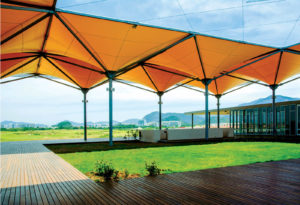
Fabric technology also plays a crucial role in sustainable building practices. At the Olympic Golf Course in Rio de Janeiro, Rua Arquitetos designed a public plaza shaded by 14 inverted pyramid-shaped modules made from Serge Ferrari's Précontraint® 1002 S2 fabric. These modules not only provide shade but also efficiently harvest rainwater, redirecting runoff to ground collectors for irrigation of the golf course and surrounding landscape. Similarly, at the Brazilian Paralympic Centre in São Paulo, Serge Ferrari's Soltis™ FT 381 mesh and Précontraint 502 S2 fabrics are used to create large, undulating sculptural forms. These forms shield the building's façade from solar radiation, significantly reducing heat gain and thermal insulation requirements, thereby eliminating the need for mechanical air conditioning. The custom golden-red color of the Soltis mesh evokes Olympic medals, blending aesthetic appeal with functional sustainability.
Beyond performance and sustainability, architectural fabrics are transforming buildings into dynamic visual platforms. The concept of the building as a billboard is re-imagined with developments in digital projection and LED media walls. Textile manufacturers like Low & Bonar LLC are producing surfaces such as Valmex® TF 400, which are optimized for light projection and reflectance. This was showcased in Eindhoven, The Netherlands, where a temporary installation called “Teatro del Mondo” used Valmex fabric with integrated computer-controlled laser lighting to create an interactive, dynamic performance space. Furthermore, French architect Jean Nouvel's Danish Koncerthuset utilizes Serge Ferrari’s Soltis™ FT 381 cobalt blue mesh fabric as a canvas for projected moving images, transforming the entire building into a broadcast medium for community events. These innovations highlight how architectural fabrics are becoming integral tools for architects to address functional, environmental, and artistic challenges, driven by practical needs and an evolving imagination.
#ArchitecturalFabric #BuildingPerformance #SustainableDesign #BirdFriendlyBuildings #VolcanicProtection #RainwaterHarvesting #SolarHeatGainReduction #DigitalFacades #TextileInnovation #ArchitecturalFabric #BuildingPerformance #SustainableDesign #BirdFriendlyBuildings #VolcanicProtection #RainwaterHarvesting #SolarHeatGainReduction #DigitalFacades #TextileInnovation
0 comment in total
 No comments yet
You may also like
Inside Out

Seamless Indoor-Outdoor Living, All Year Long
Glass walls and pocket gardens blur the lines between inside and outside in this Buckhead home
How to Blend Inside Comfort with Outdoor Style
Welcome to the Great Indoors

Sliding Into Home | Home and Garden | Life
At Home: The Door

Parts of the House

Outside the box: Bold architecture meets sophisticated style

Inside Out | An Entrance Hall That Really Cooks
Inside a Home That's Not Afraid of the Dark

15 Open Living Rooms that Connect Inside and Outside

Beautiful on the Inside and Out
Home & Design | A World of Interiors

White Internal Doors


Internal Door Frames & Casings | Interior Door Linings

11 indoor-outdoor rooms to fall in love with
Internal Doors
External Doors

Spring: It's time to move the indoors out