1/10
Every Single Step French Lighting Company Mathieu Lustrerie Takes to Make Its Sea-urchin Chandelier
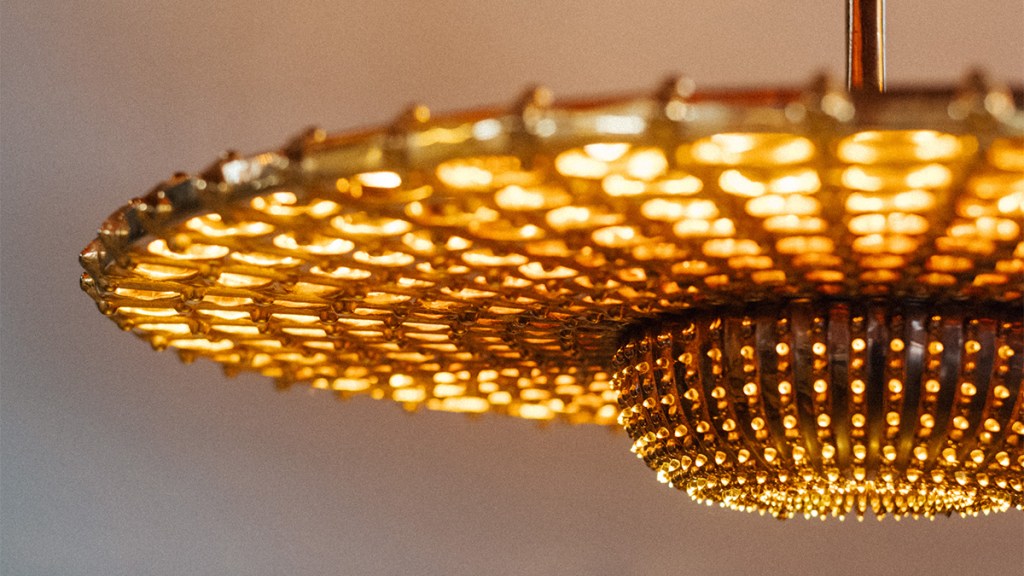
Mathieu Lustrerie, a French lighting company, crafts an intricate sea-urchin inspired chandelier, drawing inspiration from 19th-century German artist and biologist Ernst Haeckel’s marine-life drawings. Régis Mathieu, the head of the family-owned business, was particularly impressed by the modern feel of Haeckel's designs, noting that even Gustave Eiffel was influenced by the same artist. This inspiration has led to a collection of light fixtures that resemble corals, jellyfish, and a bejeweled sea urchin, echoing the natural motifs and fluid lines characteristic of the Art Nouveau movement. Mathieu highlights the significance of Art Nouveau, a period where the advent of electricity allowed for new lighting possibilities beyond flames.
The company, founded in 1948 by Henri Mathieu, is now seeing Régis’s daughter, Inès, gradually taking over. Mathieu Lustrerie is renowned for restoring and reissuing chandeliers using traditional techniques, including the recent restoration of over 70 fixtures in Paris’s Notre-Dame Cathedral following the fire. The company operates a workshop and gallery in Paris, along with an atelier and lighting museum in Gargas, Provence, where Mathieu’s personal collection is housed.
The sea-urchin chandelier, a centerpiece of their new collection, requires three to four months to produce. Due to its complex design, the company can only manufacture a maximum of ten such chandeliers annually, with each priced at approximately $55,000. Every artisan involved in its creation custom-makes their tools for specific tasks like carving and chiseling. Mathieu humorously suggests the piece would be fitting for Louis XV's table.
The manufacturing process begins with initial sketches, which took the Lustrerie team nearly a year to refine into a working prototype, addressing production challenges and finding solutions for any issues. Following the design phase, the chandelier progresses to shaping. This involves 3-D printing pieces that are then used in sand casting. Molten bronze is poured into these molds, taking on the desired shape. Once the metal solidifies, the parts are meticulously tested for a proper fit. The crown consists of five solid sand-cast bronze elements, while the central orb is formed by joining two hollow half-spheres. Artisans account for metal contraction during cooling, as the pieces are not computer-generated.
Next, using 18th-century chiseling techniques, craftsmen carve light-reflecting details into the bronze, creating a contrast that either rejects or catches light. The pieces are then buffed and polished to remove imperfections and achieve the desired shine. Gilding is achieved by immersing the metal in a custom corrosive electrolyte bath, allowing Mathieu to mix and control the final shade of gold, ensuring a unique patina. The chandelier is then meticulously studded with 800 individually placed semiprecious stones, sourced by Mathieu himself, through which light will disperse. Clients can request custom color combinations for these stones.
The final stage involves assembly, where electrical components, including LED lights at the bottom and behind each stone, are installed. Electrical tests are conducted to ensure functionality. The finished sea-urchin chandelier, weighing around 155 pounds, is designed to appear as if floating when suspended. Mathieu personally designs the chain to conceal cables and a special canopy to hide the transformer, completing the illusion of weightlessness.
#MathieuLustrerie #ChandelierDesign #ArtNouveau #LuxuryLighting #FrenchCraftsmanship #BronzeSculpture #SemipreciousStones #Handcrafted #HomeDecor #MathieuLustrerie #ChandelierDesign #ArtNouveau #LuxuryLighting #FrenchCraftsmanship #BronzeSculpture #SemipreciousStones #Handcrafted #HomeDecor
0 comment in total
 No comments yet
You may also like
Plumen adds customisable chandelier kit to lighting range
A sparkling lighting collection, inspired by the flamboyant energy of Las Vegas

The new chandeliers which offer decorative flourishes and a breath of fresh air in a world of pendant lights
Big Leaves Leaf High Transparent Glass Nordic Hotel Lustre LED Gold Hanging Pendant Lamp Round Chandeliers & Pendant Lights

The power of collaboration according to Italian lighting brand Masiero
You Can Now Buy the Incredibly Chic Lighting at the Coco Chanel Apartment in Paris

La Vieille Maison and Lighting, Inc.

SLAMP Debuts Crystal-Inspired Light Fixtures by Adriano Rachele
beau & bien crafts bespoke chandelier of cascading porcelain bubbles
The Light Factory founder turned an idea into extraordinary light fixtures and a thriving company

Psst: This Effortlessly Chic Fashion Brand Also Makes Amazing Lighting

The 15 Best Online Lighting Stores Everyone Should Know
forestier's thésée collection infuses primitive design into handcrafted floating luminaires
Finding the Perfect Light Fixture Is Complicated—These Architects Have the Answer

The Best Online Lighting Stores, Vetted

Meet Queue, A Linear LED Pendant System from Rich Brilliant Willing

Lucifer Lighting's fixtures are designed to ‘define and disappear’

Trueing's Cerine lighting hangs from chunky coloured glass chains
Mathieu Lehanneur’s liquid marble installation makes a splash in France
heathfield co produces range of bespoke lighting installations