1/14
Investigating lighting calibration opportunities in virtual reality for real-world illumination fidelity: an empirical study of variable lighting arrangements
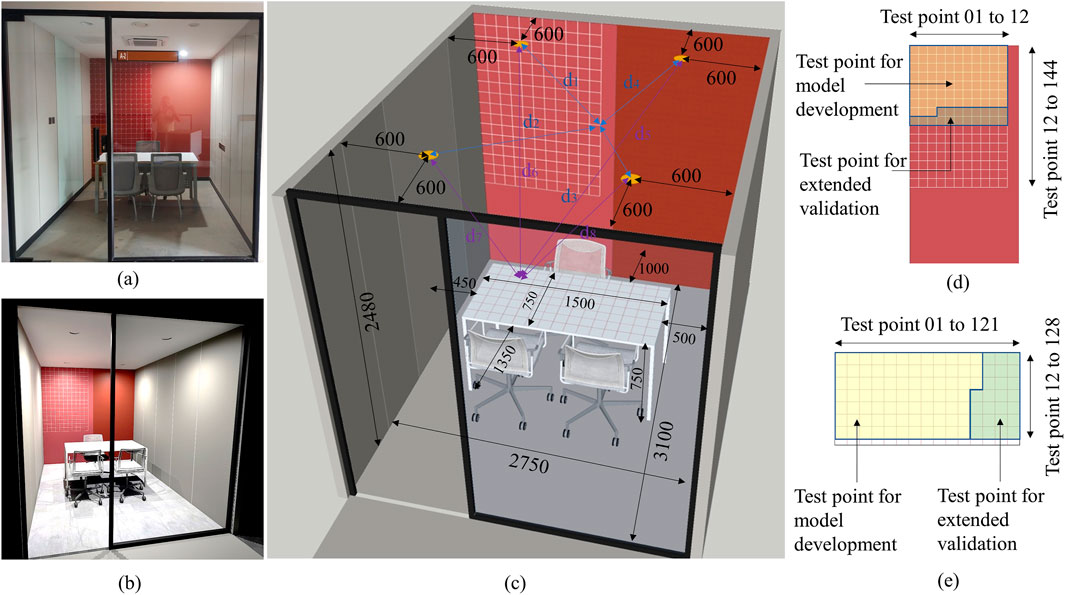
Virtual reality (VR) offers a powerful platform for human behavioral studies through controlled simulations, yet accurate replication of real-world conditions, especially for lighting, remains a challenge. This study addresses the discrepancies in light distribution between real-world environments and VR simulations, developing predictive models to minimize these variations and outlining practical limitations. The research empirically examines illumination differences between real-world measurements, DIALux evo simulations, and Unreal Engine 5 (UE5) VR environments. A controlled room was used to collect data from 100 test points per plane (horizontal and vertical) across one-, two-, and four-luminaire configurations. Multiple linear regression with interaction terms was employed to develop predictive models for each configuration and plane. Model validation involved cross-space application and residual analysis using an additional dataset of 60 test points per plane in a separate room with a similar lighting setup.
Statistical analysis revealed significant illumination intensity differences, ranging from 53% to 88% across various configurations. Specifically, UE5 substantially underestimated illumination, requiring 53%–61% correction on horizontal surfaces and 82%–88% on vertical surfaces, contrasting with DIALux evo's minimal error (0% to -5% on horizontal and ±20% on vertical surfaces). The predictive models developed proved effective in reducing discrepancies on the horizontal plane, particularly for linear, low-intensity lighting scenarios. For a single light source on the horizontal plane, the model achieved an R-squared of 0.998, explaining 99.76% of variance, with RMSE of 0.75 lx. For two light sources, the R-squared was 0.993, and for four light sources, 0.986. However, the models highlighted the need for further investigation into vertical illumination and more complex luminaire arrangements, as residual analysis for vertical surfaces showed significant deviations from normality and high multicollinearity, limiting the reliability of direct parametric inferences.
Cross-space validation using a different office setup showed strong agreement between VR illumination predictions and real-world values on horizontal surfaces, with residuals ranging from -12 to +18 lux (errors ≤ 6.6%). A consistent underestimation bias of +145 lux was identified and corrected through calibration, improving model accuracy across varied spatial conditions. In contrast, vertical surface predictions exhibited variable underprediction (+60 to +110 lux), indicating orientation-dependent limitations and the need for context-specific refinements. This variability suggests that the current models do not adequately account for complex factors influencing vertical lighting behavior, such as spatial occlusion and material reflectance inaccuracies within UE5.
This study underscores that visual fidelity in VR does not inherently translate to accurate illumination levels, emphasizing the distinction between visually oriented applications and those demanding precise, data-driven lighting models. It introduces a novel calibration methodology for multi-light configurations, advancing the reliability of VR lighting simulations for scientific investigations in the built environment, particularly for horizontal working planes. Future work should focus on integrating perceptual observations, developing advanced modeling techniques like machine learning for high-intensity and complex luminaire arrangements, and creating a unified framework for both horizontal and vertical predictions to broaden practical applicability.
Overall, the findings have practical implications for VR-based lighting studies, building performance simulations, and virtual illumination design, promoting more accurate and reliable VR tools for sustainable architectural design and human-centric built environments. This research contributes to SDG 7 (Affordable and Clean Energy) and SDG 11 (Sustainable Cities and Communities) by enhancing the precision of VR tools in design, research, and the construction industry.
#VirtualReality #LightingSimulation #IlluminationFidelity #BuiltEnvironment #PredictiveModeling #Calibration #UnrealEngine #VirtualReality #LightingSimulation #IlluminationFidelity #BuiltEnvironment #PredictiveModeling #Calibration #UnrealEngine
 No comments yet
5 Tricks to Maximize Your Home's Natural Light on Darker Autumnal Days Using Artificial Lighting

Best lighting for a makeup vanity – the 5 secrets to a flattering glow-up for your get-ready spaces


How to fake natural light in a dark room - 5 design tricks to brighten up a gloomy space
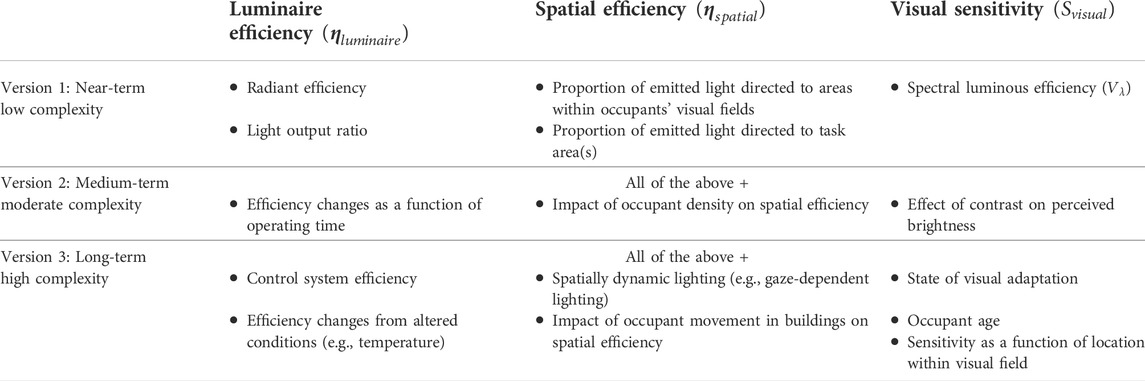
Lighting application efficacy: A framework for holistically measuring lighting use in buildings