The Mizner Touch
The article delves into the architectural legacy of Addison Mizner in 1920s Florida, focusing on his Mediterranean Revival style, which uniquely blended Spanish, Italian, and Moroccan design elements. Mizner's approach was characterized by an imaginative and often extravagant fusion that prioritized creating a distinct character for a flat landscape. The narrative then shifts to a contemporary home in Boca Raton, designed for humorist Al Tapper by architect Hank Goldman (of Garcia Brenner Stromberg Architecture) and interior designer Catherine C. Cleare, which embodies a similar spirit of inventive historicism.
The home, spanning 6,000 square feet, showcases a rich tapestry of decorative arts, drawing inspiration from Portugal, Spain, the Byzantine Empire, and medieval Europe. Tapper's desire for a highly detailed house, beautiful even without furnishings, led to an extensive use of custom stonework. A mason worked for three years, casting cement stones from molds for the columns, walls, doorways, and windows, creating a diverse range from Italianate to Gothic styles. This meticulous craftsmanship is complemented by hand-forged ironwork reminiscent of Spain, rococo chandeliers, Dutch delft tiles, and Portuguese painted tiles, all contributing to a hybrid historical aesthetic that echoes Mizner's uninhibited design philosophy.
The article highlights Cleare's dedication to authenticity in furnishing the home. Unlike Mizner, who established a factory to mass-produce 'antique' items, Cleare sourced nearly all furnishings from prestigious auction houses like Christie's and Sotheby's. These pieces were then meticulously restored, reupholstered, or reconfigured to fit the new dimensions of the house, as exemplified by a Louis XVI double bed transformed into a king-size, with new carvings seamlessly integrated with the original.
A central theme is the creation of an aura of genuine antiquity. The dining room, envisioned as a 'fantasy garden,' features caryatids from a Palm Beach garden, intentionally left with a 'crumbly' texture to suggest age, a detail Mizner would have appreciated. Hand-painted frescoes, a limestone floor echoing the mahogany ceiling pattern, and a dark, lead-patterned mirror add depth and mystery. Despite its ancient feel, the house incorporates modern amenities discreetly; for instance, audio/video and air-conditioning systems in the dining room are hidden behind stone grilles.
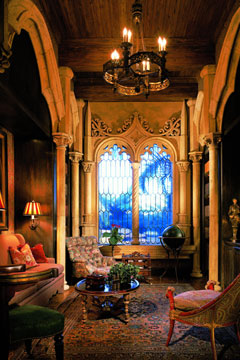
The living room exhibits a Gothic influence with carved columns, arched windows, and stone grilles above the fireplace. Museum lighting is employed throughout the house to emphasize art and create a dramatic, moody glow. Cleare's commitment to authenticity is further seen in the master bedroom, where light oak floors are stenciled to mimic European manor inlays. Nineteenth-century painted panels adorn the bedroom wall, and local artist Jonathan Kohrman was commissioned to paint mythological scenes for the oval medallions on the barrel-vaulted ceiling. The exterior, a former sandy site, was transformed into a lush landscape with citrus orchards, palm trees, and stone-framed pools, reinforcing the historic ambiance. The success of this design is underscored by a newly hired workman mistaking the eight-day-old house for eighty years old. Despite its grandeur, Tapper emphasizes the house's practicality and comfort, stating that he utilizes every room, finding them both beautiful and functional.
#AddisonMizner #MediterraneanRevival #ArchitecturalDesign #InteriorDesign #Historicism #LuxuryHomes #BocaRaton #AlTapper #CatherineCleare #AddisonMizner #MediterraneanRevival #ArchitecturalDesign #InteriorDesign #Historicism #LuxuryHomes #BocaRaton #AlTapper #CatherineCleare
 No comments yet
Chintz Happens


Transformative touch

Tangible Touches