An Easier Way to Measure Long Spans
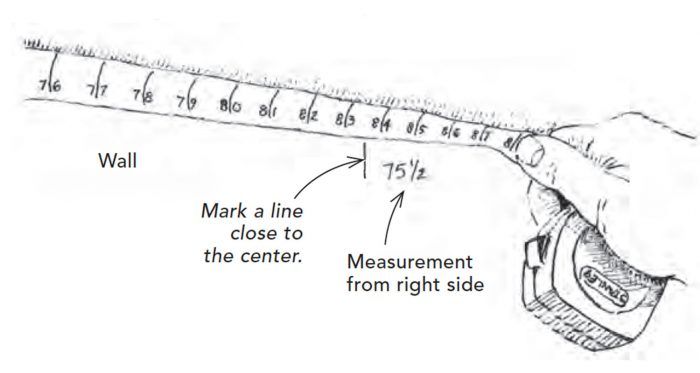
Measuring long spans, especially when working alone, can present a significant challenge for tasks such as installing crown molding or other ceiling trim. The primary difficulty often lies in maintaining the tape measure's position, as it tends to fall or slide, leading to inaccurate readings and increased frustration. This common problem can be effectively resolved by adopting a simple, two-step measurement technique: splitting the distance.
The method involves identifying an approximate midpoint along the long span that needs to be measured. Once this central area is determined, a temporary mark is made. This mark serves as a reference point, dividing the total span into two more manageable sections. The next step is to measure the distance from one end of the span to this central mark and record the measurement. Subsequently, the process is repeated from the opposite end of the span to the same central mark, and that measurement is also noted. The final, accurate length of the entire span is then obtained by adding these two individual measurements together.
This technique offers several advantages. Firstly, it eliminates the need to stretch a tape measure across an entire long span in one go, which is particularly difficult for a single person. By breaking down the measurement into smaller segments, the risk of the tape measure falling or slipping is significantly reduced, thereby improving accuracy and efficiency. Secondly, this method is not only useful for solo work but also serves as an excellent strategy for measuring distances that exceed the total length of the available tape measure. For instance, if a wall is 30 feet long but the tape measure is only 25 feet, marking a point at 15 feet from one end allows for two shorter, manageable measurements that can then be combined to find the total length.
Furthermore, an additional refinement to this technique, as suggested by a practitioner, involves intentionally choosing a round, easy-to-calculate number as the intermediate measurement from one side. For example, if measuring a long stretch, one could measure exactly 100 inches from one end to the central mark. This simplifies the subsequent addition, making the overall calculation quicker and less prone to mathematical errors. The principle remains the same: sum the two smaller measurements to achieve the total length. This approach transforms what could be a cumbersome and error-prone task into a straightforward and reliable process, ensuring precise cuts and installations for various home improvement projects.
This measuring strategy is especially beneficial in applications involving custom trim work, such as crown molding, where precision is paramount for a seamless finish. The ability to accurately measure long distances alone or with limited tools enhances productivity and reduces material waste, making it a valuable tip for both professional builders and DIY enthusiasts. The described method represents a practical solution to a common construction challenge, offering a clear and effective way to achieve accurate measurements in demanding situations.
#MeasuringTechnique #HomeImprovement #CrownMolding #DIYTips #ConstructionMeasurement #CarpentrySkills #AccuracyInBuilding #PracticalSolutions #MeasuringTechnique #HomeImprovement #CrownMolding #DIYTips #ConstructionMeasurement #CarpentrySkills #AccuracyInBuilding #PracticalSolutions
 No comments yet
The Best Tape Measure | Reviews by Wirecutter
How I Turned My Android Phone Into an All-In-One Measuring Tool

Made to Measure


4 Easy Tips For Measuring Curtain Length Like A Pro