1/6
Robotic arms create custom furniture in Kram/Weisshaar's Robochop installation
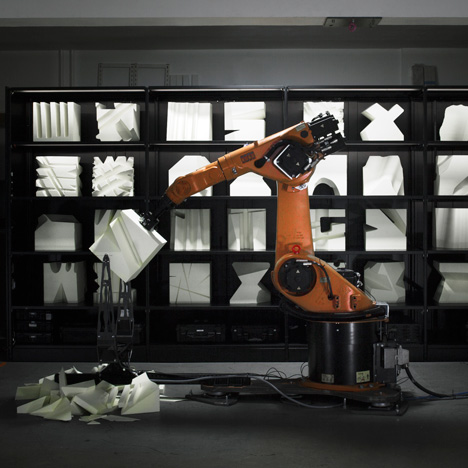
The design studio Kram/Weisshaar, comprising Stockholm-based Reed Kram and Munich designer Clemens Weisshaar, has developed an interactive installation named Robochop. This innovative project allows users to remotely control robotic arms to sculpt custom furniture pieces and abstract sculptures from foam cubes. The installation is a pop-up robotic plant specifically designed and coded for CODE_n, a digital innovation platform.
The Robochop installation features four robotic arms, typically employed in car manufacturing, which are made accessible to online users globally. These users can direct the robots to carve objects from 50-square-centimetre foam cubes. The system integrates a sophisticated mechanism where the robotic arms, fitted with needle grippers, retrieve and position dense foam blocks from a storage unit. Each robot's pedestal includes a cutting wire that heats up to slice sections from the foam cube as the robot manipulates the block's surface over the wire.
Kram/Weisshaar developed a dedicated application that serves as the interface for users. Through this app, individuals can create design instructions for the robots using hand gestures on a touchscreen. Once a design is finalized and uploaded to the system, the robotic arms execute the cutting process. Upon completion, the personalized products are packaged and shipped to their respective creators.
The installation was open to both internet participants and on-site visitors at the CeBit 2015 IT fair in Hannover from March 16 to March 20. This project builds upon Kram/Weisshaar's previous work, such as the 2010 Outrace installation in London's Trafalgar Square. Outrace enabled global users to control six robotic arms to create light patterns.
According to Weisshaar, Robochop signifies an evolution from creating virtual media, as seen in Outrace, to manufacturing tangible, real-world objects. The studio's commitment to exploring the intersection of technology and design is further exemplified by their recent project, where they installed a film studio inside one of Audi's high-speed driverless cars. This setup was designed to record passengers' reactions during the autonomous, high-speed journey, showcasing their interest in innovative applications of robotics and digital control in various fields, from art and design to industrial production and entertainment.
#RoboticArms #CustomFurniture #KramWeisshaar #RobochopInstallation #3DPrinting #InteractiveDesign #DigitalFabrication #CEBIT2015 #ProductDesign #RoboticArms #CustomFurniture #KramWeisshaar #RobochopInstallation #3DPrinting #InteractiveDesign #DigitalFabrication #CEBIT2015 #ProductDesign
0 comment in total
 No comments yet
You may also like
High-tech production creates a handcrafted look

Experimental Kinetic Furniture Design: Aaron Preyer's Blooming Project

Roc H Biel Turns Wood Dust Into Column-Inspired Furniture
multifunctional furniture ‘DICE’ is a wooden stool, coffee table, leg bench and lamp at once
Nine designers work socially distanced wonders with wood
Sculpture and Furniture Design

Bauhaus-Inspired Hardware

Marie van der Kroft’s cabinet of curiosities

The Transforming Cubrick Cabinet Comes from "Chaos Technique"
Furniture makers embellishing with rivets

21 of the greatest craftspeople working in Britain today, as chosen by the nation's best designers and architects
15 future furniture and home decor design classics to invest in now
Walking wooden coffee table is equal parts mesmerizing and unsettling

What if your side table cared for you?
Inside the design shift toward robot vacuum-friendly sofas

Lahoma Uses Parametric Modeling to Design Custom Furniture

Freeze Design Build Creates Custom Furniture

Exploring the Future of Millwork CAD Drawings in Furniture and Interior Design
Designed & Made's integrated approach to custom woodworking projects
Take This Chair & Stuff It