




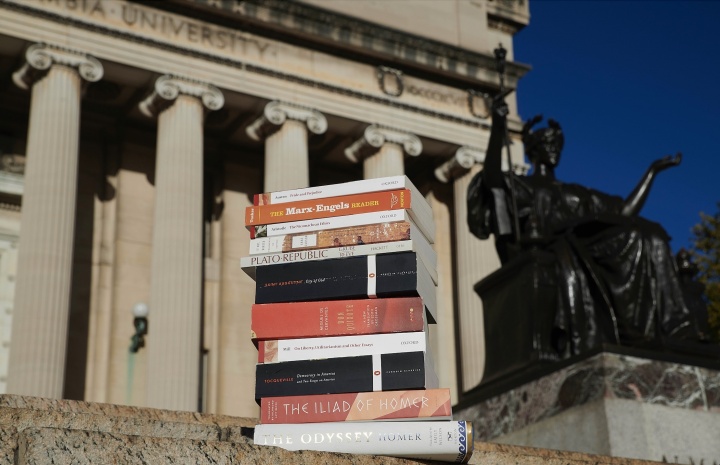
The Core Shed Light in an Unexpected Place
This article details a personal account of how the Columbia Core Curriculum provided intellectual and emotional support during a challenging period involving the incarceration of a friend. The author, Daniele Sahr ’00, recounts her journey in assisting her swim and fitness coach, a Navy veteran, after his sentencing. Initially, Sahr, having no prior experience with the prison system, focused on practical support such as setting up communication accounts, sending packages, and navigating specialized veteran services. However, she quickly realized the crucial need for both her friend and herself to find inspiration and maintain a positive outlook.
Sahr found unexpected guidance in the concepts from her Columbia Core Curriculum. She recalls how Foucault’s critiques and Locke’s optimism came to mind, demonstrating how the Core equipped her with ethical and historical perspectives to understand human systems and choices. When her friend gained access to e-books via Project Gutenberg on a prison-issued tablet, he requested readings that could uplift his spirits. Having previously shown interest in The Republic, Sahr suggested The Odyssey, reframing the epic hero as a war veteran trying to return home, a narrative that resonated deeply given her friend's background. Their discussions extended to texts from Plato, Dante, Cervantes, St. Augustine, Marx, and Freud, providing intellectual stimulation and a sense of connection.
The friend's perseverance was highlighted by his reading of Don Quixote in its original Spanish. Later, he enrolled in an associate’s degree program through SUNY Higher Education in Prison. Sahr's knowledge from the Core proved invaluable as she helped him with references from his classes, pasting texts about Sophocles for background on Oedipus and discussing Dante’s Inferno when Virgil was mentioned in a social psychology class. The prison's censorship system posed challenges, but the information eventually reached him. Their conversations evolved to include Machiavelli’s The Prince, where her friend drew parallels between the text's ideas and the social dynamics within his dormitory, offering Sahr insights into prison life. They also discussed Thucydides and the Peloponnesian War.
The associate’s degree eventually led to her friend's early release. He was subsequently admitted to a cognitive science internship at Princeton and is now pursuing both this opportunity as a visiting undergrad researcher and a degree at Rutgers. Sahr reflects that the education she received at Columbia College was instrumental in enabling her to provide the comprehensive support her friend needed. Beyond physical comforts, the Core readings offered fodder for the spirit and mind, framing their conversations and connecting them to centuries of human thought, dignity, and transformation. These texts ultimately became sources of inner strength, helping them both navigate a deeply constricting time and ultimately bringing them back together.
#CoreCurriculum #PrisonEducation #ClassicalLiterature #IncarcerationSupport #IntellectualGrowth #VeteransAffairs #DanieleSahr #ColumbiaCollege #HigherEducationInPrison #CoreCurriculum #PrisonEducation #ClassicalLiterature #IncarcerationSupport #IntellectualGrowth #VeteransAffairs #DanieleSahr #ColumbiaCollege #HigherEducationInPrison
 Комментариев пока нет