1/3
Looking at buildings can actually give people headaches – here’s how
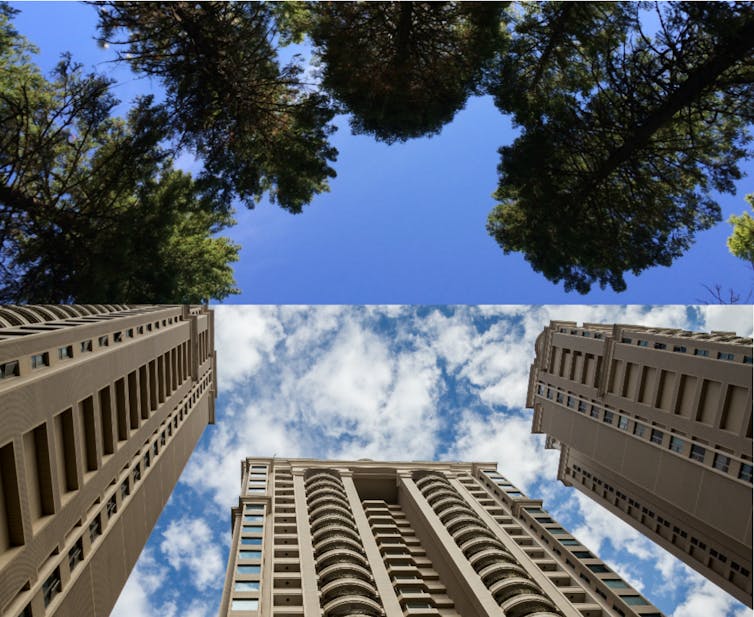
The human brain, having evolved over millennia to process natural scenes effectively, encounters a unique challenge when confronted with urban landscapes. These artificial environments, characterized by their repetitive patterns and stark, monotonous straight lines, deviate significantly from what the brain is naturally optimized to perceive. This divergence from natural visual stimuli can lead to discomfort, including headaches.
Mathematician Jean-Baptiste Joseph Fourier's work suggests that scenes can be deconstructed into various striped patterns, known as Fourier components, which differ in size, orientation, and position. In nature, there's a general 'rule' where low spatial frequency components (large stripes) have high contrast, and high spatial frequency components (small stripes) exhibit lower contrast. This natural arrangement often results in patterns that effectively cancel each other out, making natural scenes visually harmonious and easy for the brain to process. However, urban environments frequently violate this 'rule of nature' due to the common use of repetitive design elements like windows, staircases, and railings. These regular patterns are uncommon in natural settings, making them more challenging for the human brain to efficiently process.
This inefficiency in processing urban architecture contributes to visual discomfort. Some repetitive patterns, such as those found on doormats, carpets, and escalator treads, have been known to induce headaches and, in severe cases, even epileptic seizures. Research has measured the brain's processing efficiency by constructing computer models that simulate how nerve cells interpret visual information. These models, developed by researchers like Paul Hibbard and Louise O'Hare, indicate that processing images that deviate from the 'rule of nature' increases neural activity and makes its distribution less sparse, implying greater effort for the brain.
Further research involved a computer program to quantify how well images adhere to the 'rule of nature,' demonstrating that deviations predict the level of discomfort experienced by observers, whether viewing buildings or artwork. Analysis of apartment building designs over the past century reveals a growing departure from this natural rule, with an increasing prevalence of stripes decade by decade, resulting in progressively less comfortable structures to view.
Another method to assess brain efficiency involves measuring oxygen consumption in the visual cortex. Typically, looking at uncomfortable images, such as urban scenes, correlates with higher oxygen usage in this brain region. The 'rule of nature' not only predicts discomfort levels identified by computer models but also correlates with the amount of oxygen used by the brain. Since headaches are often linked to excessive oxygen consumption in the brain, this mechanism could explain why certain architectural designs trigger headaches. Individuals prone to migraines are particularly sensitive to the discomfort caused by repetitive patterns, as these patterns further elevate oxygen usage, which is already abnormally high in migraine sufferers, potentially leading to headaches. Consequently, there is a call for architects and interior designers to integrate the 'rule of nature' into their design software and practices, minimizing unnecessary repetitive patterns in both building exteriors and interiors to enhance visual comfort and well-being.
#Psychology #Cities #Architecture #ComputerModelling #BrainResearch #BrainScience #UrbanDesign #VisualPerception #HeadacheTriggers #Psychology #Cities #Architecture #ComputerModelling #BrainResearch #BrainScience #UrbanDesign #VisualPerception #HeadacheTriggers
 まだコメントはありません
Our buildings are making us sick
The Power of Scale: How Proportions Shape Human Experience