1/4
kei atsumi on bridging ancient japanese joinery & 3D printing at dubai design week pavilion
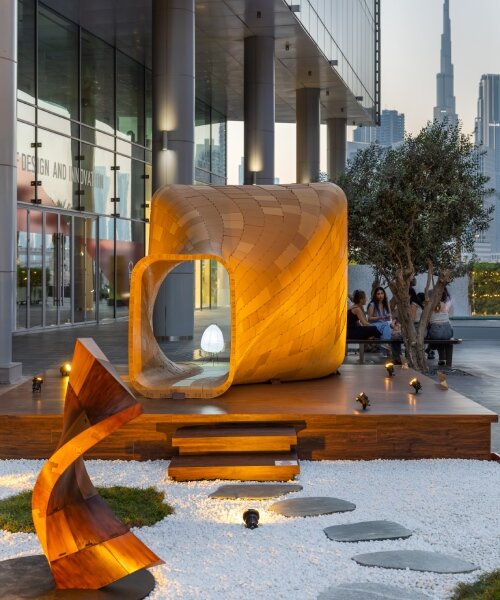
Mitsubishi Jisho Design architects Kei Atsumi and Motoya Iizawa unveiled 'The Warp' pavilion at the tenth Dubai Design Week, an immersive installation envisioned as a zen Japanese tea garden. This pavilion aims to bridge ancient Japanese craftsmanship with contemporary 3D printing technology. Situated amidst Dubai's modern skyscrapers, the installation offers a temporal journey from traditional Japan to the emirate's futuristic landscape. The Warp was activated through various events, including matcha tea ceremonies and design workshops, emphasizing its cultural and educational aspects.
The core concept of The Warp pavilion revolves around the innovative integration of centuries-old Japanese joinery systems with advanced 3D printing techniques. Kei Atsumi highlighted that the pavilion comprises over 900 unique pieces, each featuring distinct shapes and curves, a complexity achievable only through computational design. These components are assembled using traditional Japanese joinery, a system historically employed in wooden shrines and temples. This method allows for easy assembly, disassembly, and relocation, showcasing an adaptive application for a more intricate, modern structure while ensuring its portability and reusability. The design process leverages computational modeling to precisely generate these small, double-curved panels, which seamlessly interlock to form the overall structure without the need for adhesives, nails, or metal fittings.
The pavilion's journey for visitors commences at a pebbled garden, leading to the tea house, an intimate wooden space designed with a gentle twist that visually references Arabian sand dunes. Upon entering through a traditional small, low passage known as a nijiriguchi, visitors can participate in a matcha ceremony led by a Japanese tea master. This experience is intended to transport individuals into a Japanese spiritual realm, while simultaneously offering a view of Dubai's iconic Burj Khalifa, thus creating a dialogue between historical tradition and modern advancement. This spatial arrangement underscores the pavilion's role as a portal connecting disparate cultures and eras.
Beyond its aesthetic and cultural significance, The Warp pavilion also promotes Mitsubishi Jisho Design’s Regenerative Wood technique. This circular production system focuses on reintegrating wood waste back into the forestry industry. Atsumi noted that typically, only about 50% of wood material is utilized in architecture and other products, with the remainder becoming waste. The pavilion addresses this issue by constructing the entire structure from a 3D-printed wood composite. This composite material is composed of 30% recycled sawdust and 70% bioplastic, making the pavilion a sustainable and beautiful example of material reuse and ecological responsibility. This project exemplifies a new language of architectural expression, combining traditional wisdom with cutting-edge technology for sustainable design and construction.
#KeiAtsumi #DubaiDesignWeek #JapaneseJoinery #3DPrinting #SustainableArchitecture #PavilionDesign #WoodComposite #ComputationalDesign #MitsubishiJishoDesign #KeiAtsumi #DubaiDesignWeek #JapaneseJoinery #3DPrinting #SustainableArchitecture #PavilionDesign #WoodComposite #ComputationalDesign #MitsubishiJishoDesign
0 Kommentare insgesamt
 Noch keine Kommentare
Das könnte Ihnen auch gefallen
Akira Minagawa’s Japanese-Nordic Style Spans Fashion to Fabrics

Muji explores the art of minimalism in Japanese rock garden installation in New York

Dancing Squares by Nendo
This interior design experiment in Tokyo successfully merges traditional Japanese design with contemporary inf

African Designs Go Mainstream: Jomo Tariku Showcases The Birth Chair II at Dubai Design Week

Japan in Milan: the best of Japanese design at Milan Design Week 2024

werteloberfell experiments with 3D printing to obtain flexible lighting structures
A conversation with design visionary Naoto Fukasawa

Japan’s best and brightest designers set to shine in Milan
creation as DIALOGUE: modern design meets ancient nagoya crafts at maison&objet 2023
A floating dialogue in space: Pod by B&T Design and Jin Kuramoto


Step inside Acne Studios’ pink-hued Tokyo flagship: ‘fashion is supposed to be fun’

tokyo fiber '09 senseware' exhibition at milan design week
The Design Show: Egypt’s Must-See Design Exhibition this May

Architect Spotlight: 12 Works by Japanese Architect Kengo Kuma
takao shiotsuka atelier connects the floors of SJ building in japan via outdoor concrete ramp
Office in the Breeze / Furumori Koichi architectural design studio+Daiju Kuwahara

Ten furniture and lighting designs by Japanese brands and designers
Japan in Milan! See the highlights of Japanese design at Milan Design Week 2025
snarkitecture excavates areas for art within '3110NZ' restaurant and gallery in tokyo