



1/3
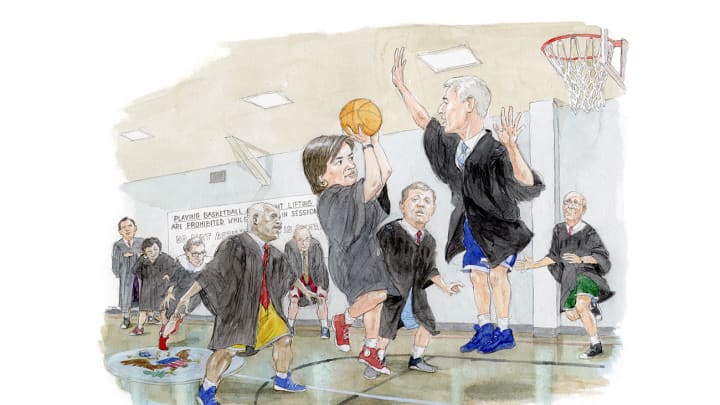
The Highest Court in the Land
The article delves into the unique history and vibrant culture surrounding a basketball court located on the fifth floor of the Supreme Court building in Washington D.C., affectionately known as "The Highest Court in the Land." Originally a storage room, this space was converted into a gymnasium in the 1940s and has since served as an unofficial recreational hub for Supreme Court justices, their clerks, and other staff members. It highlights how this unassuming court provides a rare space for camaraderie, physical activity, and a brief escape from the rigorous intellectual and legal demands of the nation's highest court.
Several anecdotes illustrate the court's significance and the personalities who have graced it. Karl Tilleman, a former Canadian Olympic basketball player and Supreme Court clerk, recounts his experience attempting to play with Justice Clarence Thomas. This led to an unfortunate incident where Justice Thomas tore his Achilles tendon, an injury that became a running joke between them. Tilleman still keeps a photograph of himself and Thomas, with the justice's walking cast prominently displayed, as a reminder of their shared experience on the court. This story exemplifies the personal connections fostered in this unexpected setting.
The article also features Justice Byron White, a former professional football player known for his athleticism and competitive spirit. White, nicknamed "Whizzer," was a formidable presence on the court, frequently engaging in robust games of two-on-two with his clerks. Descriptions from former clerks like Richard Cordray highlight White's physical play and his insistence on full effort from his opponents, regardless of their status. Even Chief Justice John Roberts acknowledges White's physical dominance and unique style of play, underscoring the deep athletic heritage associated with some Supreme Court members.
Justice Elena Kagan's experience on the court is also detailed, showcasing the evolving demographics of its players. As one of the few women to play on the court, Kagan's participation, alongside other female clerks, represented a shift in what was once a predominantly male space. Her anecdote about injuring her leg while playing basketball and Justice Sandra Day O'Connor's sympathetic remark about the benefits of aerobics further illustrate the dynamic social interactions and humor that permeate this unique judicial amenity. O'Connor, the first woman justice, had previously reserved the gym for women's aerobics classes, indicating a conscious effort to make the space inclusive.
The court has also been a venue for organized events, such as a basketball tournament among the chambers in 1980, spearheaded by Bill Murphy, a clerk for Justice Harry Blackmun. This tournament, which involved both male and female players and was watched by Justice Blackmun, served as a welcome diversion during a high-stress period for the court. The event even led to a marriage between two participants, Neil Eggleston and Penda Hair, further cementing the court's role in forging personal connections. For clerks like Noah Feldman, the court provided a crucial sanctuary for decompression, especially during the intense deliberation of capital cases, offering a space where ideological differences momentarily dissolved in the spirit of sport. The article concludes by emphasizing that the court represents an idealized vision of Washington—nonpartisan, impartial, and amicable—where the only 'justice' sought is in the game itself.
#SupremeCourt #Basketball #JudicialLife #CourtCulture #ClarenceThomas #ByronWhite #ElenaKagan #JudicialHistory #WorkplaceCulture #SupremeCourt #Basketball #JudicialLife #CourtCulture #ClarenceThomas #ByronWhite #ElenaKagan #JudicialHistory #WorkplaceCulture
 No comments yet