



1/2
The 1 Super-Quick Thing You Should Do To Your Ceiling Fan In The Winter
Ceiling fans, commonly associated with cooling a room, possess a lesser-known functionality that can significantly enhance comfort and potentially reduce energy costs during colder months. The direction in which a ceiling fan's blades rotate dictates how air is circulated within a space, influencing the perceived temperature rather than directly altering the room's actual temperature. In the winter, the optimal setting for a ceiling fan is to have its blades spin in a clockwise direction. This contrasts with the summer operation, where blades should rotate counter-clockwise.
When a ceiling fan spins counter-clockwise, it pushes air downwards, creating a downdraft that generates a cooling sensation, similar to a breeze. This effect is desirable in warm weather as it helps evaporate sweat from the skin, making people feel cooler. However, in the winter, a downward breeze would exacerbate the feeling of cold, negating efforts to warm the home. Conversely, when the fan rotates clockwise, it pulls air upwards. Since warm air naturally rises and collects near the ceiling, this upward motion gently recirculates the warmer air trapped at the top of the room downwards along the walls. This process helps distribute the heat more evenly throughout the space, eliminating cool spots and contributing to an overall warmer indoor environment.
For this winter function to be effective and comfortable, the ceiling fan should be operated at a low speed. The goal is not to create a strong draft but rather a gentle circulation that aids in destratifying the air layers. A high fan speed would still generate an undesirable breeze, even with clockwise rotation, counteracting the intended warming effect. The subtle movement of air at a low speed ensures that the warm air is mixed into the room without creating a chilling sensation.
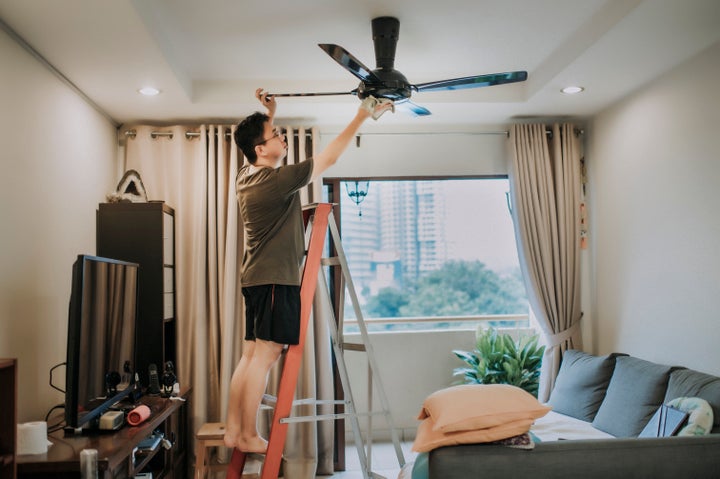
Adjusting the direction of a ceiling fan is typically a straightforward process, though the exact method can vary depending on the fan model. Most ceiling fans have a physical switch located on the motor unit, usually found just below the blades. Before attempting to change the direction, it is crucial to turn off the fan and wait for the blades to come to a complete stop to prevent injury. For newer or more modern fans, the direction change might be controlled via a remote control. If the specific model is unknown, consulting the fan's manual or searching online using the make and model can provide detailed instructions. Some fans might also feature a pull-down plate revealing a switch. Prior to engaging the fan in its winter mode, it is advisable to clean the fan blades to avoid circulating dust and allergens throughout the home.
The financial benefit of this simple adjustment can be notable. Experts suggest that optimizing ceiling fan direction seasonally could lead to savings of up to 15% on heating and cooling costs. However, the actual savings can fluctuate based on several variables, including the home's insulation quality and the efficiency of its heating and cooling systems. While the monetary savings may vary, the primary advantage remains the enhanced comfort and the ability to make a home feel warmer during the cold winter months without necessarily increasing thermostat settings or relying solely on other heating sources.
#CeilingFan #WinterTips #HomeComfort #EnergyEfficiency #HouseholdMaintenance #HeatingCosts #AirCirculation #DIYHome #CeilingFan #WinterTips #HomeComfort #EnergyEfficiency #HouseholdMaintenance #HeatingCosts #AirCirculation #DIYHome
 No comments yet