1/19
Tensile strain-hardening cementitious composites and its practical exploration without reinforcement: A review
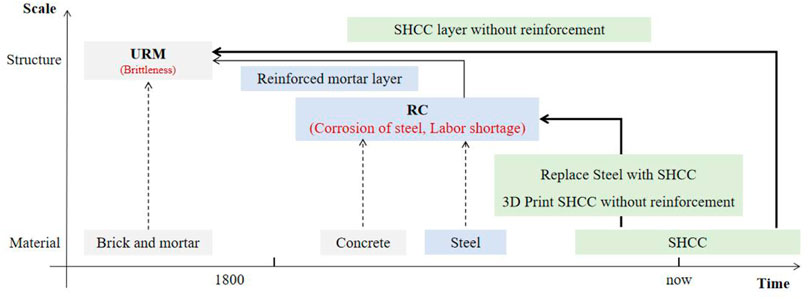
The widespread use of steel as reinforcement in brittle structural materials like concrete and unreinforced masonry (URM) structures has been challenged by issues such as installation waste and corrosion, which impede the progress of the construction industry. Strain-hardening cement composites (SHCC) offer a potential solution for steel-free construction. This review article comprehensively examines the properties of SHCC and its practical applications without traditional steel reinforcement.
The paper begins by highlighting the superior properties of SHCC and its structural applications in Reinforced Concrete (RC) structures. Concrete's inherent brittleness under tensile and bending loads often leads to cracking and subsequent steel corrosion, significantly impacting the lifespan of infrastructures like roads, bridges, and water conservancy systems. Furthermore, inadequate concrete ductility contributes to structural damage during natural disasters, such as earthquakes, where RC structures frequently experience concrete crushing and steel bar buckling. The current challenges in civil engineering, including labor shortages, high formwork costs, and environmental sustainability concerns, further emphasize the need for innovative materials.
SHCC, particularly those reinforced with polyethylene (PE) fibers, offers significantly enhanced mechanical properties compared to traditional concrete. Designed using fracture mechanics and micro-mechanics principles, SHCC exhibits a tensile capacity exceeding 3% with a fiber volume fraction of no more than 2%, providing approximately two orders of magnitude greater ductility. This material's ability to develop multiple cracks, each smaller than 100 μm, renders it highly resistant to environmental degradation. PVA fiber-based SHCC, while commonly used, often faces challenges with premature fiber rupture due to strong chemical bonding with the cementitious matrix, limiting its strain-hardening potential. Treatments like oil coating and air-entraining agents are employed to mitigate this, though PVA-SHCC typically has a compressive strength below 60 MPa and a lower elastic modulus than regular concrete, leading to greater deformation under compression.
Conversely, PE fiber-based SHCC leverages the hydrophobic nature and superior tensile strength of PE fibers, promoting fiber pull-out rather than rupture and leading to ultra-high ductile cementitious composites (UHDCC) with mean tensile strains often exceeding 8% and even 12% in some mixtures. This high ductility is attributed to the ultra-high fracture bridging capability of PE-SHCC, allowing for excellent tensile behavior even with high fracture toughness matrices. Comprehensive studies have explored the tensile qualities of various strength grades of SHCC, as well as size effects and rate-dependent tensile properties, leading to performance-based design concepts that consider mechanical and crack pattern characteristics.
SHCC has found significant application in RC structures, improving beam-column connections and infill masonry. Experimental results indicate that SHCC can reduce or even eliminate the need for steel reinforcement in certain conditions, offering practical value in civil engineering. Plain PE-SHCC beams have demonstrated mechanical properties comparable to RC beams with 0.5%–1.5% steel reinforcement ratios, and plain PE-SHCC columns matched RC columns with a 0.8% steel ratio. Shaking table tests on PE-SHCC frames under seismic action showed remarkable crack control and compliance with seismic codes.
SHCC is also critical for retrofitting URM structures, which are highly vulnerable to seismic activity due to limited shear strength and ductility. Common failure modes in URM buildings include in-plane cracking and out-of-plane collapse. Traditional strengthening methods using reinforced mortar layers, while effective to some extent, suffer from incompatibility with masonry substrates, low reinforcement material utilization, and excessive thickness for indoor applications. SHCC, with its multi-cracking and strain-hardening properties, offers a superior alternative. Studies show that SHCC strengthening can increase shear strength by 1.8–5.7 times and energy dissipation capacity by at least 35 times, significantly mitigating brittle failure. Double-sided strengthening provides even greater improvements in strength and ductility, and the strong bond between SHCC and masonry ensures effective composite action without interface stripping. SHCC layers can also enhance out-of-plane strength and ductility, preventing collapse during disasters. Furthermore, spraying SHCC simplifies construction while maintaining reinforcement quality. Shaking table tests on SHCC-strengthened masonry buildings demonstrate improved damage patterns, deformability, and overall stiffness, outperforming steel-grid-reinforced mortar layers.
The review also explores the advancements in 3D concrete printing (3DCP) with SHCC. Extrusion-based 3DCP is a widely used technique due to its simplicity and suitability for lightweight structures. SHCC materials are well-suited for 3DCP, requiring specific fresh properties like pumpability, extrudability, and buildability. Studies confirm that SHCC exhibits respectable workability in 3D printing, with fibers and nanoparticles enhancing rheological characteristics. Printed SHCC typically shows better in-plane properties than cast SHCC, maintaining micro-cracking and strain-hardening characteristics. Fiber alignment during printing improves mechanical performance, allowing for thinner 3D-printed structures with reduced or eliminated steel reinforcement. Printed PE-SHCC also exhibits superior deformability and energy dissipation. The multi-layer structure of 3D-printed SHCC introduces anisotropy in mechanical properties, which has been investigated, revealing both challenges and advantages, such as enhanced ductility and toughness in nacre-inspired designs. The use of SHCC in 3DCP holds significant promise for future steel-free construction.
In conclusion, SHCC's high ductility and toughness facilitate the development of structures without steel reinforcement across various applications, including RC structures and URM retrofitting. The integration of SHCC with 3DCP technology further advances the potential for automatic and steel-free construction. Future research should address interface properties, full-scale structural behaviors, seismic response, workability, and shrinkage of 3DCP-SHCC to fully realize its engineering applications and unlock its true value when coupled with theoretical models. This will pave the way for automated, steel-free construction in the future. The development of nacre-inspired 3DCP-SHCC demonstrates enhanced mechanical behavior, particularly in ductility and toughness, further validating the potential for reinforcement-free 3DCP-SHCC structures. These explorations, combined with theoretical models, will highlight the true value of auto-construction without steel reinforcement.
#StrainHardeningCementitiousComposites #SHCC #SteelFreeConstruction #UnreinforcedMasonry #URM #3DConcretePrinting #PEFibers #StructuralApplications #SeismicRetrofitting #MaterialScience #StrainHardeningCementitiousComposites #SHCC #SteelFreeConstruction #UnreinforcedMasonry #URM #3DConcretePrinting #PEFibers #StructuralApplications #SeismicRetrofitting #MaterialScience
 No comments yet
Cement