




1/5
Live like a Rockefeller — A Chinese export dinner service in the ‘Rockefeller’ pattern
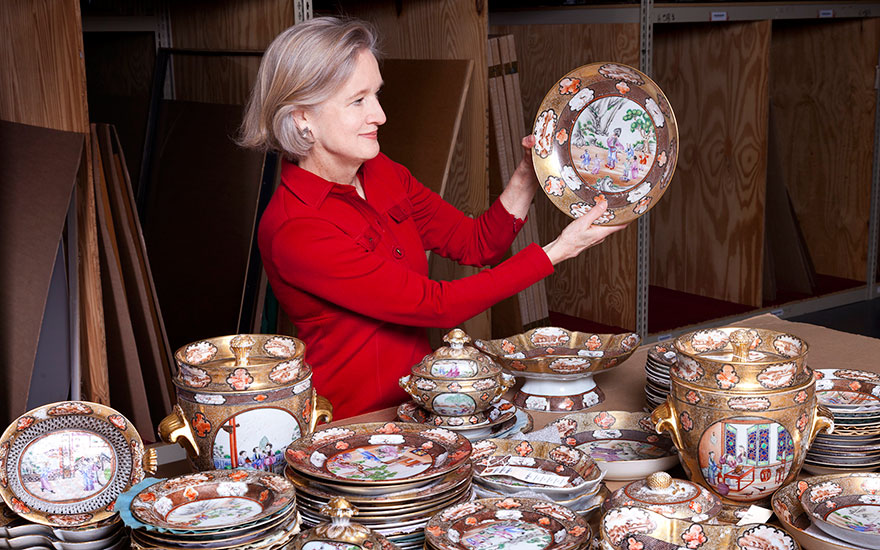
The passion for collecting within the Rockefeller family, particularly for Chinese porcelain, spanned multiple generations, much like their tradition of philanthropy. John D. Rockefeller, Jr., son of the dynasty's founder, developed a significant interest in Chinese porcelain. His first major art acquisition in 1915 involved 65 pieces from J.P. Morgan’s collection, which included tall Kangxi-period ‘beaker’ vases prominently displayed in the family's Manhattan townhouse. John D. Rockefeller, Jr. was also drawn to high-quality Chinese export porcelain, specifically a pattern then known as ‘palace ware.’ This pattern is characterized by rich decoration, extensive gilt borders, and intricately enameled Chinese court scenes, each of which is unique.
John D. Rockefeller, Jr. began acquiring pieces of this ‘palace ware’ in the 1920s, assembling a nearly complete dinner and tea service through esteemed dealers like Alfred Rochelle Thomas of London, J.A. Lloyd Hyde of New York, and Yamanaka of New York. This porcelain collection was initially used in the 54th Street house and later moved to the family's apartment at 740 Park Avenue, where it was featured in a 1930s photograph of the ‘China Room.’ Following his father’s death in 1937, John D. Rockefeller, Jr. and his wife, Abby, brought the ‘Rockefeller’ porcelain to Kykuit, the house built by his father in the Pocantico Hills.
After John D. Rockefeller, Jr.'s passing in 1960, Peggy and David Rockefeller acquired a substantial portion of this service from his estate. The porcelain gained further prominence when dealer and collector J.A. Lloyd Hyde featured pieces from John D. Rockefeller, Jr.'s collection in his 1964 scholarly book on Chinese export porcelain. The collecting community took notice, and due to its association with the prominent American family, the pattern, with its lavish gilt and sepia borders enclosing unique Chinese figure scenes in colored enamels, became known as the ‘Rockefeller’ pattern.
Peggy and David Rockefeller also inherited ‘Rockefeller’ porcelain from David’s aunt, Lucy Truman Aldrich, who shared a passion for both European and Chinese export porcelain with her sister, Abby Aldrich Rockefeller. Lucy frequently purchased pieces for both of them during her extensive travels. Peggy and David acquired seven pieces from Lucy’s estate in 1955 and later added eight more pieces at a Morton’s auction house in New Orleans in 1982, further expanding their already extensive service. This collection was displayed in a large bookcase cabinet in the dining room of their 65th Street townhouse.
It is understood today that this ‘Rockefeller’ porcelain likely originated from three or four very large dinner services, produced at slightly different times in the early 19th century. Two of these are known to have descended through wealthy Scottish China trading families. The journey of this porcelain, from China to Scotland in the early 19th century, and its subsequent reassembly by two generations of Rockefellers over several decades, created a magnificent dinner service. The article concludes by imagining the service reflecting candlelight in the Rockefellers’ 65th Street house, surrounded by antique Chinese wallpaper, and contributing to the family’s entertainment of friends and family.
#RockefellerFamily #ChineseExportPorcelain #DinnerService #PorcelainCollecting #DecorativeArts #HistoricalAntiques #ChristiesAuction #ChinaTrade #HomeDecor #RockefellerFamily #ChineseExportPorcelain #DinnerService #PorcelainCollecting #DecorativeArts #HistoricalAntiques #ChristiesAuction #ChinaTrade #HomeDecor
 No comments yet