
1/5
Keeping It Weird
The article discusses Cosmic Saltillo, a new taqueria in Austin, Texas, designed by Ten Eyck Landscape Architects and Clayton Korte. This project stands out in Austin's rapidly developing urban landscape, which has seen the demolition of numerous historic structures due to a booming tech and venture capital sector. Christy Ten Eyck, the founding principal of Ten Eyck Landscape Architects, emphasizes the importance of preserving "little jewels" amidst this rapid growth.
Cosmic Saltillo is the second location for Cosmic Coffee, a business known for its distinctive and community-focused spaces. The new 18,000-square-foot facility is located in East Austin, revitalizing two historic, graffiti-covered metal buildings that once served as a Texaco storage depot and later as an artists' and musicians' venue. These buildings are among the last remnants of a former railyard, now part of the Saltillo mixed-use development. The project's connection to Austin's Red Line commuter rail and the adjacent Red Line Trail further integrates it into the city's urban fabric.
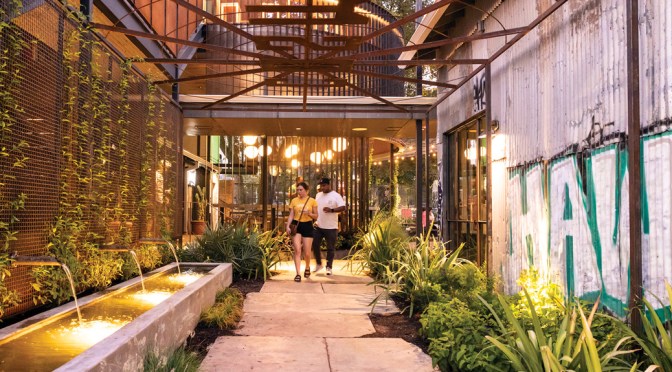
A central theme of the project is meticulous preservation and adaptive reuse. The existing Texaco buildings' shells, including their graffiti, were carefully maintained. Furthermore, three towering elm trees and crumbling brick walls on the property were preserved and integrated into the design. These brick walls were repurposed to create intimate, vine-covered seating areas, distinct from the main courtyard. This approach contrasts sharply with the widespread demolition of older buildings in Austin, showcasing a commitment to historical continuity and environmental responsibility.
Paul Oveisi, co-founder of Cosmic Coffee, highlighted the extensive efforts to salvage and reuse materials. For instance, the concrete slabs from the original buildings were jackhammered out and painstakingly repurposed as massive, asymmetrical pavers for the entry. Christy Ten Eyck was reportedly a strong advocate for preserving this old concrete. Billy Spencer, founder of Spencer Landscape Company, who oversaw the construction of the entry and a custom fountain made from salvaged oil pipe and a gravel crusher, noted the significant effort involved. Spencer, who previously collaborated with Ten Eyck Landscape Architects on the El Cosmico hotel in Marfa, Texas, underscored that this dedication to reuse was unusual and required considerable commitment, as a more conventional approach would have been less effort-intensive.
The design ethos aimed to maintain Austin's unique, "funky, organic, creative part." The project’s success in integrating the new taqueria into its historical context is partly attributed to allowing the site's existing vegetation to re-establish itself. Vines that had previously covered the back half of the site were cut back during construction but were intentionally allowed to grow back, contributing to a sense of established natural integration. This decision reinforces the perception that the site has long been part of the landscape, aligning with the project's overall goal of preservation and authenticity.
The article was written by Timothy A. Schuler, an award-winning writer and contributing editor at LAM, focusing on the intersection of design, materials, and preservation. The project demonstrates a successful model for urban development that respects historical integrity and promotes sustainable practices, providing a new community space that honors Austin’s past while serving its present.
#AustinTexas #HistoricPreservation #AdaptiveReuse #LandscapeArchitecture #UrbanDevelopment #SustainableDesign #MaterialReuse #CommunitySpace #TenEyckLandscapeArchitects #AustinTexas #HistoricPreservation #AdaptiveReuse #LandscapeArchitecture #UrbanDevelopment #SustainableDesign #MaterialReuse #CommunitySpace #TenEyckLandscapeArchitects
 No comments yet
Out of the Ordinary