How Two Children Are Keeping Their Father’s Design Legacy Alive (Published 2020)
The article explores the enduring legacy of Japanese-American furniture designer George Nakashima through the lens of two Pennsylvania homes he constructed, which have become lasting testaments to midcentury folk craft. Inspired by Soetsu Yanagi's "What Is Folk Craft?" and the *mingei* movement, Nakashima, originally an architect, embraced craft as a moral and artistic endeavor. After studying architecture globally and working with Antonin Raymond and Frank Lloyd Wright, Nakashima's path shifted dramatically after his internment during World War II. Sponsored by Raymond, he moved to New Hope, Pa., where he established his studio and dedicated his life to transforming natural wood into functional art, such as tables and chairs. His daughter, Mira, who has managed the studio since his death in 1990, emphasizes that his work was an "antithesis of Modernism, a protest against mass production."
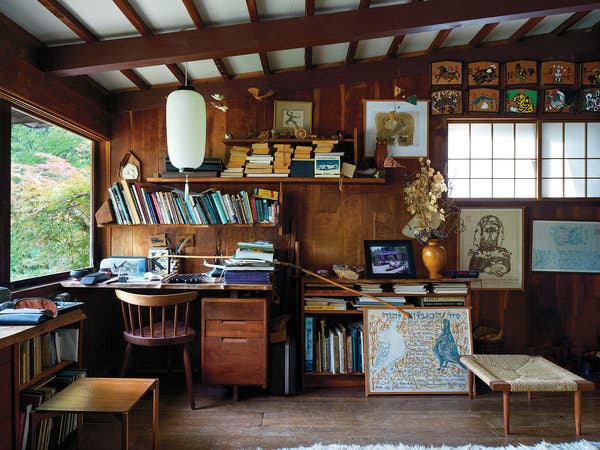
Nakashima built 19 structures on his 8.8-acre compound, including two homes for his children: a 1,397-square-foot ranch home for his family in 1946, where his son Kevin now resides, and a 2,550-square-foot house completed in 1970 for Mira. While other structures like the Conoid Studio and Reception House are more architecturally ambitious, these homes embody the *mingei* spirit—functional, handcrafted objects that integrate with daily life. Kevin's home, built after Nakashima signed a contract with Knoll Associates, exemplifies low-cost construction using locally sourced materials like cinder blocks and fieldstones, and cheap nails for black walnut and oak floorboards. Its intimate, cluttered interior reflects Kevin's role as the keeper of family lore, filled with personal mementos, art, and furniture, showcasing a "Kevinizing" effect—the natural wear and tear that comes from a life lived within the space.
Mira's house, built during a more prosperous period, is larger but still reflects Nakashima's commitment to frugality and elegant austerity. It features mismatched black walnut floorboards and a central post fashioned from a felled cedar trunk, blending seamlessly with Mira’s eclectic collection of art and objects from friends like Isamu Noguchi and Harry Bertoia. Both homes demonstrate how Nakashima's design principles extended beyond furniture to architecture, viewing buildings as larger versions of his crafted pieces—made by hand, designed to age gracefully, and intended for practical use rather than mere aesthetic display. Unlike his modernist contemporaries who embraced industrial materials, Nakashima focused on natural materials and handmade processes, rejecting the distance machinery created between design and production.
The article highlights that Nakashima's approach, akin to the American Craftsman, de Stijl, and Arts and Crafts movements, sought to strip away frivolous ornamentation and reconnect with fundamental craft. His philosophy was shared with Yanagi, both observing how technological advancements led to a culture of disposability for objects and makers alike. Figures like Nakashima, Anni Albers, and Eva Zeisel, despite Modernism's dominance in architecture, made humane and modern work by valuing traditional craftsmanship and organic forms. The author, who grew up with Nakashima's furniture, reflects on the personal connection to these objects and the concept of "Kevinizing"—the intentional acceptance of wear as part of an object's life. The homes, rather than being monuments, are useful, affordable creations that elevate and dignify the lives of their occupants, designed to be used, abused, and restored.
The future of the Nakashima legacy faces challenges, as Kevin has no children and Mira’s children are not interested in taking over the studio’s operations. Mira, approaching the future with equanimity, is focused on broader environmental and design issues, advocating for honest utility over frivolity. The timber shed, Pole Barn, designed by Mira, serves as a poignant reminder of the living material that forms the core of the studio's work, where each slab of wood tells a story, and its "life can continue" even after being cut. This ongoing tradition underscores the fragility and enduring beauty of a significant American craft legacy.
#GeorgeNakashima #MidcenturyDesign #FolkCraft #JapaneseAmericanDesign #ArchitecturalLegacy #Craftsmanship #HomeDesign #SustainableDesign #ArtisticHeritage #GeorgeNakashima #MidcenturyDesign #FolkCraft #JapaneseAmericanDesign #ArchitecturalLegacy #Craftsmanship #HomeDesign #SustainableDesign #ArtisticHeritage
 No comments yet
2 Interiors Designers Talk Style, Inspiration & The Concept Of ‘Future Heritage’

Second Act: A 1960s ranch home gets a glow-up that reflects its owner’s new career in design


Meet Susana Cisneros | Co-Owner Plume Home Decor

Do You Have a 'Living Room Family' or a 'Bedroom Family'?