1/12
Critical earthquake response of elastic–plastic structures under near-fault ground motions (Part 1: Fling-step input)
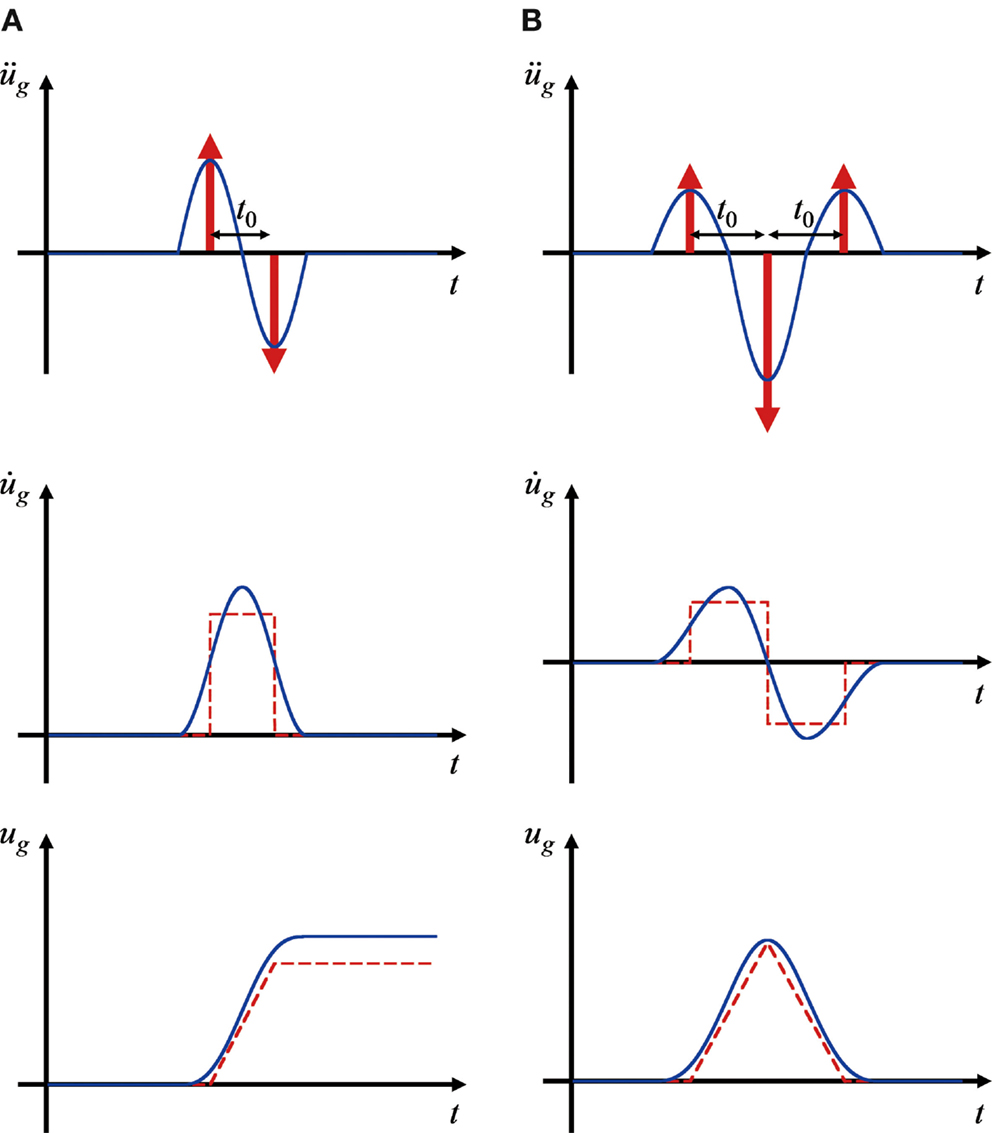
This study introduces the double impulse input as an approximation for fling-step near-fault ground motions and derives a closed-form solution for the elastic-plastic response of structures using a 'critical double impulse input.' The approach leverages energy principles, focusing on free-vibration behavior under double impulse conditions to simplify the analysis of complex elastic-plastic responses. A key finding is that the maximum inelastic deformation can occur either after the first impulse or after the second, depending on the input level. The accuracy and validity of the proposed theory are assessed by comparing its results with those from response analyses subjected to a corresponding one-cycle sinusoidal input, which represents fling-step near-fault ground motion. The amplitude of the double impulse is adjusted to match the maximum Fourier amplitude of the sinusoidal input.
The paper highlights the historical significance of near-fault ground motions, citing earthquakes like Northridge (1994), Hyogoken-Nanbu (Kobe) (1995), and Chi-Chi (Taiwan) (1999), which drew significant attention from earthquake structural engineers. It notes that fling-step and forward-directivity motions are typically characterized by two or three wavelets. Previous research often focused on elastic responses due to the complexity and numerous parameters involved in elastic-plastic analysis. The current work aims to overcome this by introducing the double impulse, which allows for an energy-based solution without direct integration of the differential equation of motion, especially since only free-vibration occurs under such impulse inputs.
The research details the evaluation of maximum elastic-plastic deformation for a single-degree-of-freedom (SDOF) system. It explains three cases based on the yielding stage of the structure: elastic response throughout, plastic response after the second impulse, and plastic response after the first impulse. Energy conservation laws are applied to derive formulas for maximum deformation in each case. A significant advantage of this method is that it directly determines the resonant equivalent frequency without iterative procedures, unlike conventional sinusoidal input methods. The critical timing for the second impulse is identified as the moment of zero restoring force.
Comparisons between the double impulse and one-cycle sinusoidal wave responses are presented, including ground displacement, velocity, ductility, and earthquake input energies. While the double impulse generally provides a good approximation for maximum deformation when Fourier amplitudes are matched, some discrepancies are noted in the larger deformation range. The study also proposes a design flowchart for determining stiffness and strength based on specified velocity, near-fault ground motion period, and response ductility. This design concept operates on the principle that if a structure is safe under the worst-case resonant conditions, it is likely safe under non-resonant conditions too. The non-dimensional relations derived in this study facilitate such design. The method focuses on capturing only the critical (upper bound) response, thus automatically determining the critical resonant frequency for increasing input levels. This approach significantly reduces the computational effort compared to traditional methods that analyze a wide range of stiffness and strength parameters. A numerical validation further confirms that the critical timing of the second impulse, at zero restoring force, corresponds to the maximum deformation for various input levels.
#EarthquakeResponse #ElasticPlasticStructures #NearFaultGroundMotions #FlingStepInput #DoubleImpulse #StructuralEngineering #SeismicDesign #EnergyApproach #EarthquakeResponse #ElasticPlasticStructures #NearFaultGroundMotions #FlingStepInput #DoubleImpulse #StructuralEngineering #SeismicDesign #EnergyApproach
 No comments yet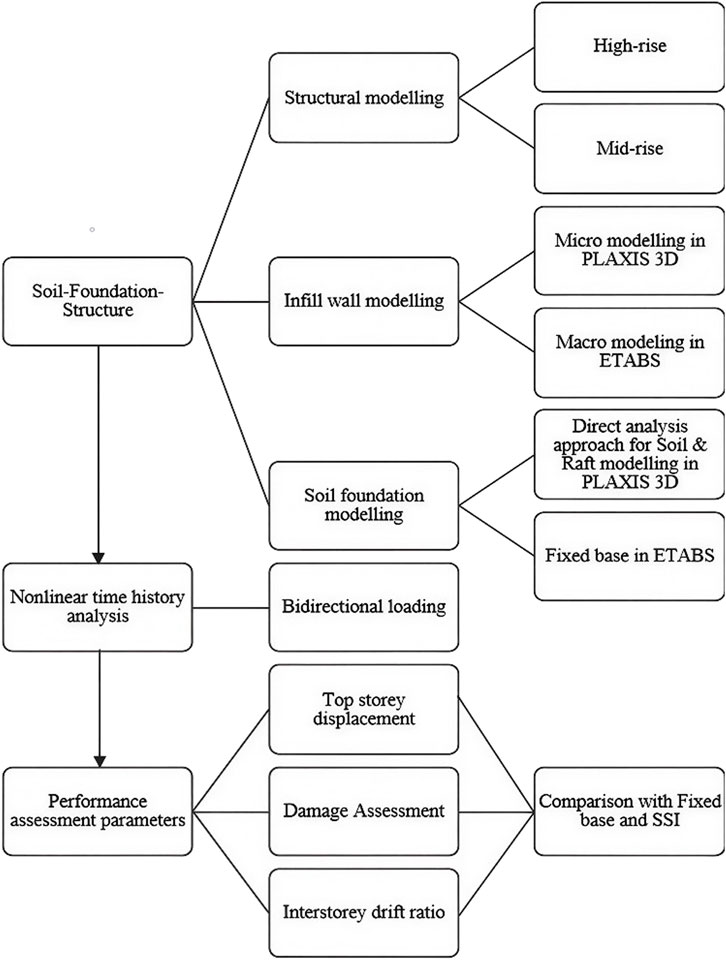
Seismic performances of reinforced concrete buildings with openings in unreinforced masonry infill walls: a soil–foundation–structure modelling approach