



1/9
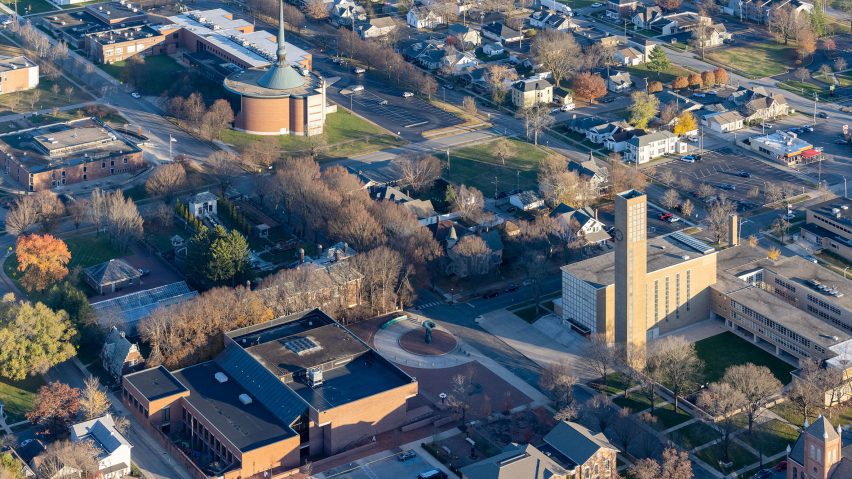
Columbus was built as the "exemplary mid-century city"
The city of Columbus, Indiana, stands as a testament to the post-World War II belief in design as a transformative tool for societal progress. This small Midwestern town experienced a significant architectural boom, leading to its international recognition for its mid-century modern buildings. The driving force behind this development was the Cummins Engine Company, specifically its president, J. Irwin Miller, who fostered an environment where design excellence was prioritized for civic structures. This initiative transformed Columbus into a living monument of design, showcasing how progressive ideas could be implemented at a local level to create a more egalitarian and prosperous society. The period between 1954 and 1974 marked the most intense phase of this architectural development.
Initially spurred by the need to house workers, Miller's vision expanded to include investing in public architecture. He provided institutions with a curated list of prominent architects, leading to the construction of fire stations, schools, and churches designed by luminaries such as I.M. Pei and Eero Saarinen. This approach imbued the city's development with a spiritual undertone, focusing on enhancing community well-being rather than just aesthetic preferences. Columbus exemplified an ethos of individual responsibility towards the public realm, demonstrating that significant improvements could be achieved at a local scale, contrasting with the increasing bureaucratic challenges faced by federal programs at the time.
Today, many of these mid-century modern structures are maintained by the Landmark Columbus Foundation, though preservation efforts also rely on private owners. The city's architectural heritage remains a vital record of a specific era in American history and the mid-century modern movement, symbolizing a continuous pursuit of excellence. This enduring commitment ensures that Columbus remains a good place to live, even as the world evolves and new challenges emerge.
The article highlights seven significant projects that embody this architectural legacy. The Lincoln Center Ice Rink, designed in 1958 by Harry Weese and Dan Kiley, exemplifies early recreational investments. Eero Saarinen's North Christian Church (1964) is notable for its hexagonal design and Saarinen's personal commitment to creating a spiritually resonant space. The First Baptist Church (1965) by Harry Weese and Dan Kiley showcases a preference for natural materials over concrete, reflecting the congregation's desires for a softer aesthetic. Robert Venturi's Fire Station No. 4 (1968) stands out for its simple brick structure, contrasting with prevailing modernist trends, and its symbolic civic gesture. I.M. Pei's Cleo Rogers Memorial Library (1969) is a significant civic building, anchoring a plaza with Henry Moore's Large Arch sculpture and featuring an innovative waffle-slab ceiling. L. Francis Smith Elementary (1969) by John Johansen is characterized by its brightly colored, tubular hallways and a design that fostered progressive, student-centered learning. Finally, Eliot Noyes' Southside Junior High School (1969), now Southside Elementary, is a Brutalist structure with warm wood interiors, designed to function like a miniature city with a central commons area promoting interaction and shared learning.
#ColumbusIndiana #MidCenturyModern #Architecture #CivicDesign #UrbanPlanning #IMPei #EeroSaarinen #ArchitecturalHeritage #MattShaw #ColumbusIndiana #MidCenturyModern #Architecture #CivicDesign #UrbanPlanning #IMPei #EeroSaarinen #ArchitecturalHeritage #MattShaw
 No comments yet