1/4
10 Questions With… Jomo Tariku
Jomo Tariku, a Virginia-based designer and furniture maker, shares insights into his creative process, which draws heavily from his Ethiopian upbringing and African heritage. Born in Kenya and having traveled extensively across Africa during his youth due to his mother's work at Ethiopian Airlines, Tariku was exposed to a diverse collection of objects and furniture from an early age, collected by his diplomat father. His early experiences included working in a car shop in Addis Ababa between the ages of 14 and 16, where he constantly sketched and drew his surroundings while performing various tasks. This period, along with his later academic pursuit of an industrial design degree at the University of Kansas, laid the foundation for his distinctive approach to furniture design.
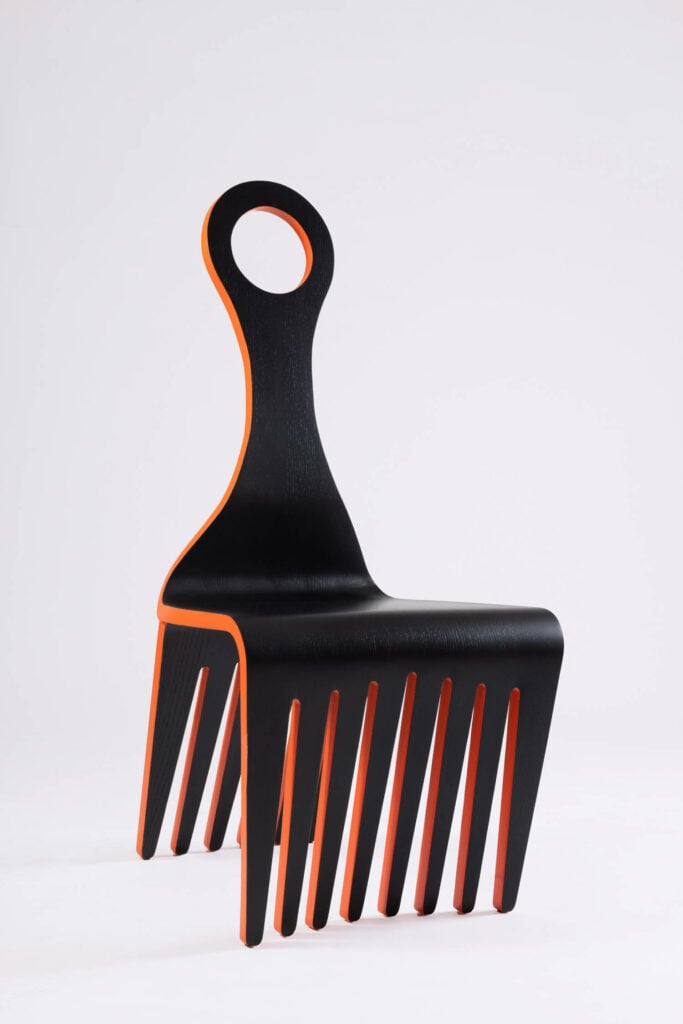
Tariku's work is characterized by its exploration of objects and culture, often reinterpreting everyday African items and totemic figures into sleek, minimalist furniture. His designs incorporate bold colors like black ash and orange, paying homage to African craft and furniture-making traditions. Notable pieces, such as the Nyala chair, the Qwanta totem chair, the Meedo chair, and the Mukecha stool, have gained significant attention. His comb-shaped Mido chair (2021) was acquired by The Metropolitan Museum of Art, and other works are part of the collections at the Los Angeles County Museum of Art, Mint Museum, Denver Art Museum, and Baltimore Museum of Art. His work has also transcended the art and design world, with production designer Hannah Beachler featuring some of his pieces in "Black Panther: Wakanda Forever."
Tariku recounts his journey into design, initially considering computer science before discovering his aptitude for art and design during his college years. His mentor at the University of Kansas encouraged his passion, which eventually led him to pursue furniture design for his industrial design thesis. He emphasizes that inspiration should not be limited to existing seating designs but can come from a wide array of African contexts, including hairstyles, the afro pick, landscapes, and headrests, allowing for truly unique and innovative designs.
He discusses the transhistorical quality of his designs, which blend ancient influences with modern interpretations, creating pieces that defy chronology and symbolize collective and personal histories. He acknowledges the scarcity of historical data for many African objects, which were often made for utility without formal manufacturing structures. As a Western-educated industrial designer, Tariku interprets this past through his skills, ensuring that his pieces are titled to reference their inspirations, such as the Nyala chair's connection to antelopes or the Boraatii stool's link to Oromia headrests.
The designer also considers the interactive relationship with users, exemplified by the Qwanta chair, which features an interchangeable backrest. This design was inspired by traditional African birch chairs and aims to involve users in creating their own totems, transforming the chair into a collaborative art piece. He explains his philosophy that his furniture serves both an artistic and functional purpose, akin to how common objects in Ethiopia were used for utility and then displayed as decorative elements. He views his pieces as sculptural, conceptual, and functional statements.
Tariku elaborates on the sculptural aspect of his work, highlighting the balance between artistic form and ergonomic functionality. He strives for elegance, clean lines, and organic shapes that provide visual satisfaction and comfort. His creative process involves rigorous prototyping to ensure both aesthetic appeal and practicality. Regarding abstraction, he focuses on extracting the simplest geometric shapes from his inspirations, testing their endurance and researching thoroughly. He aims to make his designs recognizable to those familiar with the cultural references while also appealing to a broader audience.
He discusses his material palette, which is currently limited to ash, American ash, and birch plywood, primarily due to cost and environmental considerations. He consciously avoids exotic African woods, prioritizing sustainable forestry practices in the U.S. He expresses interest in expanding into materials like plastics, metals, and carbon fiber when appropriate. Finally, Tariku speaks about his involvement with the Black Artists and Designers Guild (BADG), co-founded by Malene Barnett, which aims to promote and increase the visibility of Black designers from the diaspora and Africa. He believes that his work, and that of other Black designers, is crucial for challenging Western-centric design canons and pushing against misconceptions about African design, ultimately contributing to a more inclusive representation of global creative traditions.
#JomoTariku #FurnitureDesign #AfricanDesign #Afrofuturism #IndustrialDesign #InteriorDesign #CulturalHeritage #BlackArtistsAndDesignersGuild #SculpturalFurniture #JomoTariku #FurnitureDesign #AfricanDesign #Afrofuturism #IndustrialDesign #InteriorDesign #CulturalHeritage #BlackArtistsAndDesignersGuild #SculpturalFurniture
 No comments yet
10 Questions With… Rebecca Benichou

10 Questions With… Randy Rubin

10 Questions With… Daniel Boddam

10 Questions with… Daniel Rybakken

10 Questions With… Randy Chan
10 Questions With… Madelynn Ringo