



1/6
A Tale of 5 Installs Part 1 - Frank's Pad
This article details the first part of a series focusing on various home audio installations, specifically addressing the challenges and solutions encountered when setting up a surround sound system in an older home with a limited budget. The client, referred to as Frank, desired a surround sound system but faced constraints including a modest budget of approximately $500, an older Spanish-style home with wood floors and character, and a small, narrow room with layout limitations.
The initial assessment of Frank's living room revealed a space roughly 11 feet wide by 20 feet long. The room's configuration, with numerous doors and openings, precluded the use of traditional bookshelf speakers on stands or wall-mounted options for all channels. The decision was made to ceiling-mount the satellite speakers, which also influenced the size of speakers that could be effectively integrated into the small space. Given the budget and room constraints, a home theater-in-a-box (HTiB) system was deemed the most practical solution.
The installation process began with planning the wiring. Due to the house's age (1930s) and its accessible attic, running cables through the attic was chosen as the primary method. This avoided complex wall modifications, especially for the right wall, which was an exterior wall. The plan involved dropping all four speaker lines down the wall behind the equipment rack and then running them to four ceiling points. The goal was a clean installation, with cables directly connecting to speakers without ceiling-mounted wall plates. Behind the equipment rack, banana jack keystone modules were planned for termination and labeling.
Locating precise points for drilling in an older home with plaster walls proved challenging. An air conditioning duct in the attic served as a reference point to find the desired location for dropping the wires down the wall. The electrical box for the binding post connectors was installed after carefully cutting through plaster and wood slats. The attic access was at the back of the house, requiring a somewhat unconventional setup with a ladder on a table to reach. Despite the heat and fiberglass insulation, the team successfully ran CL2-rated 12/2 speaker cable for the front and surround channels, using a drill bit extender to guide the wires down the wall cavities.
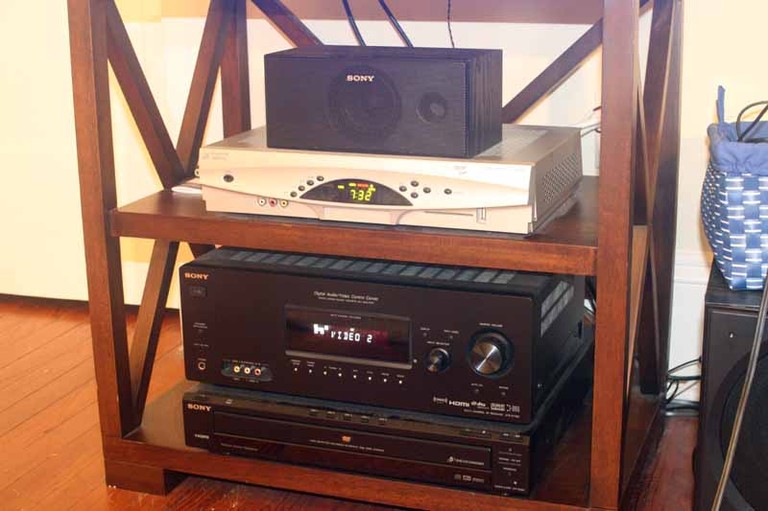
Ceiling holes for the speakers were marked and drilled from below, with single wires inserted from the attic to mark positions. Pre-cut cables were then pulled through these holes. For the surround speakers, a decision was made to point them together rather than towards the middle of the room to create a more diffuse soundfield. After the wiring was complete, Frank purchased the recommended Sony HTiB system. The system setup involved navigating Sony's somewhat unintuitive menus to calibrate levels, speaker sizes, and confirm ceiling mounting. Initial video issues with an HDMI cable were resolved by replacing the cable and adding an optical cable for surround sound, as the HTiB did not support HDMI audio.
Testing with _Gladiator_ and multi-channel music revealed that while the system performed adequately within its budget, the subwoofer was underpowered for the room, which was also not acoustically sealed due to French doors. Adjustments were made to the subwoofer's position to mitigate dead spots in primary seating areas. The experience underscored the importance of adapting to specific home challenges, meticulous planning, and the belief that most rooms can be successfully equipped with a surround sound system through patience and creative problem-solving.
#HomeTheaterInstallation #DIYAudio #SurroundSound #BudgetHomeTheater #CableManagement #RoomAcoustics #OlderHomeRenovation #AudioSetup #SpeakerPlacement #HomeTheaterInstallation #DIYAudio #SurroundSound #BudgetHomeTheater #CableManagement #RoomAcoustics #OlderHomeRenovation #AudioSetup #SpeakerPlacement
 No comments yet