




1/11
Crows in the Dining Room and Other Messy Histories
At the Brooklyn Museum, artist Valerie Hegarty has implemented an exhibition titled "Alternative Histories," which reimagines the traditional, staid period rooms with a dynamic and disruptive intervention. Hegarty's work transforms three of the museum's decorative arts period rooms: the Cane Acres Plantation dining room, and the parlor and hall of the Cupola House. Instead of presenting these historical settings in their typical preserved and orderly state, Hegarty introduces elements of decay, disorder, and natural intrusion, prompting visitors to reconsider established narratives and the pristine portrayal of history.
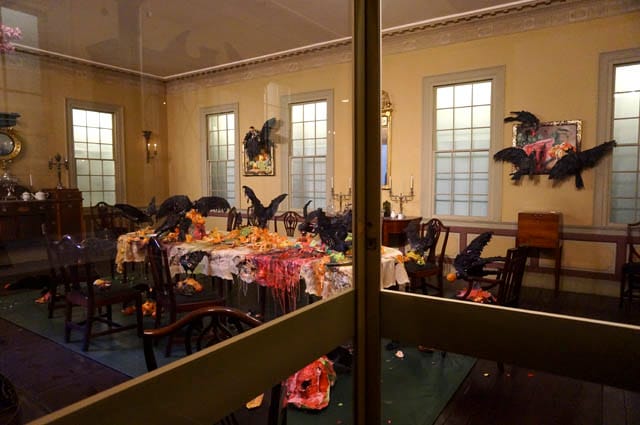
In the Cane Acres Plantation dining room, the expected scene of refined dining is subverted by the presence of crows. These birds are depicted pecking at vibrant, amorphous blobs of fruit scattered across the dinner table, attacking paintings, and leaving a trail of crumbs, creating a chaotic and untamed atmosphere. This installation, specifically featuring works like "Tablecloth with Fruit and Crows" and "Still-Life Paintings with Crows," challenges the serene and idealized representation of antebellum Southern life.
The Cupola House's parlor also undergoes a significant transformation. Here, a portrait of George Washington is altered, showing his face grotesquely fallen from the canvas, symbolizing a disruption of historical figures and their iconic status. Below the portrait, a Native American-patterned rug appears to be decaying, a commentary on the often-overlooked or suppressed narratives within American history. Hegarty’s works in this space, including "Native American Chief (Sharitarish) with Branches" and "Native American Rug with Marsh Grass," highlight themes of destruction and the re-evaluation of colonial legacies.
Further within the Cupola House, in its hall, a painting and various furniture pieces are marred with holes that resemble bullet wounds, which have since oxidized, suggesting violence and the passage of time. This particular intervention features pieces like "The Pic-Nic with Downy Woodpecker" and "Dishware with Holes," and creates a visual narrative of historical erosion and damage. Hegarty's approach generates an immersive experience that causes visitors to question the authenticity and completeness of historical displays.
The exhibition has evoked notable reactions from museum-goers, ranging from amusement and confusion to appreciation for the museum's willingness to host such a provocative display. The installations intentionally disrupt the conventional museum experience, leading to inquiries about the artist's focus on themes of destruction and decay. By actively altering these historical environments, Hegarty prompts a critical examination of how history is curated, presented, and understood, offering an 'alternative history' that is messy, incomplete, and subject to natural and human forces. The exhibition provides a critical lens through which to view decorative arts and their historical contexts, inviting a deeper, more nuanced engagement with the past.
#BrooklynMuseum #ValerieHegarty #AlternativeHistories #PeriodRooms #ArtInstallation #HistoricalReimagination #ContemporaryArt #DecorativeArts #MuseumExhibit #BrooklynMuseum #ValerieHegarty #AlternativeHistories #PeriodRooms #ArtInstallation #HistoricalReimagination #ContemporaryArt #DecorativeArts #MuseumExhibit
 No comments yet