



1/10
‘To Keep off the Company’ – a study of a seventeenth-century royal bed rail from Hampton Court Palace
This article delves into the historical significance and evolution of the royal bedchamber in seventeenth-century England, using a unique surviving bed rail from Hampton Court Palace as a case study. This rare artifact, initially overlooked for many years, was rediscovered in the nineteenth century and mistakenly identified as an altar rail from the royal chapel. More recently, it was associated with King Charles II; however, comprehensive technical and historical research has now established its creation during the reign of his father, Charles I, preceding the widespread adoption of the French _lever_ and _coucher_ ceremonies in England.
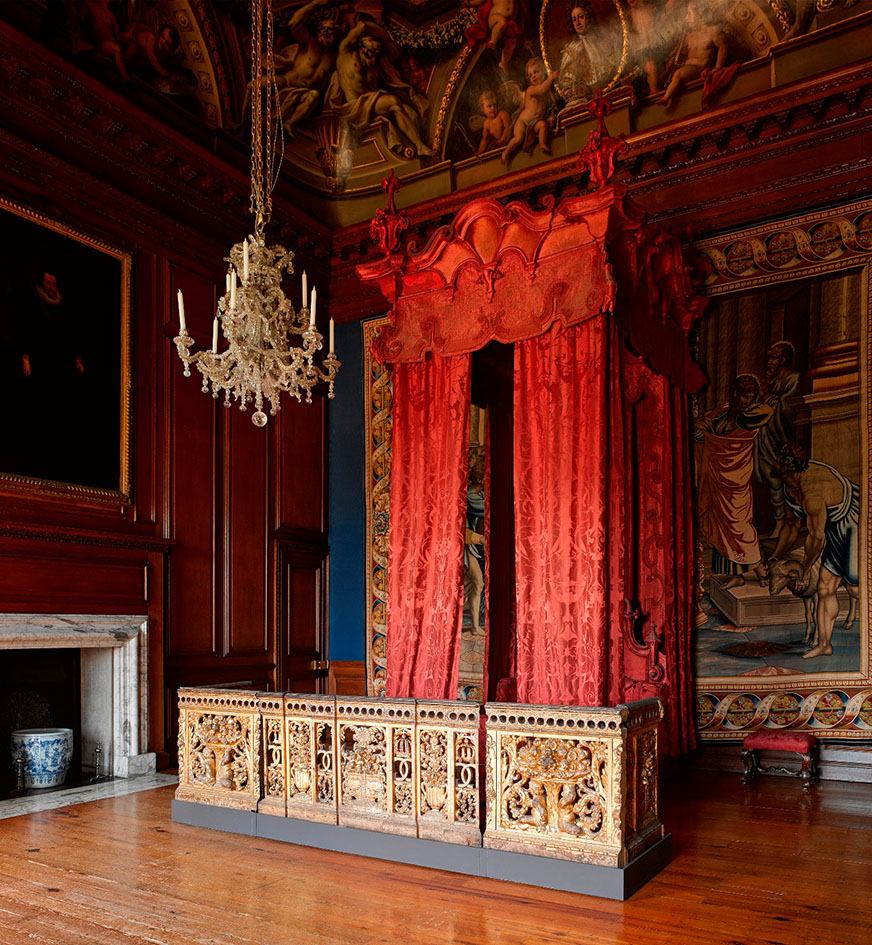
New evidence suggests the bed rail was likely created for Queen Henrietta Maria, who introduced numerous French customs and possessions to England, including the use of bed rails during accouchements. Subsequent alterations indicate its adaptation for Charles II and possibly his Queen, Catherine of Braganza, and later for George I, the first Hanoverian King of Great Britain. The article traces the bed rail's journey, highlighting the adjustments made to accommodate different monarchs and evolving court ceremonies. It describes the bed rail's physical attributes, including its fragmented state, its construction from carved and gilded oak, and its distinctive decorative motifs featuring putti, fruit, flowers, imperial crowns, and the interwoven letters 'C'. The current incomplete state of the rail consists of ten panels, measuring 90cm in height and approximately 840cm in total length, though originally it would have been significantly longer. Technical examination has revealed crucial repairs and alterations that shed light on its operational life, which is not extensively documented in royal records.
The dendrochronological analysis of the Baltic oak used in its construction dates it to between 1642 and 1650, challenging earlier assumptions of its origin. This dating excludes Charles II and points to Charles I's reign. The construction methods, characterized by simple pegged or nailed joints and thick laminated planks, suggest it was not typical of the highest quality carving in English palaces, potentially indicating a specialized craft like ship carvers. Paint analysis confirms only two gilding layers over three centuries, reflecting long periods of disuse, especially after the _lever_ ceremony faded in England.
The imagery of fecundity and fertility on the rail, alongside floral motifs like lilies, roses, and sunflowers, strongly supports its use in a conjugal bedchamber, likely for Queen Henrietta Maria, whose contemporary iconography also featured such elements. Her role as a Catholic queen who maintained French customs, including the use of bed rails for accouchements, is emphasized. Historical records confirm her ownership of bed rails at St James’s Palace and Somerset House, with some being silvered, a practice that continued for queens in the seventeenth century.
An engraving depicting Marie de Medici receiving guests in front of a balustraded bed suggests the typical arrangement of such rails, fixed to the floor around three sides of the bed with central gates. Despite a gap in the object's documented history regarding its original location, its design elements and later reuse by various monarchs underscore its function in the royal bedchamber. The article concludes by contrasting this unique object with later bedchamber furnishings of other English monarchs in the late-seventeenth century, who adopted different bed rail designs in response to England's evolving parliamentary monarchy. The bed rail's history culminates with its use by George I, whose adaptation of the ciphers to form the letter 'G' indicates a final reuse before the political significance of the bedchamber in Britain diminished with the rise of parliamentary democracy. This case study underscores the changing role of bedchamber ceremonies and the interplay of European fashions in seventeenth-century English court life.
#RoyalBedchamber #SeventeenthCenturyEngland #HamptonCourtPalace #RoyalFurniture #BedRail #HenriettaMaria #CharlesI #CharlesII #GeorgeI #CourtCeremony #ArchitecturalHistory #HistoricRoyalPalaces #RoyalBedchamber #SeventeenthCenturyEngland #HamptonCourtPalace #RoyalFurniture #BedRail #HenriettaMaria #CharlesI #CharlesII #GeorgeI #CourtCeremony #ArchitecturalHistory #HistoricRoyalPalaces
 No comments yet