1/7
Samuel Yellin and the "Poetry and Rhythm of Iron"
The Cloisters museum and gardens feature architectural elements by Samuel Yellin, a significant figure in the American Arts and Crafts movement. Yellin's metalwork, ranging from intimate to monumental scales, is integrated into various spaces within The Cloisters, often forming the entry points for visitors. Born in Russia in 1884, Yellin immigrated to Philadelphia in 1900, where he apprenticed as a blacksmith, studied at the Pennsylvania Museum and School of Industrial Art, and later taught "wrought-iron work." He established his first shop in 1909 and, by 1915, moved into a purpose-built studio. At its peak in 1928, his firm, "Samuel Yellin Metalworker," employed 268 men and executed over twelve hundred commissions in the 1930s. The company, now known as the Samuel Yellin Metalworkers Co., continues to operate under the stewardship of his granddaughter, Clare Yellin.
Yellin's dedication to his craft is evident in his philosophy, notably his assertion that "There is only one way to make good decorative metalwork and that is with the hammer at the anvil." This principle guided his studio, where even draftsmen were trained in basic blacksmithing to ensure a fundamental understanding of metalworking processes. He emphasized working from traditional designs, believing past masters captured the "poetry and rhythm of iron." His extensive collection of antique ironwork served as a crucial resource for his staff, with some pieces later acquired by The Cloisters in 1955. Yellin's own creations are also part of The Metropolitan Museum of Art's collection.
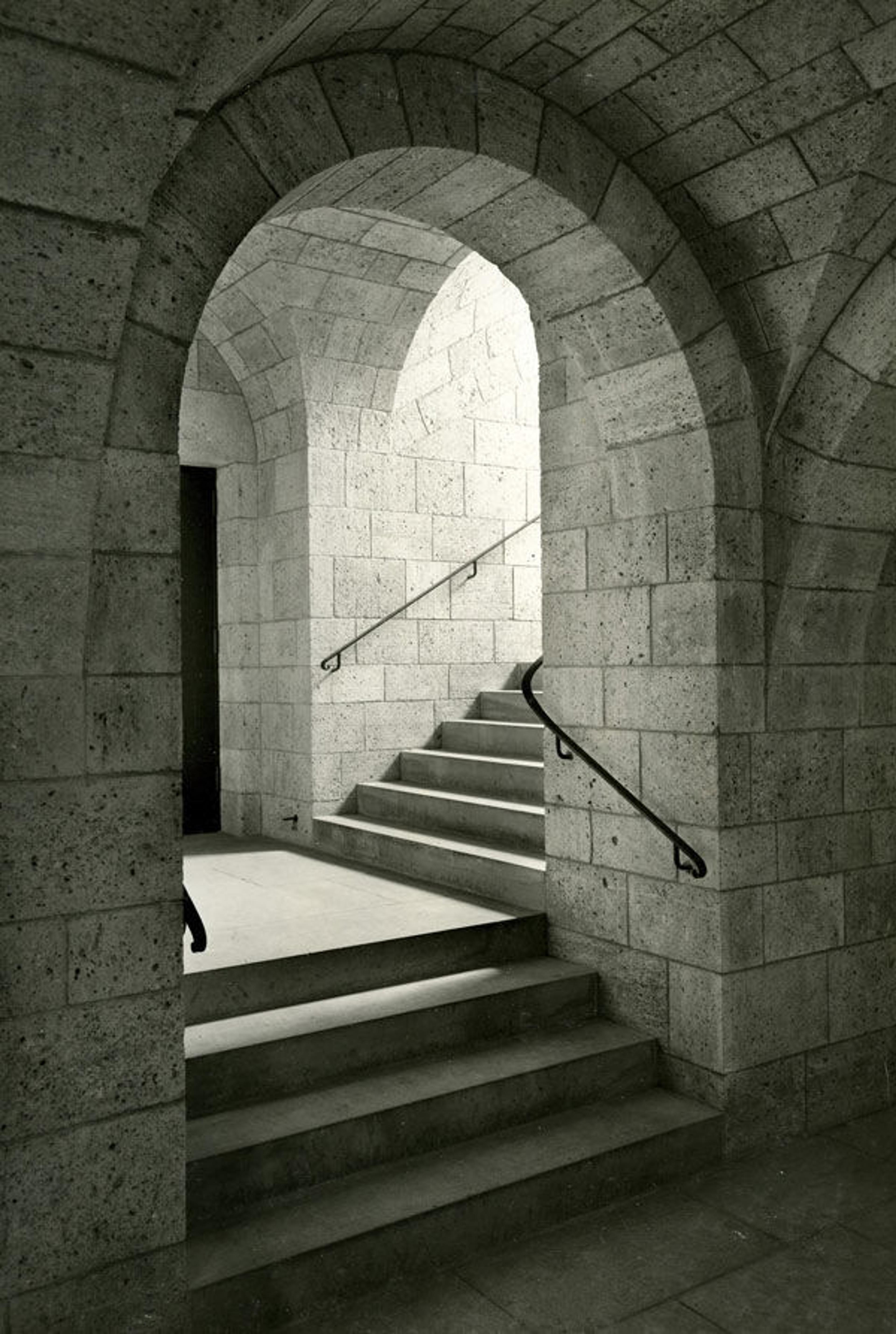
The collaboration between Yellin and The Cloisters likely began in 1935, with initial contact made by Yellin himself, alongside a letter of introduction praising his work sent to John D. Rockefeller, Jr. Archival documents confirm a 1937 contract for ornamental railings, grilles, gates, and structural iron door frames, including decorative pins for the Portcullis Gates and a whimsical bell frame on the building's southwest corner. An additional order followed the building's opening, providing stair rails for the Gothic portal and the Postern Gate stairs.
Yellin's metalwork at The Cloisters functions both as independent art and as harmonizing architectural elements. He believed ironwork should not act as a barrier but rather create a visual connection between people and buildings, and the surrounding environment. Examples include unique grille designs for the east facade windows, featuring simple, geometric patterns with technically challenging pierced intersections. All lower-level exterior and interior courtyard windows are equipped with grilles of various patterns. Standard railing designs, used both indoors and outdoors, feature square iron balusters rotated by forty-five degrees, flat handrails often pierced by balusters, and volute terminations. Balusters on staircases and rampart railings are further distinguished by a square horizontal rail at midpoint.
The railings are designed to be both tactile and visually engaging, showcasing the manipulation of iron through turning, twisting, and pulling. Yellin strategically incorporated tenons as integral design elements, making joinery explicit and adding texture and dimension. He maintained that his work was "honestly and simply done," reflecting the material's nature in its handling and finish. Despite the perceived lack of intrinsic value and coarse appearance of iron, Yellin saw its potential, stating, "I love iron: it is the stuff of which the frame of the earth is made and you can make it say anything you will." The visual evidence of handcrafting imbues his ironwork with significant character and appeal, particularly fitting within the stone context of The Cloisters.
#SamuelYellin #Metalwork #TheCloisters #ArtsAndCraftsMovement #ArchitecturalDesign #WroughtIron #Blacksmithing #HistoricPreservation #MuseumArchitecture #SamuelYellin #Metalwork #TheCloisters #ArtsAndCraftsMovement #ArchitecturalDesign #WroughtIron #Blacksmithing #HistoricPreservation #MuseumArchitecture
 No comments yet
CraftBoston Presents The Iron Age Of John Rais