



1/6
The ancient enigma that still resonates today
The spiral, an ancient geometric form, has consistently appeared across cultures and natural phenomena, influencing art, design, and architecture from Neolithic times to contemporary structures. This ubiquitous symbol is observable in various natural formations such as snail shells, pine cones, fingerprints, and even in celestial bodies like galaxies and the double helix of DNA. Archeological evidence shows that petroglyphs of spirals date back to the Neolithic period, making it one of the oldest geometric patterns known to humanity. Spirals manifest in diverse mathematical forms, including the logarithmic, Archimedean, and Fermat's spirals, as well as helixes and vortices.
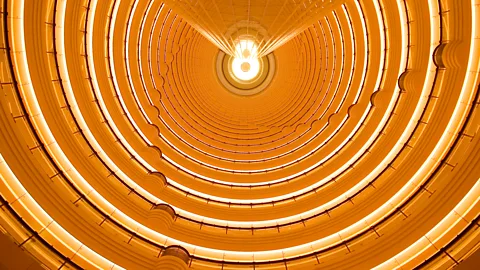
In human creations, the spiral is a prominent motif in both secular and sacred architecture, exemplified by structures like the 9th-Century Great Mosque of Samarra and the Vatican Museum's spiral staircase. Modern architecture continues to incorporate this form, as seen in "The Spiral," a new 66-floor skyscraper in New York City. This building features open-air garden terraces that spiral upwards, creating a continuous green pathway. Architects of The Spiral, BIG NYC, designed it with occupant well-being in mind, integrating biophilic elements such as outdoor access and improved indoor air quality to provide a calming environment. The project aims to be the world's first and highest vertical garden of its type, with plants acclimated to the urban environment before installation.
Artists throughout history have drawn inspiration from spirals. Leonardo da Vinci incorporated them into his drawings of molluscs and the double-helix staircase at Chateau de Chambord. Contemporary artists like Singapore's Chan Hwee Chong use continuous spiralling lines to recreate famous paintings. For the French-American artist Louise Bourgeois, spirals were deeply personal and symbolic, representing birth, life, rebirth, and themes of motherhood. She also associated them with control and freedom, drawing from her childhood experiences in her family's tapestry restoration business. Her work, including sculptures like "Spiral Woman," often depicted spirals as powerful, sometimes violent, symbols, intertwining with motifs like spiders, reflecting her decades of psychoanalysis and exploring themes of mental states and identity.
Beyond art and architecture, the spiral also features in land art, such as Robert Smithson's "Spiral Jetty," a massive environmental artwork in Great Salt Lake, Utah, which reflects his interest in entropy and is interpreted as a symbol of the feminine and the unconscious. Carl Jung, a renowned psychiatrist, viewed the spiral as a representation of psychological growth, where one revisits the same point from a different perspective, gradually approaching a central understanding. The symbol gained further prominence in the West with the rise of meditation and yoga practices in the 1960s, particularly Kundalini yoga, where the spiral represents a serpent of energy coiling through chakras. In healing arts, it signifies divine connectivity.
In popular culture, spirals are used to convey altered states of consciousness, madness, or hypnosis. Alfred Hitchcock's film "Vertigo" extensively uses spirals in its opening credits and narrative to depict the protagonist's descent into insanity. Animators frequently employ spiral or concentric eyes to denote madness or hypnotic states, as seen with Kaa the snake in "The Jungle Book." In a different context, the African-American artist collective Spiral, formed in 1963, chose the Archimedean spiral as their logo to symbolize outward movement and upward progress in addressing the changing political and cultural landscape of the US. Even in fashion, the spiral has recently been adopted by luxury brands to represent circularity and exquisite craftsmanship.
Astronomically, the spiral is a fundamental structure of the universe; most discovered galaxies, including our own Milky Way, are spiral-shaped, characterized by elegant, twisting arms of stars and gas. The enduring presence and multifaceted interpretations of the spiral across various domains underscore its enigmatic and cosmic significance, making it one of life's persistent mysteries.
#SpiralSymbolism #ArchitectureDesign #ArtHistory #Psychology #CulturalInfluence #BiophilicDesign #ModernArt #MathematicalForms #CosmicPatterns #SpiralSymbolism #ArchitectureDesign #ArtHistory #Psychology #CulturalInfluence #BiophilicDesign #ModernArt #MathematicalForms #CosmicPatterns
 No comments yet