




1/4
Eight is Enough on Hi Mount Road
Octagonal houses, once considered a beneficial architectural trend due to their perceived advantages in floor space and natural light, experienced a brief period of popularity in the U.S. after Orson Fowler's 1848 publication, 'The Octagon House: A Home for All'. This trend, however, faded by the early 1900s, though some of these unique eight-sided structures are now listed on the National Register of Historic Places. One such octagonal residence is located in Palm Beach.
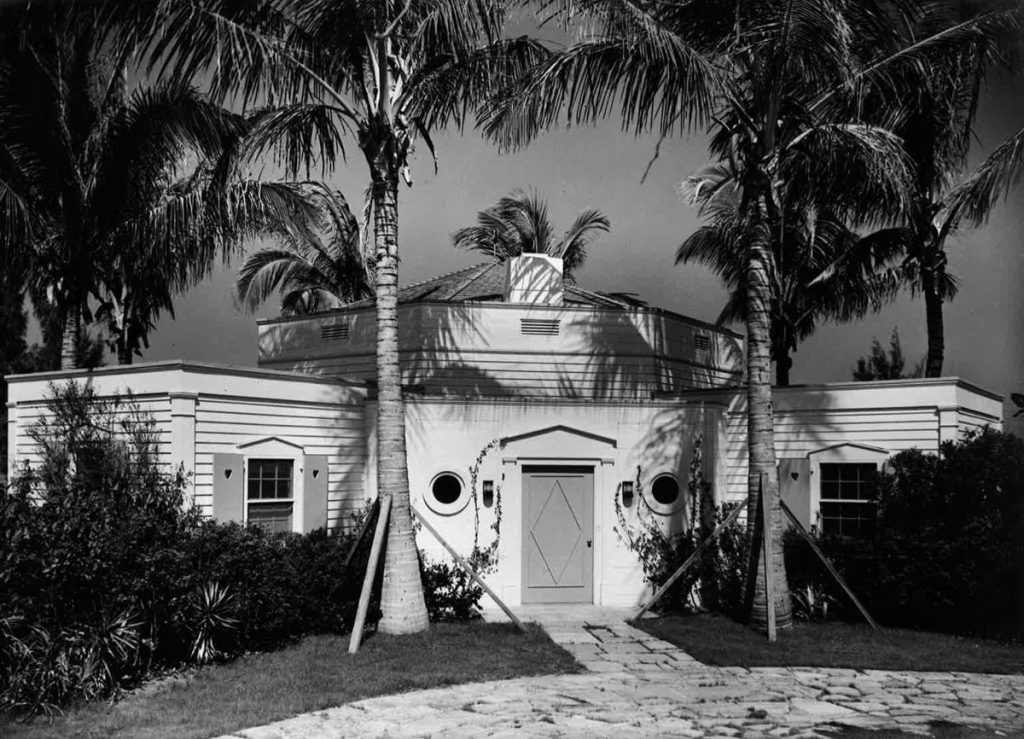
The French artist Bernard Boutet de Monvel commissioned Swiss architect Maurice Fatio to design his 'folie' — a French term for 'madness' used to describe eccentric buildings of the 16th to 18th centuries. Monvel, known for his photorealistic portraits, industrial landscapes, and fashion illustrations for 'Vogue', was a prominent figure who painted many of Palm Beach’s elite. During his residence in this 'folie', he notably painted portraits for Otto Hermann Kahn, who later commissioned Monvel to design his Villa Oheka.
Monvel's specific request to Fatio was for a home in a pure geometrical form (square, circle, or octagon) that offered privacy and abundant northern light. Fatio met this challenge by constructing the home on the only hill in Palm Beach and incorporating a large north-facing window, ensuring ample light for Monvel’s studio. Fatio expressed his admiration for the project in a letter to his wife, Delphine, describing it as “utterly, utterly ravishing,” highlighting not just the house itself but also its incredible position and exquisite garden.
This wasn't Monvel's first encounter with octagonal design; Louis Süe, a French architect and designer, had previously created an octagonal dining room in Monvel's Parisian home, for which Monvel designed an octagonal dining table. The Palm Beach house drew inspiration from a pair of octagonal pavilions Süe designed for the 1925 International Exhibition of Modern Decorative and Industrial Arts, an event famously associated with the coining of the term Art Deco.
Initially, the eight-sided structure featured a central studio with four square wings—a kitchen, a bathroom, and two bedrooms—each separated by a terrace. The octagonal theme extended to the landscape, with eight palm trees planted around the property, an octagonal pool, and even octagonal floorboard patterns. After Monvel's death in 1949, the 'folie' became the residence of Gertrude Schweitzer, a New York artist and seasonal resident known for her modern watercolors, whose work was often exhibited at the Norton Museum of Art.
Following Schweitzer’s passing in 1989, the Landmarks Preservation Commission recommended historical designation for the structure. In 1990, the central octagon was officially designated as a landmark, though the four square wings were removed. The central structure was then relocated to another part of the property, and the new owner constructed a Monterrey-style main residence on the original site. This house represents a unique blend of traditional and modern styles, being the only Fatio-designed building in the wood frame, American Classical Revival tradition, and an unusual combination of mid-19th-century style with Art Deco influences. While no longer functioning as an artist’s studio, it serves as a significant link to the prominent artists and architects in Palm Beach’s history. Marie Penny, the director of archives for the Preservation Foundation of Palm Beach, provided insight into this historical property.
#OctagonalHouse #ArchitecturalHistory #MauriceFatio #BernardBoutetDeMonvel #PalmBeachArchitecture #HistoricPreservation #ArtDecoInfluence #ArtistStudio #OctagonalHouse #ArchitecturalHistory #MauriceFatio #BernardBoutetDeMonvel #PalmBeachArchitecture #HistoricPreservation #ArtDecoInfluence #ArtistStudio
 No comments yet