



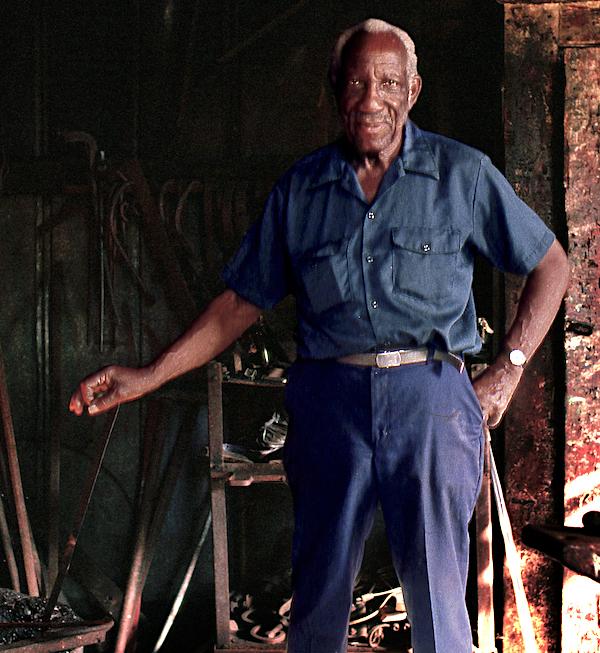
Philip Simmons
Philip Simmons, born on Daniel's Island, South Carolina, on June 9, 1912, became a distinguished ornamental ironworker and a 1982 NEA National Heritage Fellow. His journey into metalworking began at the age of 13 when he apprenticed under Peter Simmons in Charleston. Peter, born a slave in 1855, had inherited the trade from his father, Guy Simmons. Philip was drawn to the craft by the visual and auditory elements of the blacksmith's shop, specifically the sparks, fire, and the ringing of the hammer, which fueled his passion for the work.
By 1930, Philip transitioned into a full-fledged blacksmith. An illness experienced by Peter left Philip responsible for the shop. During this period, he undertook a significant project, repairing three large metal tubs for the Johnson Coal Company. This marked a substantial increase in his earnings, elevating his weekly income from $4.00 to $17.50, which was considered a significant sum at the time. In the late 1930s, Simmons began to shift his focus towards decorative wrought ironwork, although he continued to identify as a 'general blacksmith.' This meant he was proficient in various metalworking disciplines, including angle smithing, farriery, wheelwrighting, toolmaking, and ornamental ironwork. He asserted that the fundamental principles of shaping metal, whether for a leaf or a horseshoe, were similar, underscoring his versatility.
Simmons's inaugural decorative piece in Charleston, located at 9 Stolls Alley, is a prime example of the city's traditional ornamental wrought iron style. This piece features an overthrow adorned with spear points and incorporates S and C scrolls, which are prominent motifs in Charleston's ironwork tradition. Since the 1940s, Simmons received numerous commissions for decorative ironwork, encompassing gates, fences, handrails, window grills, and balconies. His work characteristically blended historical aesthetic elements with practical functional requirements. He emphasized the importance of maintaining consistency with existing architectural styles to ensure the coherence and aesthetic integrity of his additions.
In some of his projects, Simmons incorporated sculptural motifs. Notable examples include his 'snake gate,' designed to evoke lifelike qualities through the inclusion of eyes, and the 'star and fish gate,' created in 1976 for the Smithsonian Institution. The latter was crafted from multiple curved iron pieces to convey the illusion of movement, as if swimming. These bespoke gates were client-requested, necessitating Simmons to employ his imaginative skills to realize their vision. In 1991, his admirers established the Philip Simmons Foundation, a non-profit organization dedicated to developing and maintaining a garden that commemorates his work on the grounds of his church, St. John's Reformed Episcopal Church, in downtown Charleston. His works are also part of the collections of prestigious institutions such as the National Museum of American History, Smithsonian Institution; the International Museum of Folk Art, Santa Fe; the Richland County Public Library, Columbia, South Carolina; and the Atlanta History Center, Atlanta, Georgia, showcasing his significant contribution to American folk art and craftsmanship.
#PhilipSimmons #OrnamentalIronwork #Blacksmith #Charleston #NationalHeritageFellow #FolkArt #Metalworking #HistoricalCraft #SculpturalMotifs #PhilipSimmons #OrnamentalIronwork #Blacksmith #Charleston #NationalHeritageFellow #FolkArt #Metalworking #HistoricalCraft #SculpturalMotifs
 No comments yet