1/18
SVS 3000 In-Wall Subwoofer Review
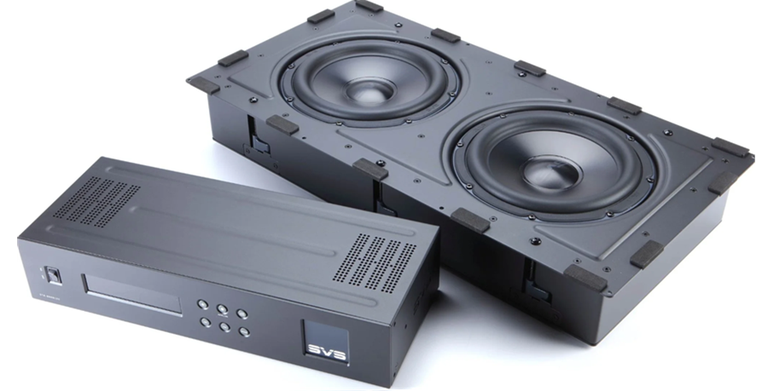
The SVS 3000 In-Wall Subwoofer is SVS's initial foray into the architectural audio market, offering an in-wall subwoofer system at a price point of $1,999 for a single unit and amplifier or $2,999 for two subwoofers and an amplifier. This product is designed to fit within standard 2x4 stud walls, making it suitable for both new constructions and retrofits. The subwoofer features two custom-designed 9-inch high-excursion drivers housed in a sealed enclosure. The design prioritizes discretion, with a black metal box and grill, but maintains a robust build quality utilizing a combination of MDF and aluminum to maximize internal volume and driver size while keeping the profile thin.
The SVS 3000 In-Wall Subwoofer system includes a proprietary Sledge STA-800D2C amplifier, which delivers 800 watts RMS and 2500 watts peak power through discrete MOSFET output devices. The amplifier is compatible with the SVS smart control app, providing users with convenient adjustments for various parameters, including three bands of parametric EQ, which are deemed sufficient for achieving excellent sound. The amplifier also supports the addition of a second subwoofer, offering an economical solution for dual subwoofer setups.
From an installation perspective, the compact enclosure, measuring less than 27 inches tall, allows for easier retrofit installations compared to many in-wall subwoofers that require pre-drywall installation. However, this compact size results in a smaller box volume, which pushes the resonant frequency (Fs) higher into the mid-bass range and limits deep bass output. The subwoofer's performance is characterized by clean and tight bass within its operational limits, with measurable extension down to 20Hz, though it does not deliver the high output levels expected from larger box subwoofers or high-performance home theater systems. While the SVS 3000 In-Wall Subwoofer excels in mid-bass slam and articulate sound, it is not designed to achieve reference-level bass that a dedicated bass enthusiast might desire. Its protective limiters ensure the subwoofer operates without strain or artifacts, delivering its best performance within its capabilities.
Objective measurements, including CEA-2010 burst tests, reveal that while the SVS 3000 In-Wall Subwoofer demonstrates good frequency response and extension down to the mid-20Hz range with room gain, its absolute output levels are significantly lower than comparable box subwoofers. For instance, it achieved 91.2dB at 31.5Hz, in contrast to the SVS SB-3000's 104.8dB at the same frequency. This difference is attributed to its small enclosure and reliance on Digital Signal Processing (DSP) for response shaping, which boosts frequencies below its natural resonant frequency of 77Hz. The DSP, while enabling impressive extension for its size, introduces higher group delay, particularly below 60Hz. Despite this, the trade-off is considered acceptable, as preventing distortion is prioritized over minimizing group delay, which is deemed less audibly significant by some.
In conclusion, the SVS 3000 In-Wall Subwoofer is presented as a well-engineered retrofit in-wall subwoofer. It is not intended to replace high-output box subwoofers for reference-level home theater performance but serves as an excellent discrete solution for casual home theater and music setups, particularly when paired with smaller bookshelf or in-wall speakers. Its strength lies in its ability to extend in-wall or box speakers to the lower octaves with quality bass reproduction, making it a commendable option within its specific niche of retrofit in-wall subwoofers.
#SVS #InWallSubwoofer #HomeAudio #AudioReview #HomeTheater #SoundSystem #SubwooferTechnology #RetrofitInstallation #SVS #InWallSubwoofer #HomeAudio #AudioReview #HomeTheater #SoundSystem #SubwooferTechnology #RetrofitInstallation
 No comments yet
The 4 Best Subwoofers of 2025 | Reviews by Wirecutter
2024 Audioholics Product of the Year Award Winners!
KEF Ci200QSb-THX and Ci200TRb In Wall Subwoofer Preview
Focal On Wall 301 loudspeaker review: Thin is definitely in

Triad InWall Bronze/4 SlimSub
RBH Sound SI-615 In-Ceiling Atmos Speakers Review