Will Libraries Exist in the Future? If So, They’ll Be Very Different.
The article explores the evolving identity of libraries in the 21st century, particularly in the face of the digital age and shifting societal needs. It begins by recounting the historical significance of large-stack library shelving systems, like those developed by Snead Bookshelf Company, which not only housed vast collections but also provided structural support to iconic library buildings. The New York Public Library's controversial proposal to remove its stacks and relocate much of its research collection is presented as a prime example of the challenges libraries face in adapting to new realities. This proposal sparked significant debate among scholars and preservationists, highlighting the deep-rooted perception of libraries as physical repositories of books.
The narrative then shifts to the broader decline in library funding, citing examples from the US and UK, and draws parallels with historical "biblioclasms" such as the burning of the Library of Alexandria. This historical context questions whether the digital age marks another period of decline for libraries, or if the widespread access to information online offers a net gain, even if it means some traditional library elements like paper books and physical buildings are phased out.
Andrew Carnegie's vision of public libraries as monumental, egalitarian "third places" – spaces for community gathering, learning, and browsing – is discussed. These ideals, established in the late 19th and early 20th centuries, continue to influence modern library design, even in unconventional locations like converted strip malls or Walmart stores. However, the fundamental purpose of providing access to knowledge, once primarily achieved through physical books, is now largely fulfilled by the internet and e-book lending programs, prompting libraries to redefine their mission.
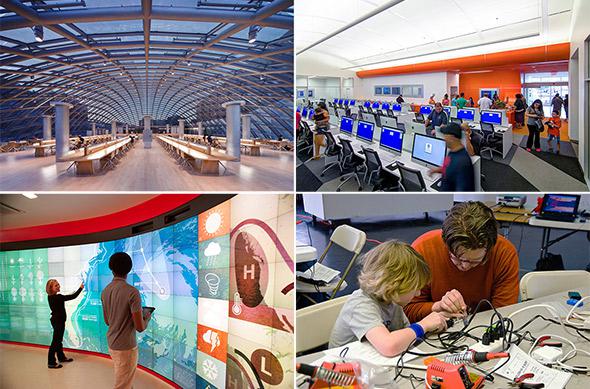
The article highlights how libraries have begun to adapt by offering access to new technologies, though even this role is becoming less critical as internet access becomes ubiquitous. Instead, libraries are embracing their role as "third places" focused on learning and community engagement. Examples include the creation of "maker spaces" equipped with tools like 3-D printers and sewing machines, fostering skill development and hands-on creation. Another innovative approach is the "Library as Incubator Project," which promotes art-focused programs, supporting local artists and providing platforms for community art displays and content creation, such as local music projects and traveling sketchbooks.
Further examples of this evolution include libraries hosting self-publishing technologies like the Espresso Book Machine, emphasizing creation over passive consumption. The Digital Public Library of America (DPLA) is presented as a large-scale initiative to build a nationwide digital archive, connecting digital content with local physical libraries to explore community history. University libraries, often better-funded, are at the forefront of this transformation, exemplified by the James B. Hunt, Jr. Library at North Carolina State University. This library features robotic book retrieval systems and abundant flexible spaces designed for collaboration, specialized technology access, and interdisciplinary innovation, moving away from traditional hushed environments.
Despite these advancements, the article acknowledges that many typical public libraries still primarily offer underused book collections, internet access for the underserved, and even shelter for the homeless. This last point raises questions about the library's evolving social welfare role and its impact on funding and community perception. The Bibliotheca Alexandrina, a modern reincarnation of the ancient library, is presented as a complex example of a library of the future, grappling with funding issues and societal instability despite its technological ambition.
Ultimately, the article suggests that the future of libraries hinges on community engagement and adaptability. It poses that libraries will only survive if they remain relevant to the communities they serve, potentially transforming into sanctuaries for focused study, community hubs for creation, or museum-like attractions preserving historical architectural marvels. The enduring challenge is for libraries to find their purpose in a world where information is digital and constantly accessible, while still upholding their traditional values of knowledge dissemination and community support.
#LibraryEvolution #DigitalAge #PublicLibraries #ArchitecturalDesign #CommunitySpaces #TechnologicalAdaptation #CulturalInstitutions #InformationAccess #FutureofLibraries #LibraryEvolution #DigitalAge #PublicLibraries #ArchitecturalDesign #CommunitySpaces #TechnologicalAdaptation #CulturalInstitutions #InformationAccess #FutureofLibraries
 No comments yet
Are Open Shelves Finally Out of Style in 2026? Designers Weigh In

Top 7 Bookshelves of 2025 That Will Transform Your Home Library

Are Open Shelves Finally Out of Style in 2026? Designers Weigh In