




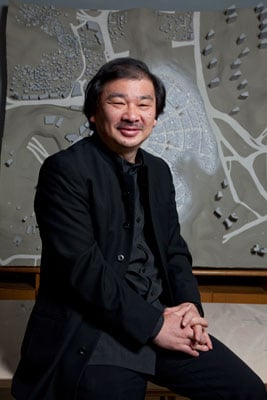
Shigeru Ban: 2010 Hall of Fame Inductee
Shigeru Ban, born in 1957, is a Japanese architect renowned for his innovative use of cardboard tubing in architectural design, a material he began experimenting with in his 20s. His early work, such as the 1986 Alvar Aalto exhibition at Tokyo’s Axis Gallery, showcased his concept of "paper architecture," which utilized recycled-paper tubes to create temporary installations, avoiding the waste of more precious materials. Ban's approach challenges conventional notions of durability in architecture, drawing a parallel between seemingly ephemeral paper structures and concrete buildings, which he notes can suddenly fail during earthquakes. His paper architecture has proven resilient, notably in disaster relief efforts.
Following the 1995 Kobe earthquake, Ban designed and helped construct a Paper Church in just five weeks with the assistance of 160 volunteers. His commitment to disaster relief was further demonstrated when he collaborated with fellow Interior Design Hall of Fame member Calvin Tsao after the 2008 Chengdu, China earthquake, leading to Ban’s design for a temporary school. This responsiveness highlights his practical and humanitarian approach to architecture.
Ban's work extends beyond disaster relief to more permanent and high-profile projects. When his firm, Shigeru Ban Architects, was involved in the design team for the Centre Pompidou-Metz, a satellite museum in Metz, France, he established a temporary Paris studio using cardboard. This pavilion, built on a terrace of the Pompidou’s Beaubourg headquarters, showcased his material innovation and cost-effective solutions. The studio was later disassembled but is planned to be re-erected for the Paris museum staff, underscoring the versatility and reusability of his designs.
In New York, Ban designed the Metal Shutter House, an apartment building featuring perforated-steel security gates that can be rolled down to transform its exterior. This project exemplifies his ability to integrate functional elements with aesthetic appeal, creating what he describes as "improbable poetry." Despite his serious demeanor, Ban possesses a subtle wit, as evidenced by projects like the 1995 Curtain Wall House, which replaced traditional glass and steel with a billowing, wind-whipped two-story drapery.
Dean Maltz, Ban's American business partner, attests to his character, noting a lighter side to the architect. Maltz collaborated with Ban on the 2005 Nomadic Museum on a New York pier, a temporary structure that utilized cardboard trusses and walls made from 148 locally sourced shipping containers. The reuse of identical containers in Los Angeles for a subsequent reinstallation of the museum further illustrates Ban's innovative and sustainable design philosophy. Ban's work consistently demonstrates a commitment to material innovation, humanitarian design, and a style that eschews fashionable trends in favor of functional and poetic solutions.
#ShigeruBan #ArchitecturalInnovation #CardboardArchitecture #DisasterRelief #SustainableDesign #JapaneseArchitect #MetalShutterHouse #CurtainWallHouse #NomadicMuseum #ShigeruBan #ArchitecturalInnovation #CardboardArchitecture #DisasterRelief #SustainableDesign #JapaneseArchitect #MetalShutterHouse #CurtainWallHouse #NomadicMuseum
 No comments yet
Gisue and Mojgan Hariri: 2005 Hall of Fame Inductees