



1/4
Kevin Thompson On Building Leonard Bernstein’s Homes Away From the Podium for ‘Maestro’
Production designer Kevin Thompson discusses his approach to recreating the various homes of Leonard Bernstein for Bradley Cooper’s film 'Maestro'. The film chronicles Bernstein’s life, transitioning from his humble beginnings to his rise as a celebrated American musician, depicting the personal spaces he shared with his wife, Felicia Montealegre Cohn. Thompson emphasizes the importance of authenticity and intimacy in designing these environments, aiming to reflect Bernstein's personal and professional evolution through his living spaces.
The initial setting, Bernstein's Carnegie Hall studio apartment, is a crucial starting point. Thompson details how this space was conceived as a one-shot opening, illustrating Bernstein's frantic departure to conduct at Carnegie Hall. This early apartment, inspired by actual lofts artists used for living and rehearsals, featured a double-height ceiling, a sleeping loft, and two large skylights. The design meticulously considered the film's black-and-white aesthetic and taller aspect ratio, requiring extensive collaboration with the Director of Photography to manage camera movement and architectural elements. The apartment was designed to subtly incorporate elements that hinted at Bernstein's mentors, musical collections, and early life, laying the groundwork for how his subsequent living situations would be portrayed.
Thompson explains that key pieces of set dressing were subtly moved between residences, from the initial Carnegie Hall space to the Connecticut house, the Osborne apartment, and finally, the Dakota. This continuous thread of personal items aimed to create a subliminal connection between Bernstein's different life stages, even if not explicitly noticed by every viewer. He highlights a specific example in the Fairfield home, where a replica of Bernstein's childhood piano, gifted by his teacher, was used to maintain historical accuracy and a sense of personal history.
Moving to the Osborne Apartments, which depict Lenny and Felicia in a more established, public phase of their lives, Thompson describes designing the space to reflect an elevated, all-American style. He notes details like a curved couch and walls adorned with pictures and documents, suggesting a lifestyle of entertaining and public prominence. Thompson stresses that instead of rigidly adhering to each decade, the design focused on the emotional core of each period in their relationship. For the Osborne apartment, research into the actual building and period was conducted, but ultimately, the design decisions were driven by the cinematic needs and Bradley Cooper's blocking to create an intimate, immersive experience for the audience. Furnishing choices, like the curved couch and fabric textures, were selected to telegraph the time period without explicitly stating it, with significant collaboration from set decorator Rena DeAngelo in curating personal items for the walls and desk.
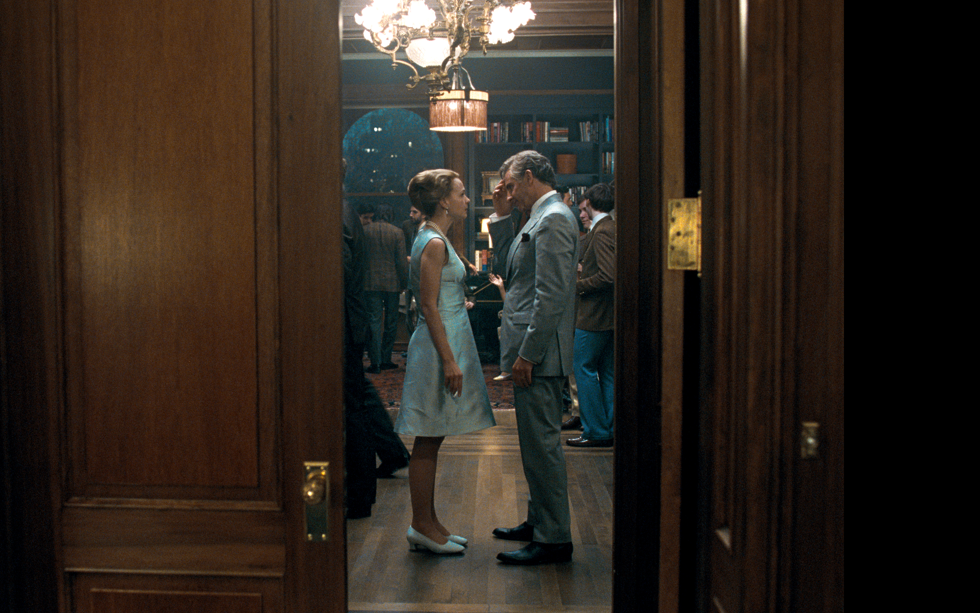
The final and most substantial setting discussed is the Dakota, a New York City landmark used for some of the film's darker, more complex scenes. The architecture of the Dakota, characterized by heavy wood molding, high ceilings, and large windows, influenced the design decisions. Thompson chose darker shades, particularly in the bedroom and study, with dark blue grasscloth walls, to convey the sadness and weight of this period in Bernstein and Felicia's marriage. The grandeur of the space, indicated by the size of the rooms, highlights their success, yet the presence of awards does not alleviate their marital problems. The design of the hallway, with its starkness and minimal decoration, was specifically crafted to support Bradley Cooper's blocking, emphasizing distance and emotional insulation during critical moments, such as Felicia discovering Lenny with Tommy Cochran. The heavy draperies further contribute to the insulated and somber atmosphere of this period.
#MaestroFilm #ProductionDesign #KevinThompson #LeonardBernstein #BradleyCooper #FeliciaMontealegreCohn #FilmSetDesign #HistoricalAccuracy #CinematicArchitecture #MaestroFilm #ProductionDesign #KevinThompson #LeonardBernstein #BradleyCooper #FeliciaMontealegreCohn #FilmSetDesign #HistoricalAccuracy #CinematicArchitecture
 No comments yet